





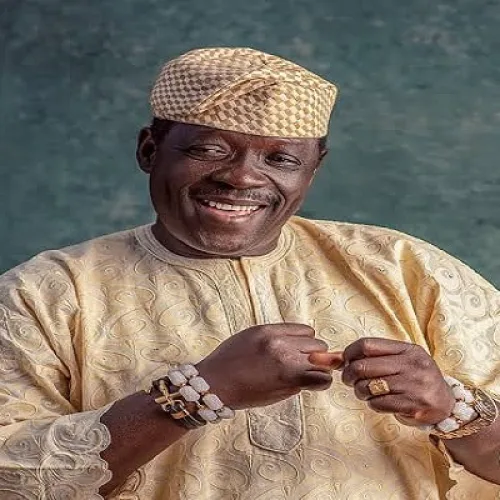
Taiwo Hassan, popularly known as Ogogo, has died at 66, leaving behind an extraordinary journey from automobile mechanic to one of Yoruba cinema’s most celebrated actors.
Below are 40 astonishing facts about him.
1. Taiwo Hassan died at 66. He was born on October 31, 1959, in Ilaro, Ogun State, and died on August 23, 2026.
2. He was a twin. His twin brother was Kehinde Hassan, making twinhood a remarkable part of his family history.
3. His family had an extraordinary history of twins. His grandfather was a twin, his father was also a twin, and his mother reportedly gave birth to twins on four occasions.
4. He did not begin life as a full-time actor. Before becoming one of Yoruba cinema’s most recognisable faces, Hassan trained as an automobile mechanic.
5. He worked for the Lagos State Water Corporation for about 13 years. He was employed as an auto mechanic while simultaneously pursuing his passion for acting.
6. He began acting as far back as 1981. Remarkably, he started his acting career while still working as a mechanic.
7. He spent more than a decade combining two very different careers. For years, he was both a government worker and an actor, arranging his productions around weekends and annual leave.
8. He eventually abandoned the security of government employment for acting. In 1994, after roughly 13 years at the Water Corporation, he left the job to concentrate fully on his acting career.
9. His breakthrough into acting came through stage performance. Reports say he started under the tutelage of theatre practitioner Ademola Fagbemi and initially concentrated on stage plays.
10. His cultural upbringing helped shape his acting identity. Hassan came from a family deeply rooted in Yoruba culture and traditional masquerading, and he developed an ability to chant oriki and ewi.
11. His skill as a traditional chanter helped him secure acting roles. He said producers particularly liked casting him as a traditional chanter because of his ability to deliver Yoruba praise poetry and chants.
12. He became one of the defining faces of Yoruba-language cinema. Ogogo was described him as one of the most successful actors in the Yoruba-language genre of Nigeria’s motion-picture industry.
13. His career spanned more than four decades. From his 1981 beginnings to his death in 2026, Hassan spent roughly 45 years in acting and filmmaking.
14. He reportedly featured in more than 300 films. In an interview, Ogogo himself said he had done about 300 movies, with roughly 280 of them involving Corporate Pictures.
15. His filmography stretched across generations of Nollywood. His listed works include Owo Blow, Agbelebu, Danfo Driver, Ekun-Ayo, Omo Ghetto, Omin, Elewon, Tenant of the House, Amerah, Aníkúlápó and Aníkúlápó: Rise of the Spectre.
16. He was not just an actor. Hassan was also a producer, director and screenwriter, making him a multifaceted figure behind and in front of the camera.
17. He played the Alaafin Ademuyiwa in Aníkúlápó. His role in Kunle Afolayan’s acclaimed historical fantasy film introduced his performance to another generation of viewers.
18. He reprised the Alaafin role in Aníkúlápó: Rise of the Spectre. The character therefore became one of his notable later-career performances.
19. His performance in Aníkúlápó earned him an AMVCA nomination. He was nominated for Best Supporting Actor at the 2023 Africa Magic Viewers’ Choice Awards.
20. He remained professionally active deep into his sixties. His listed career extends to 2026, the year of his death.
21. He was already acting before he became a full-time professional actor. Hassan’s own account shows that his passion for acting developed while he was still working at the Water Corporation.
22. His decision to leave government employment was partly driven by the demands of acting. He recounted how productions such as Nkan Omo Olubadan kept him away from his government job for days, making it increasingly difficult to balance both careers.
23. He chose to resign rather than compromise his responsibilities as a civil servant. He submitted his resignation rather than continue struggling to balance his increasingly demanding acting career with his government position.
24.He reportedly rose to senior craftsman level at the Water Corporation. He was described him as having reached Level Six before leaving government employment.
25. He was known for action-packed roles. His public image was strongly associated with tough, authoritative and traditional characters in Yoruba films.
26. His nickname ‘Ogogo’ became inseparable from his identity. The name became so closely associated with him that many Nigerians knew the actor primarily by his screen name rather than Taiwo Hassan.
27. Ogogo was deeply connected to Yoruba culture. Beyond acting, he reportedly wanted to use television to showcase Yoruba culture and correct what he regarded as abnormalities in cultural representation.
28. He once revealed plans for a Yoruba culture television programme. Hassan said he wanted to create a full-time culture programme aimed at showing Yoruba culture to the world.
29. He gave back to his childhood community. Ogogo donated a borehole to his former primary school, Christ Church School, in Ilaro.
30. His journey was a remarkable transition from mechanic to movie icon. He moved from repairing automobiles and working for a government water corporation to becoming a celebrated actor, producer and director.
31. He once said quitting acting had never crossed his mind. In a 2015 interview, when asked whether he had ever considered abandoning acting, Hassan answered that such a thought had never crossed his mind.
32. His career was rooted in persistence. He spent years doing stage work and combining acting with government employment before finally taking the enormous step of becoming a full-time actor.
33. He was still working at an age when many entertainers would have retired. His career record shows activity through 2026, meaning he remained part of the Nigerian film industry into his mid-60s.
34. His final days became a public medical struggle. Shortly before his death, his daughters, Lima and Kira Taiwo, publicly sought medical assistance as he battled stage-four cancer. Reports said Kira disclosed that doctors had told the family chemotherapy could no longer continue.
35. The family said they only became aware of the severity of his illness about three weeks before their public appeals. Lima Taiwo reportedly said his outward appearance had initially masked the seriousness of his condition.
36. The family was initially not asking the public for money. Their appeal was primarily for access to hospitals, specialists and appropriate medical treatment.
37. His illness generated widespread public concern before his death. Fellow entertainers and members of the public rallied around the family after his daughters’ emotional appeals for medical help.
38. His death came shortly after false reports of his death had circulated. On August 18, his daughter Lima publicly dismissed an earlier viral death report as fake.
39. That earlier false death report makes his death today particularly poignant. Only days after his family had publicly denied that he had died, Hassan eventually died.
40. Ogogo’s story was ultimately one of reinvention. A man who began as an automobile mechanic transformed himself into a stage performer, then a film actor, producer, director and screenwriter whose career became deeply intertwined with Yoruba cinema.
Comments
Start the conversation about this story.