





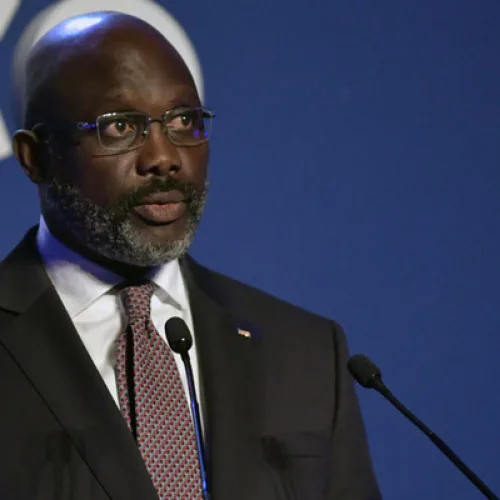
George Weah, former President of Liberia, has warned political leaders against weakening institutions, compromising the judiciary and undermining safeguards designed to check executive power.
The former Liberian leader, who gave the warning at the opening of the 66th Annual General Conference of the Nigerian Bar Association (NBA) in Port Harcourt, Rivers State, on Sunday, said such practices endanger democracy.
He charged lawyers and judges to remain fearless in defending the rule of law and democratic institutions, adding that elections alone cannot sustain democracy.
Weah said the true test of democratic governance lies in the strength of institutions and the ability of the judiciary and the legal profession to hold those in power accountable.
“Democracy does not survive on the strength of elections alone. Elections are merely the doorway into democracy, not the house itself.
“What keeps democracy standing are institutions, and among the most important of these are an independent judiciary and a principled Bar,” he said.
Weah noted that democratic systems could be undermined not only through military coups or the refusal of defeated politicians to concede elections, but also through the gradual erosion of institutional safeguards by elected leaders.
He added that an independent judiciary and a fearless Bar were indispensable to protecting citizens’ rights, maintaining accountability and preventing the abuse of executive power.
Weah warned against governments that profess commitment to democracy while exerting influence over judges and judicial institutions to manipulate the rule of law.
He identified budgetary controls, politically motivated judicial appointments and pressure on judges as among practices capable of weakening judicial independence, warning that once the courts lose their independence, public confidence, investment, security and national stability are placed at risk.
He urged lawyers across Africa to remain vigilant and resist every attempt to compromise the independence of the judiciary, stressing that judicial decisions must be allowed to stand without political interference.
Weah recalled his decision to concede defeat in Liberia’s 2023 presidential election before the final results were completed, saying the interest of the country and the will of the people must always prevail over personal ambition.
“I have always believed that the will of the people must stand above the ambitions of any one man in a democratic setting,” he said.
He noted that disputed elections could threaten national peace and security, insisting that political leaders must place the survival of democratic institutions above personal or partisan interests.
Weah also challenged African countries to address poor governance and weak infrastructure, while advocating stronger engagement with the continent’s diaspora and greater investment in institution-building as critical pathways to sustainable development.
Siminalayi Fubara, governor of Rivers State, in his remarks, charged judges to consider the wider implications of their judgments on the polity, arguing that law, order and national development are closely tied to the quality and integrity of justice delivered by the courts.
Fubara urged judges to ensure that truth prevailed irrespective of the status, political affiliation or social standing of litigants.
He said: “We cannot continue to insulate our laws from today’s reality; neither should justice remain shackled by unjust precedents, technicalities, inadequate access, undue delays, slavish adherence to rigid processes, political manipulation or brazen corruption.”
The governor said such impediments had damaged the reputation of the judiciary and the legal profession, stressing that the courts must remain a credible refuge for citizens seeking justice, accountability, human dignity and enforcement of their constitutional rights.
He said the judiciary was indispensable to true democracy, good governance and economic development, adding that the ultimate purpose of law was to protect citizens, guarantee equality before the law and create an environment conducive to socioeconomic development.
Fubara called on judges to demonstrate courage, sound legal reasoning, commitment and integrity in holding both government and citizens accountable to the Constitution and the rule of law.
He also challenged Nigerian lawyers, as custodians of justice, to rise above real and perceived constraints in protecting constitutional democracy and advancing citizens’ rights to good governance.
Fubara said, “In Rivers State, we understand what it means to push beyond limits. We have walked through the furnace of power, may have been bruised, yet remain unbowed in our determination to safeguard our unity, peace and progress and are more resolved than ever in our commitment to delivering the dividends of democracy to our people.”
Afam Osigwe, outgoing NBA President, said the association deliberately returned its flagship conference to Port Harcourt following the restoration of democratic governance in Rivers State, describing the decision as consistent with the NBA’s commitment to the rule of law.
Osigwe said Nigeria’s founding aspiration to become a beacon of Africa remained largely unrealised because of institutional weaknesses, tribalism and parochial interests.
He urged lawyers to move beyond criticism and provide practical solutions to the country’s challenges, particularly by expanding access to justice, clearing the backlog of cases, embracing technology and upholding the highest ethical standards.
Osigwe maintained that the legal profession had a critical responsibility to make the rule of law the foundation of national security, democratic stability and sustainable development.
The conference, with the theme: “Beyond Limits,” attracted legal practitioners, judges, academics and policymakers from across Nigeria and beyond, with deliberations centred on democracy, judicial independence, governance reforms and the future of the legal profession in Africa.


Comments
Start the conversation about this story.