





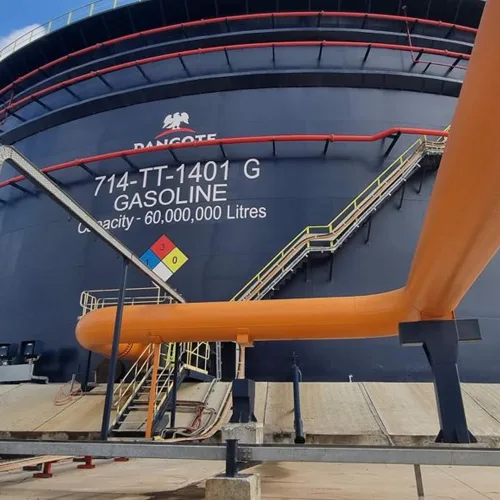
Dangote Refinery has raised its gantry price for Premium Motor Spirit (PMS), popularly known as petrol, by N15 to N1,200 per litre, effective August 26, 2026.
The latest increase, communicated to customers on Tuesday by the refinery’s Group Commercial Operations, represents the second petrol price hike in less than a week.
The refinery previously increased its gantry price from N1,165 to N1,185 per litre on August 21.
Read also: Dangote plans ship acquisitions to beat Nigeria’s export vessel shortage
In the latest notice titled ‘PMS Price Change Communication (N1,185 per Litre To N1,200 per Litre)’, the refinery also raised its coastal delivery price from N1,562,265 to N1,582,380 per metric tonne.
Customers were instructed to return existing Authorisation to Collect (ATC) documents for repricing before loading resumes.
“You are advised to return all ATCs for repricing, and a new volume contract will be issued for immediate loading resumption,” the refinery said.
The refinery has yet to publicly explain the latest N15 increase. The latest adjustment comes despite a decline in international crude oil prices.
Read also: Dangote refinery drives seven-fold rise in Nigeria petroleum product exports, EIA says
Data cited from Oilprice showed Brent crude at $86.83 per barrel, down 1.98 percent, while WTI stood at $80.70, down 2.02 percent. However, Murban crude rose to $93.44 per barrel.
The divergence between falling crude prices and rising domestic petrol prices could put additional pressure on marketers and consumers, particularly as downstream operators factor the higher refinery gate price into transportation, storage and retail costs.
Industry sources expected the increase to feed through to pump prices, potentially pushing petrol towards an average of N1,250 per litre, depending on location and distribution costs.
The increase also comes amid heightened uncertainty in global oil markets following the US-Iran conflict.
While crude prices have recently declined on expectations that sanctions and diplomatic developments may limit the immediate threat to global supplies, shipping risks remain elevated around the Strait of Hormuz.
Only two commodity vessels transited the strategic waterway on Monday, according to Reuters, marking the lowest daily traffic since early May.
The Strait of Hormuz previously handled about one-fifth of global oil consumption, making continued disruption a significant risk to international crude and refined-product markets.


Comments
Start the conversation about this story.