





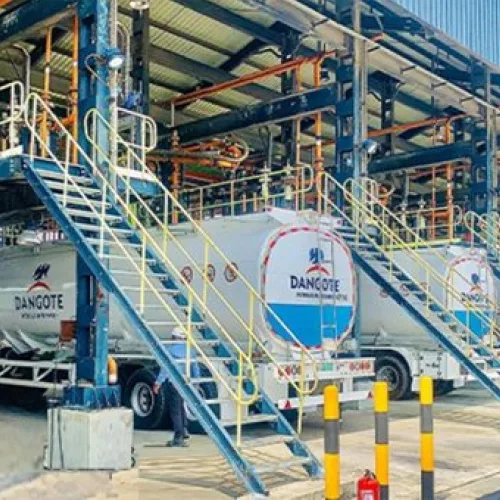
Dangote Refinery’s planned $5 billion stock market debut could become Africa’s biggest initial public offering, but beneath the refinery’s record capacity and strong refining earnings lies a critical investment risk: securing enough affordable crude oil to keep the 650,000-barrel-per-day plant running profitably and fund its planned expansion.
With the refinery seeking to double capacity within three years, investors are likely to look beyond its impressive production numbers to a more fundamental question whether Nigeria can supply enough crude at competitive prices, or whether Dangote will increasingly have to rely on expensive dollar-priced imports to feed its operations.
The planned October listing comes after months of strong refining margins, supported by disruptions in the Middle East that have increased demand for alternative sources of fuel.
For investors, however, the refinery’s long-term profitability could depend less on its refining capacity and more on its ability to secure competitively priced crude.
“If Dangote’s only supplier of oil is Nigeria … this does increase the risk of the refinery as an investment,” Rob Thummel, senior portfolio manager at US-based Tortoise Capital Management, told Reuters.
Dangote Refinery, majority-owned by Africa’s richest man, Aliko Dangote, reached its initial maximum capacity of 650,000 barrels per day in February and has already tested production at 700,000 barrels per day.
The refinery’s coastal location gives it flexibility to import crude, but this also exposes the business to international crude prices and foreign exchange risks.
David Bird, chief executive of Dangote Refinery, said imports account for about 30 percent to 40 percent of the refinery’s crude intake, despite Nigeria being Africa’s biggest oil producer with output of about 1.6 million barrels per day.
The challenge is that a significant portion of crude from the Nigerian National Petroleum Company Limited’s joint ventures is tied to oil-backed loans and pre-export financing arrangements, limiting the amount available to domestic refiners.
Dangote has also raised concerns about the pricing of Nigerian crude, saying some domestic cargoes can be more expensive than comparable imports because local crude is priced against international benchmarks such as Brent, which include freight and logistics costs.
Edwin Devakumar, group vice president of Dangote Industries Limited, told Reuters that some Nigerian cargoes were more expensive than comparable imports.
As a result, Dangote has diversified its crude sources, buying from other African producers as well as the United States and Guyana. But imported crude is priced in dollars, adding to the refinery’s exposure to global oil prices and currency movements.
Read also: MTN seeks local investors for $1.1bn IHS Nigeria stake to meet deal condition
“The main risk is the cost of importing these barrels,” Alan Gelder, an analyst at Wood Mackenzie, said.
Nigerian authorities are exploring a crude-swap system that could match domestic refiners with local producers, reducing delivery times and logistics costs.
For Dangote, the success of the proposed IPO may ultimately hinge on whether the refinery can convert its huge refining capacity into sustainable profits while securing enough affordable crude to support its next phase of expansion.


Athekame Kenneth is a politics, economy, and finance reporter whose work is anchored in sharp investigative storytelling. He brings analytical depth to every piece, drawing on a strong academic foundation that includes a degree in Economics, an MBA in International Trade, and a minor in Petroleum Economics from Lagos State University, Ojo. His reporting blends rigorous research with a keen eye for hidden truths, delivering stories that illuminate power, policy, and the forces shaping everyday lives.
Comments
Start the conversation about this story.