






Nigeria and Turkiye have reaffirmed their commitments to deepen defence cooperation with emphasis on local and joint production of defence hardwares and technology transfer.
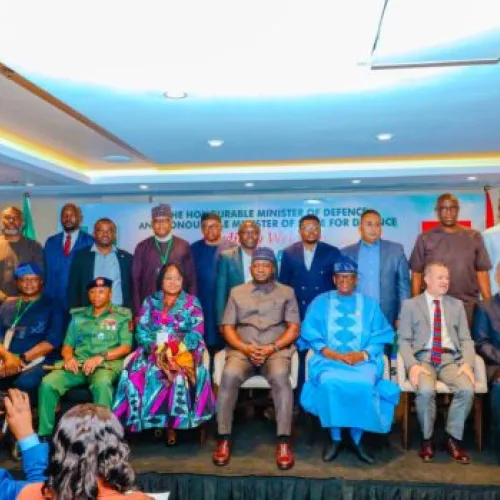
Speaking at the 7th edition of Nigeria – Turkiye Defence Industry Business Forum in Abuja on Wednesday, Nigeria’s minister of defence, General Christopher Musa (retd.), said it time for both countries to move their defence partnership to the next level.
The minister said Nigeria’s message at the forum is clear, adding that Nigeria is open to strategic defence-industrial partnerships and responsible investment.
“We welcome credible partnerships in areas including joint ventures, co-production, technology licensing and transfer, local manufacturing and assembly, component production, maintenance, repair and overhaul, research and development, training, human-capacity development and defence supply-chain integration.
“We are particularly interested in partnerships that strengthen Nigeria’s ability to progressively acquire the skills, technologies and industrial capabilities required to manufacture, maintain, upgrade and sustain defence equipment throughout its life cycle. Technology transfer and local capacity development must therefore remain central considerations in our engagements.
“The ultimate measure of success should not simply be the delivery of a platform or system, but the extent to which Nigerian personnel, institutions and industries acquire the knowledge and capabilities to sustain and further develop that capability.”
He however, added that sustainable industrial partnerships must be based on mutual respect, transparency, trust and clearly defined commercial and strategic interests.
“We also recognise the legitimate importance of protecting intellectual property, maintaining appropriate regulatory safeguards, ensuring responsible technology transfer and creating a predictable and enabling environment for investment,” he said.
He said Nigeria’s ambition goes beyond meeting its immediate defence requirements, adding that it seeks to develop an industrial ecosystem capable of positioning Nigeria as a competitive defence manufacturing hub in Africa, “one that creates quality employment, develops highly skilled Nigerian professionals, strengthens domestic supply chains, promotes innovation and contributes to national security as well as broader economic development.”
He said this vision is particularly important at a time when the global security environment is becoming increasingly complex and technologically driven.
He noted that contemporary conflicts are demonstrating the growing importance of unmanned systems, artificial intelligence, advanced communications, cyber capabilities, precision systems, surveillance technologies, space-based assets and other emerging technologies.
He said, “Nigeria must therefore build the capacity not only to acquire such capabilities, but also to understand, adapt, manufacture, maintain and continuously improve them.
“This requires strong partnerships between government, the Armed Forces, research institutions, academia and industry, supported by sustained investment in innovation and human capital. “
He said Türkiye’s remarkable transformation into a major and increasingly self-reliant defence industrial power provides valuable lessons for countries seeking to develop indigenous defence capabilities.
“Türkiye has demonstrated what can be achieved through sustained government commitment, deliberate investment in indigenous research and development, innovation, strong private-sector participation, effective institutional coordination and close collaboration between government, the Armed Forces, research institutions and industry.
“Nigeria therefore views the Turkish defence industry not merely as a source of equipment, but as a strategic partner in our defence industrialisation journey. We are interested in learning from Türkiye’s experience and adapting relevant aspects of that experience to Nigeria’s own circumstances, requirements and strategic interests,” he said
Musa said a stronger Nigeria–Türkiye defence industrial partnership can create opportunities not only for wo countries, but also for the wider African market.
“Nigeria’s strategic location, growing economy, substantial human capital and large domestic market provide a strong foundation for developing partnerships capable of serving both national and regional requirements.”
He said the forum is expected to give practical expression to both countries shared vision.
” The discussions on strategic defence partnerships, technology transfer, co-production, local content, investment opportunities, incentives, procurement processes and regulatory frameworks are particularly important.
“I encourage our Nigerian and Turkish companies to use this opportunity to identify specific, commercially viable and technologically meaningful areas of cooperation.
“We should be looking beyond general expressions of interest towards partnerships with clearly defined objectives, timelines, investment commit
ments, production arrangements and measurable outcomes.”
In his remarks, Mr Gokman Ucar, Vice President, SSB Turkiye and Head of the Turkish Defence Delegation, said the forum could open new chapter in Nigeria-Tukiye defence partnership by bringing companies from the two countries.
He added that discussion would also focus on joint production and technology transfer.
” Firstly, we’ll look at the big picture by reviewing our strategic defence partnership through the lens of defence industrialisation.
“We’ll continue by focusing on joint production, technology transfer and localization and be informed about the regulatory and investment framework in Nigeria for establishing strategic partnerships,” he said.
The Minister of State for Defence, Dr Bello Matawalle, said the forum provided an opportunity for both countries to move beyond dialogue and explore practical opportunities for investment, local production and long-term industrial cooperation.
Matawalle said the DICON Act 2023 had created a framework for strengthening local production, private-sector participation and strategic partnerships.
He urged Nigerian and Turkish stakeholders to explore practical models for joint production, technology licensing, co-development and localisation.
Comments
Start the conversation about this story.