






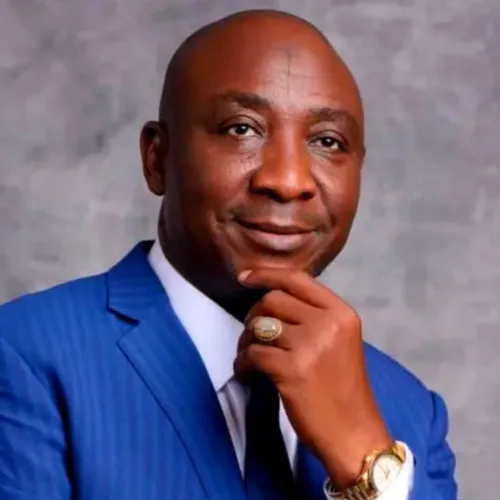
Ibrahim Gusau has defended his administration’s record and explained his decision to resign as President of the Nigeria Football Federation (NFF), bringing his three-year, 11-month tenure to an end.
Gusau announced his resignation at a press conference in Abuja on Thursday amid months of pressure over Nigeria’s disappointing international performances and growing concerns about the administration of the country’s football.
The now-former NFF president said his decision to resign followed consultations with his family, friends and stakeholders, stressing that his love for Nigeria and his desire to see the country’s football progress influenced his decision.
“I have decided to resign my position as the President of the NFF, after consultations with my family and friends,” Mr Gusau said at Thursday’s Press conference.
He also said he had advised members of his board who were willing to follow his decision to resign, although he could not immediately confirm how many had decided to step down.

“I have also advised my board members who are willing to tow the same path to resign as well,” he said.
“Some members are yet to communicate their decisions directly to me,” he added.
Gusau’s resignation comes against the backdrop of a difficult period for Nigerian football.
The Super Eagles failed to qualify for the 2022 and 2026 FIFA World Cups, while the Super Falcons recently missed out on the 2027 Women’s World Cup for the first time since the competition began in 1991.
At the youth level, the Golden Eaglets also failed to qualify for three consecutive editions of the FIFA U-17 World Cup.
Despite those setbacks, Gusau argued that his administration made progress in several areas of football development and said he would remain available to contribute to the game.
“By the grace of God, we will continue to give our contribution. Our experience, connections and relationships within African football will never go in vain,” he said.
“Whenever we are needed, we will contribute to the progress of Nigerian football.”
Gusau’s defence of his record
In what amounted to a final defence of his administration, Mr Gusau highlighted developments in coaching education, domestic league administration, refereeing and infrastructure.
He said the NFF had conducted CAF B Licence, CAF C Licence and Coaching Instructors’ courses during his tenure, with the CAF A Licence programme scheduled to commence on 16 September.
He also defended the administration’s handling of the domestic leagues, saying the board inherited a difficult situation and had made efforts to stabilise the competitions.
“We inherited a difficult situation, but we have made progress in stabilising the leagues,” he said.
Mr Gusau pointed to referee development as another area where he believed his administration had made significant progress.
He said the federation deliberately invested in younger referees and that the impact was beginning to show at international competitions.
“Today, we are beginning to see the results. At the last U-17 World Cup and the Women’s Africa Cup of Nations in Morocco, Nigerian referees were among the officials and even handled some of the semi-final matches,” he noted.
Infrastructure remains a major challenge
Mr Gusau also identified infrastructure as one of the biggest obstacles to the development of Nigerian football.
He said the NFF had used FIFA development funds to improve accommodation and training facilities for the national teams.
“As a board, we sat down and identified infrastructure as one of our greatest needs. We recognised the need for permanent accommodation and training facilities for our national teams, and we are currently working on that,” he said.
He expressed the belief that the administration’s efforts in that area would eventually be recognised.
“I believe history will judge us on this, and Nigerians will remember that we played our part in addressing the infrastructure challenge.”
Gusau’s tenure was not without major achievements.
The Super Falcons won the 2025 Women’s Africa Cup of Nations under his administration, defeating hosts Morocco in the final to claim Nigeria’s record-extending 10th continental title.
The administration also oversaw efforts to improve the visibility of domestic football, including the return of regular television coverage of the Nigeria Premier Football League.
READ ALSO: NFF probe alleges officials influenced national team invitations for financial gains
However, those achievements have been overshadowed in recent months by the national teams’ failures to qualify.
The Super Eagles’ failure to reach the 2026 World Cup followed Nigeria’s absence from the 2022 tournament, while the Falcons’ failure to qualify for the 2027 edition represented an unprecedented setback for the country’s women’s football.
The Falcons’ failure also prompted an NFF fact-finding process to examine the reasons behind the country’s poor performances.
Gusau’s resignation now leaves the federation facing questions over its leadership structure and the future of its electoral process.
The NFF’s elective congress is scheduled for 27 September in Lafia, Nasarawa State, but reports of resignations involving other members of the Executive Committee have created uncertainty over the process.
For Gusau, however, Thursday’s announcement marked the end of his tenure as federation president.
His final message was that leaving office would not end his involvement in Nigerian football.
“By the grace of God, we will continue to give our contribution,” he said.
“Whenever we are needed, we will contribute to the progress of Nigerian football.”
Discover more from Premium Times Nigeria
Subscribe to get the latest posts sent to your email.
Comments
Start the conversation about this story.