






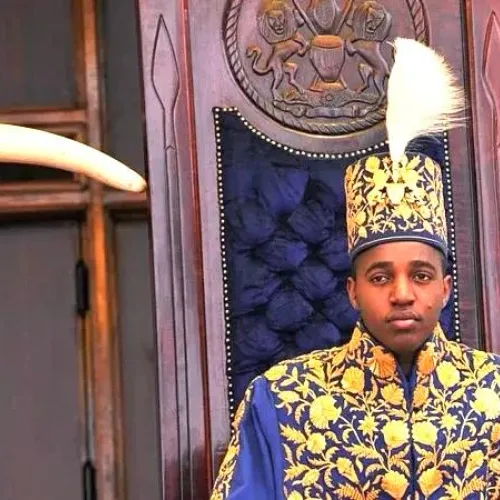
The traditional ruler of Uganda’s Tooro Kingdom, King Oyo Nyimba Kabamba Iguru Rukidi IV, who was recognised as the world’s youngest reigning monarch, has died at the age of 34.
King Oyo’s death was announced by the Prime Minister of Tooro Kingdom, Calvin Armstrong Rwomiire Akiiki, on Thursday night. Blueprint reports
The monarch, who ascended the throne at just three years old, died at about 10pm local time while receiving medical treatment in the United States.
His death has triggered an outpouring of grief in Uganda, particularly among the people of the Tooro Kingdom, where he had remained a highly respected cultural figure for more than three decades.
King Oyo ascended throne at three
Oyo Nyimba Kabamba Iguru Rukidi IV became the King of Tooro in 1995 following the death of his father, King Patrick Kaboyo Olimi III.
At only three years old, his ascension made him a global curiosity and earned him recognition as the youngest reigning monarch in the world.
Because of his age, a regency was established to oversee the affairs of the kingdom until he attained adulthood.
King Oyo eventually assumed full responsibilities as monarch when he turned 18 and was formally crowned in April 2010 during a colourful ceremony attended by Ugandan President Yoweri Museveni.
His unusual journey from a three-year-old boy placed on the throne to an adult traditional ruler made him one of Uganda’s most recognisable royal figures.
Guinness World Records later recognised him as the world’s youngest reigning monarch, further cementing his place in the history of traditional leadership.
Cause of death not disclosed
The Tooro Kingdom has not officially disclosed the cause of King Oyo’s death.
However, reports from Ugandan media indicated that the monarch had been critically ill and was receiving treatment in the United States before his death.
His deteriorating health had reportedly generated concern in recent weeks, although details about his condition were kept largely private.
Announcing his death, the Tooro Kingdom Prime Minister described it as a profound loss to the royal family and the people of the kingdom.
The announcement brought an end to the reign of a monarch whose life had been closely followed since childhood.
A king in a republic
Although King Oyo was a monarch, his position did not carry constitutional political authority.
Uganda is a republic governed by an elected president and government, but it continues to recognise several traditional kingdoms that existed before the colonial period.
These institutions do not exercise formal political power, but they remain highly influential in preserving culture, traditions and social identity.
The Tooro Kingdom, located in western Uganda near the border with the Democratic Republic of Congo, is one of the country’s prominent traditional institutions.
The kingdom has a population of more than two million people and the monarch serves as an important symbol of unity and cultural heritage for the Batooro people.
King Oyo’s role therefore extended beyond the palace, with his public activities often focused on issues affecting young people and the development of his kingdom.
Legacy beyond the throne
During his adult reign, King Oyo sought to use his position to promote youth empowerment, education, environmental conservation and public awareness campaigns.
He was also associated with initiatives aimed at giving young people greater opportunities while preserving the cultural identity of the Tooro people.
His youthful background distinguished him from many traditional rulers across Africa and allowed him to connect with a younger generation.
Despite becoming king as a child, Oyo eventually developed into a prominent traditional leader who represented Tooro at national and international events.
His reign also coincided with renewed efforts by traditional institutions in Uganda to remain relevant in a modern political environment while preserving their historical and cultural significance.
Crown succession remains assured
The death of King Oyo has raised questions about the future of the Tooro throne, but reports indicate that the continuity of the monarchy is assured.
Although the late monarch was unmarried, he reportedly left behind a son who is expected to become part of the succession process.
The identity and details of the heir are expected to be announced in accordance with Tooro traditions and established succession procedures.
The kingdom is also expected to commence traditional mourning and burial arrangements following consultations with the royal family and relevant cultural authorities.
For the people of Tooro, the death represents the loss of a monarch whose entire life was intertwined with the history of the kingdom.
Uganda mourns young monarch
King Oyo’s death has also attracted reactions from political leaders, cultural figures and members of the public across Uganda.
Tributes have focused on his unique journey, his commitment to the Tooro people and the remarkable circumstances under which he became a king.
From ascending the throne at three to assuming full royal responsibilities at 18, Oyo spent virtually his entire life in the public eye.
His death at 34 therefore marks the end of an extraordinary chapter in the history of Uganda’s traditional institutions.
While his reign was largely ceremonial in political terms, his influence as a cultural leader remained significant.
As Tooro prepares to mourn and begin the process of succession, Uganda has lost one of its most recognisable traditional rulers, a king whose story began with a three-year-old boy ascending a throne and ended, three decades later, with his death at the age of 34.
Comments
Start the conversation about this story.