






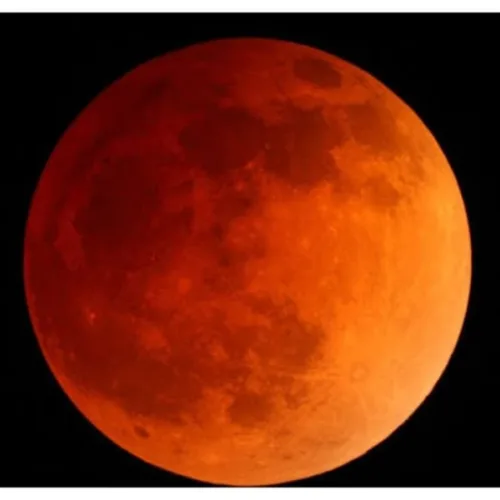
The National Aeronautics and Space Administration, NASA, has announced that a deep partial lunar eclipse, popularly known as a “blood moon,” will occur from Thursday night into Friday, with the phenomenon visible across parts of Africa and other regions of the world.
NASA said the eclipse will be visible in parts of Africa, Europe, the Americas and Western Asia, depending on the location of the observer and the position of the Moon above the horizon.
The agency said the eclipse will begin at 9:23 p.m. Eastern Time on Thursday, August 27, when the Moon first enters the outer part of Earth’s shadow.
What to expect during the eclipse
At 10:33 p.m. ET, the Moon will begin entering the darker central portion of Earth’s shadow, known as the umbra. At this stage, Earth’s shadow will gradually cover part of the lunar surface, creating the appearance of a “bite” being taken out of the Moon.
The eclipse is expected to reach its peak at 12:12 a.m. ET on Friday, when more than 96 per cent of the lunar surface will be shrouded by Earth’s umbral shadow.
NASA’s Scientific Visualization Studio said about 96.3 per cent of the Moon’s disk would be covered at the greatest extent of the eclipse, making the event a particularly deep partial lunar eclipse.
Why it is called a ‘blood moon’
The Moon may develop a reddish, orange or copper-coloured appearance during the eclipse. This occurs because sunlight passing through Earth’s atmosphere is filtered and bent towards the Moon.
The atmosphere scatters much of the blue light while allowing more red and orange light to reach the lunar surface. The resulting colour is responsible for the popular description “blood moon.”
However, NASA’s classification of the event remains a partial lunar eclipse because the entire Moon will not enter Earth’s darkest shadow.
Visibility across Africa and other regions
NASA listed the August 27-28, 2026, event as a partial lunar eclipse visible across the Americas, Europe, Africa and Western Asia.
The exact timing and appearance will vary from one location to another. Observers will only be able to see the eclipse when the Moon is above the horizon at their location.
The agency said the event will continue after its peak as the Moon gradually moves out of Earth’s umbral shadow and then through the outer penumbral shadow.
The eclipse is expected to end at about 3:01 a.m. ET, when the Moon completely exits the outer edge of Earth’s shadow.
Safe to watch with naked eye
Unlike a solar eclipse, a lunar eclipse does not require special eye protection. Skywatchers can observe the Moon directly with the naked eye throughout the event.
NASA explained that lunar eclipses occur when Earth moves between the Sun and the Moon during a full Moon, causing Earth’s shadow to fall on the lunar surface.
The August 27-28 event will therefore provide skywatchers in regions where the eclipse is visible with an opportunity to watch Earth’s shadow gradually sweep across the Moon.
NASA’s announcement has renewed interest among astronomy enthusiasts and members of the public, particularly in Africa, where the event will be visible from several locations, weather conditions permitting.
Comments
Start the conversation about this story.