






The Deputy Executive Secretary of the United Nations Convention to Combat Desertification (UNCCD), Andrea Meza, on Wednesday briefed journalists on key issues and developments shaping the ongoing COP17 negotiations in Ulaanbaatar, Mongolia.
Ms Meza expressed confidence that negotiators would reach an agreement despite lingering differences among parties, particularly over how drought should be addressed and the nature of any potential international instrument.
She said drought should no longer be treated simply as an environmental issue but as a structural risk to economies, productivity systems, ecosystems, value chains and livelihoods.
“We really need to understand that we are not talking about an environmental issue when we talk about drought. We are talking about a structural risk to our economies, productivity systems, ecosystems and livelihoods.”
According to her, drought is a global phenomenon with effects cutting across multiple sectors and regions.

She cited drought-induced food insecurity in parts of Africa, disruptions to international commerce around the Panama Canal and significant agricultural losses in Europe.
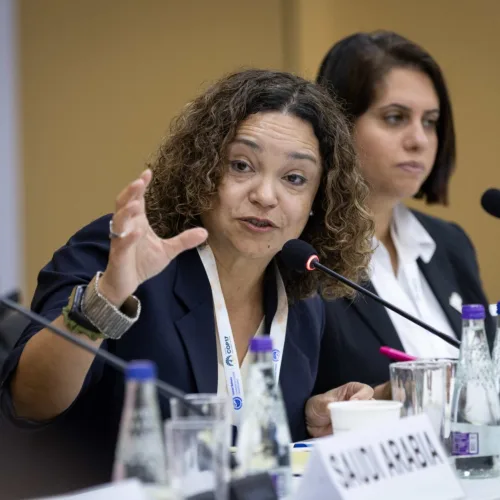
 UNCCD Deputy Executive Secretary, Andrea Meza, with Media Fellows in Mongolia
Ms Meza also noted that drought was affecting regions not traditionally associated with severe water shortages.
“This morning, we were in a meeting with the Minister of Brazil, who said that even in the Amazon — a place we always associate with tropical forests and a lot of rain — we are seeing the effects of drought,” she said.
She added that the scientific evidence points to more frequent and intense droughts, making proactive planning increasingly urgent.
“What we are hearing from science is that we will have more frequent and intense droughts. This is the reality,” she said.
Call for proactive drought management
Ms Meza said governments, communities and businesses could no longer afford to wait until drought strikes before responding.
“This is why it is very important that countries, communities and companies move towards proactive drought management,” she said.
She identified access to information and investment in early-warning systems as essential components of such an approach.
However, she said early warning should go beyond generating scientific information to ensuring that it reaches those who need it and can act on it.
“We need to know when droughts are coming. But it is not only about generating this information. It is about what we do with it,” she said.
She said governments must develop drought plans and policies that identify vulnerable sectors in advance and guide investments in resilience.
“Countries need to have their drought plans and drought policies. They need to know which sectors will be most affected in advance, and they need to start investing in becoming more resilient.”
Ms Meza said this was one reason the ongoing negotiations were important, arguing that a COP decision could provide countries with clearer guidance on the elements and steps required for proactive drought management.
Financing remains critical
Beyond policy and early-warning systems, she said substantial financial resources were needed to implement drought resilience measures at scale.
She cited the International Drought Resilience Alliance and the Drought Investment Facility as initiatives that could help mobilise resources, including private capital, for vulnerable countries.
She also pointed to the Global Environment Facility’s ninth replenishment, GEF-9, which she said was opening new financing opportunities and recognising the need for increased investment in proactive drought management.
Ms Meza also highlighted the International Drought Resilience Observatory as an important tool for translating complex scientific information into accessible information for decision-makers.
“We need to know in advance that droughts are coming, but we also need to understand whether the actions we are implementing are generating more resilience,” she said.
According to her, measuring the impact of investments would also help governments and investors make a stronger economic case for drought-resilience spending.
‘No economic sector is immune to drought’
Responding to a question from a Spanish journalist on whether politicians and businesses were taking drought seriously, Ms Meza said companies were increasingly recognising drought as a business risk.
She said businesses were already experiencing disruptions to production systems and supply chains, with agribusinesses in particular facing difficulties securing commodities needed for production.
“Just as we say that no country is immune to drought, we can say that no economic sector is immune to drought,” she said.
She urged businesses to incorporate drought into their risk-management strategies while also exploring opportunities presented by new technologies and innovations.
She cited precision agriculture, water-saving technologies, water reuse, drought-resistant crops and other innovations as areas where the private sector could contribute to solutions while creating new business opportunities.
But she stressed that the private sector’s responsibility went beyond developing new products and services.
“It is also about their operations and the way they need to include drought as a structural risk and consider it in the future,” she said.
UNCCD stresses inclusion of Indigenous Peoples, local communities
In response to a question from PREMIUM TIMES on the participation of Indigenous Peoples and Local Communities in drought management and decision-making, Ms Meza said their inclusion was increasingly important.
She recalled the creation of the Indigenous Peoples and Local Communities Caucus in Riyadh as a “landmark decision”, saying the platform was intended to ensure that their traditional knowledge, solutions and needs were reflected in the process.
However, she acknowledged that an unresolved agenda item was creating uncertainty over how some of the progress made in establishing such platforms would be affected.
“Clearly, now more than ever, we really need to make sure that platforms are put in place to guarantee the voices of local communities and indigenous peoples,” she said.
Ms Meza said that, beyond the formal negotiating process, alliances bringing together governments, NGOs, Indigenous Peoples and Local Communities could help ensure that affected communities remained involved.
She pointed to the International Drought Resilience Alliance as one platform through which more diverse groups could participate in developing and implementing drought solutions.
“No matter what happens in the negotiations, we need to continue mobilising resources to those communities and facilitating access to knowledge and information,” she said.
She added that the International Drought Resilience Observatory was intended to provide an accessible platform through which people around the world could access information and share knowledge.
Meza optimistic on drought negotiations
Asked about disagreements over the proposed drought framework, including whether it should be legally binding or voluntary and whether drought should be treated as a local, national or global issue, Ms Meza said parties remained divided.
She acknowledged that some countries viewed drought primarily as a local event that should be addressed at national level.
However, she said this was not the position of most parties.
“Most parties are recognising that this is a global challenge and should require and bring global solutions,” she said.
Despite the differences, Ms Meza said she remained hopeful that an agreement would emerge from COP17.
“I am hopeful that in this case we will get an agreement because I feel that most countries, this year with Super El Niño, are facing a lot of challenges right now.”
She said countries would face pressure to demonstrate that COP17 had produced a negotiated outcome on drought.
“They cannot go back to their cities and constituencies and say that nothing came out as a negotiated outcome from this,” she said.
She nevertheless stressed that negotiations alone would not be sufficient, saying implementation would require cooperation among governments, businesses, civil society and other stakeholders.
“Now more than ever, these coalitions of the willing are playing a critical role.”
Mongolia: Drought is the beginning of a chain of risks
During a separate session with a representative of the Mongolian Parliament, the Chairwoman of the Standing Committee on Environment said drought had long been part of Mongolia’s history and herding culture but was becoming more frequent and difficult to predict.
She said Mongolia had experienced six dzuds — severe winter conditions that can cause widespread livestock losses — in the past 20 years.
“Obviously, climate change is changing the pattern, and we can all see that. These events are becoming more frequent, intense and difficult to predict,” she said.
The parliamentary representative said drought in Mongolia could not be separated from water availability or the risk of dzud because summer drought could reduce pasture availability and increase vulnerability to severe winter conditions.
“If drought occurs, a dzud may come next. A dzud means pasture shortages. Pasture shortages affect herders’ livelihoods and livestock health. Towards the end of the chain, we have food security issues,” she said.
She said Mongolia was currently experiencing food inflation of about 25.5 per cent, adding that drought, dzud and water challenges needed to be understood as interconnected risks.
“We cannot separate drought, dzud and water issues. That is why it is important to understand them as a chain of risks. We need to manage them together, not one after the other.”
Mongolia seeks shift from reactive to preventive approach
The parliamentarian said Mongolia had historically adopted a reactive approach to drought and dzud but now needed to transition towards prevention, anticipation and resilience.
She identified three immediate priorities: integrated land and water management; early warning, early action and data-based forecasting; and adequate financing and risk management before disasters occur.
“For Parliament’s role, we need to create the right legal framework,” she said, adding that Parliament must also ensure adequate budgets and oversight.
“To end my speech, resilience is not a slogan. It has to be built into policy.”
Financing gap threatens restoration projects
Responding to a question about the difficulty of sustaining land-restoration projects after pilot phases, the Mongolian parliamentary representative identified financing as a major challenge.
“I think the core gap is definitely financing. I must admit that.”
She said Mongolia could not rely solely on national budgets to implement and sustain resilience and restoration projects.
READ ALSO: COP17: How Africa can unlock billions for land restoration — Official
“The national fund should be a catalyst to pull in other sources of funding,” she said.
She called for greater mobilisation of private investment, development finance and philanthropic partnerships to sustain restoration initiatives.
“National funding is not the only source. We need to attract private funds, development funds and even philanthropic partnerships.”
Mongolia seeks better communication with herders
Responding to a question about communicating scientific information to remote communities, she said Mongolia already had a forecasting department responsible for producing early warnings.
However, she acknowledged a gap between information and action.
“It has been pretty much information. It has not been proper action,” she said.
According to her, Mongolia now needs to move from simply disseminating warnings to developing clear action plans that communities can implement.
She said Mongolia’s governance structure could facilitate communication with isolated herders but stressed that communities themselves needed to be involved in decision-making.
“Again, every decision is made at the top, but we never bring herders and rural communities to the table. This decision-making approach needs to change.”
She called for herders, cooperatives and local associations to participate in decisions on pasture planning, seasonal restoration and land restoration.
She also said local governments should establish effective monitoring and implementation mechanisms, while Parliament should provide the legal framework, secure budgets and exercise oversight.
“If we know our roles and responsibilities and have a shared, integrated approach, system and proper framework, we can have a better flow and a common language,” she said.
Discover more from Premium Times Nigeria
Subscribe to get the latest posts sent to your email.
Comments
Start the conversation about this story.