





Scientists investigating the catastrophic floods that swept across the Nepal-China border say the disaster was triggered by a massive collapse of ice and rock high in the Himalayas, rather than by an earthquake as initially suspected.
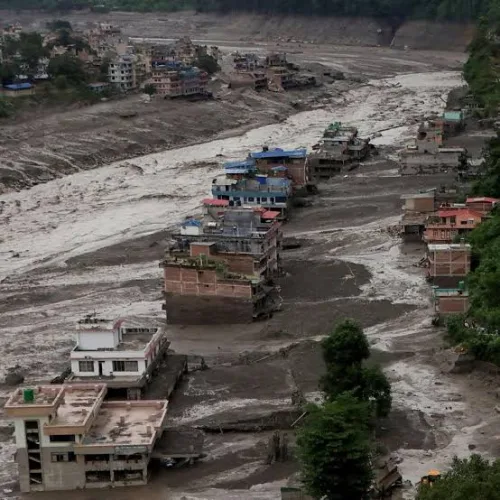
The collapse sent a powerful mixture of water, mud, boulders and debris into the Lhende Khola, a tributary of the Bhote Koshi River, producing a sudden flood wave that devastated communities, roads, bridges and hydropower infrastructure downstream.
Satellite imagery and preliminary scientific analysis indicate that a large section of a glacier broke away at an elevation of roughly 5,200 metres (17,000 feet) before plunging about 1,200 metres into the valley below.
The falling ice and rock accumulated enormous amounts of sediment and debris, while temporarily blocking the river. When the natural blockage gave way, the trapped water and debris surged downstream with devastating force.
Researchers at the International Centre for Integrated Mountain Development (ICIMOD) said the Lhende Khola was particularly affected, with water levels on the Trishuli River reportedly rising by as much as nine metres within 30 minutes at one monitoring point.
The disaster was initially linked to a reported magnitude 4.4 earthquake near the Nepal-China border.
However, subsequent analysis by the U.S. Geological Survey (USGS) found that no earthquake had occurred. Instead, the seismic signal was produced by the glacial collapse and resulting debris flow.
The event itself generated a seismic signal equivalent to about magnitude 5.2, highlighting the enormous energy released when the ice-rock mass plunged into the mountain valley.
Scientists say the disaster was not simply a conventional river flood.
As the collapsing glacier and rocks entered the valley, they picked up water, soil, boulders and other material. The resulting flow became an extremely dense and fast-moving debris mixture capable of destroying structures in its path.
Glaciologist Andrew Mackintosh of Monash University said the collapse could have triggered a cascading sequence in which water and sediment combined to greatly increase the size and mobility of the flood.
The result was a wall of debris that moved rapidly through narrow Himalayan valleys, giving communities downstream little time to react.
Scientists caution that it is too early to establish that climate change directly caused this particular glacier collapse.
However, there is growing scientific evidence that a warming climate is changing the stability of the Himalayan cryosphere.
The Hindu Kush-Himalaya region has experienced rapid glacier loss, while warming is also degrading mountain permafrost — permanently frozen ground that can act as a natural “glue” holding steep rock slopes together.
As glaciers retreat and permafrost thaws, scientists say some high-altitude slopes may become increasingly vulnerable to rockfalls, landslides and ice-rock avalanches.
The disaster has exposed the vulnerability of communities and critical infrastructure built along Himalayan river corridors.
The flood destroyed bridges and roads and damaged hydropower facilities, while the destruction of transport links has complicated rescue operations. ICIMOD has also warned of the possibility of further flooding because debris remains lodged upstream.
The threat extends beyond Nepal and Tibet because rivers originating in the Himalayas flow across several countries and support millions of people.
Experts say the disaster demonstrates the need for stronger monitoring of glaciers, mountain slopes and potentially dangerous river blockages, alongside faster cross-border information sharing.
ICIMOD said the increasing visibility of cryosphere-related hazards underscores the need for stronger regional cooperation between governments and scientific institutions.
For now, researchers are continuing to examine satellite imagery, seismic records, hydrological data and field evidence to determine precisely how the collapse unfolded.
But one conclusion is already clear: the Himalayas are changing rapidly, and communities living beneath its glaciers face increasingly complex risks from ice, rock, water and unstable mountain terrain.
Comments
Start the conversation about this story.