





SIAT Group, the African agro-industrial company and majority shareholder of Presco Plc, is positioning its next phase of growth around the same long-term investment philosophy that has shaped its expansion across Nigeria and Ghana for more than three decades.
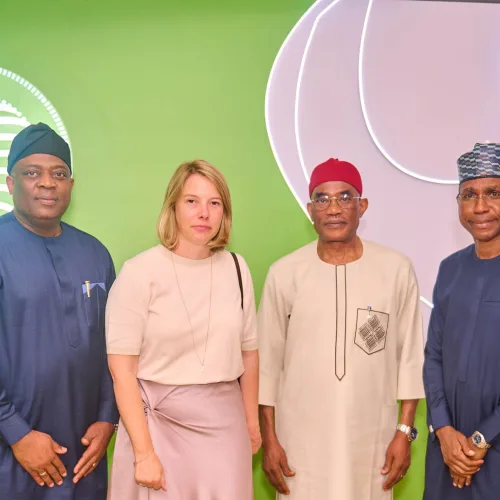
The group’s leadership said this at the SIAT Forward event held in Lagos on Friday, where founding family members, former directors, board members, executives, financial partners, and other stakeholders gathered to reflect on the company’s history and its future.
The event, themed “Legacy, Leadership & the Future,” highlighted how the group evolved from a Belgian investment company into an integrated agricultural business with operations spanning plantation development, cultivation, processing and downstream activities in Africa.
SIAT was incorporated under Belgian law in 1991 under the leadership of Pierre Vandebeeck. Its African journey began in the same year with the acquisition of Presco in Nigeria, before expanding to Ghana through the acquisition of Ghana Oil Palm Development Company (GOPDC) in 1995.
More than three decades later, the group says its businesses in Nigeria and Ghana employ more than 17,000 people while supporting thousands of smallholder farmers and rural communities.
For SIAT, the evolution has been less about the size of its plantations than about building an integrated agricultural value chain capable of creating value from cultivation through processing and marketing.
Rasheed Sarumi, group chief executive officer of Saroafrica International Limited and chairman of Presco Plc, said the company’s current position reflects the efforts of successive generations of leaders and employees.
“We do not stand as something new, but as something continued,” Sarumi said, stressing the need for the current leadership to preserve and extend the foundations laid by the founding family.
From plantations to integrated agriculture
The development of Presco illustrates SIAT’s approach to building agricultural businesses around an integrated production model.
Presco operates oil palm plantations, a palm oil mill, a palm kernel crushing plant and vegetable oil refining and fractionation facilities. Its operations also include olein and stearin packaging as well as a biogas plant for treating palm oil mill effluent.
The model allows the company to participate in multiple stages of the palm oil value chain rather than relying solely on the sale of agricultural produce.
Marie Vandebeeck, speaking on behalf of the founding family, said the group’s greatest achievement was not simply the scale of its agricultural assets but its ability to develop people and institutions in challenging operating environments.
“When I think of the legacy of SIAT Group, I don’t first think of hectares and tons of palm oil. I think of people,” she said.
According to her, Presco’s development was the result of decades of persistence, investment and the contribution of Nigerian organisations and employees who helped transform the business.
She said the founding family’s investment was underpinned by the belief that a world-class agricultural business could be built in Africa despite the risks and uncertainties associated with operating in the sector.
Leadership shift puts focus on next phase
The latest phase of SIAT’s story is now being shaped by a new generation of leadership, with Adewale Arikawe, Group Chief Executive Officer of SIAT Group, saying the immediate task is to expand the business while maintaining its long-term orientation.
“Our responsibility as a team is to take SIAT to the next level — to build something bigger, bolder and more impactful,” Arikawe said.
He said SIAT would focus on becoming a more integrated agriculture business by sustainably growing, processing and marketing agricultural resources.
The strategy comes as African agriculture faces growing pressure to move beyond primary production towards greater local processing and value addition.
For oil palm-producing economies such as Nigeria and Ghana, this means increasing domestic production, expanding processing capacity and improving the connection between large-scale plantations and smallholder farmers.
SIAT’s integrated model places it within this broader shift towards developing agricultural value chains rather than simply exporting or selling raw commodities.
Preserving institutional memory
The Lagos event also served as an effort to connect SIAT’s current leadership with those who were involved in building the business.
Among those present were Atedo Peterside, former board member of Presco; Reji George, managing director and chief executive officer of Presco; and Felix Nwabuko, former group chief executive officer of SIAT NV and institutional adviser to Presco.
The gathering underscored the importance of institutional memory in a business where investments in plantations and processing facilities require long-term capital and management commitment.
For SIAT, the challenge is therefore not only to grow its assets but also to preserve the organisational capabilities that enabled the group to survive changes in ownership, leadership, markets and operating environments.
That continuity is particularly significant for Presco, which has grown from the business acquired by SIAT in 1991 into one of Nigeria’s major integrated oil palm companies.
As SIAT looks ahead, its leadership is betting that the combination of long-term agricultural investment, vertical integration, human capital and stronger value-chain participation can provide the foundation for another phase of expansion.
The group’s stated ambition is to become “bigger and stronger” while remaining anchored to the agricultural businesses and communities that have defined its African journey.


Wasiu Alli is a business, economics cum data journalist with strong expertise covering macro trends, capital markets, government policies, corporate earnings and comparative economics analysis. Alli turns raw data into trends that not only tells compelling stories but nudges investors to make valued and informed decisions. He’s an alumnus of Lagos State University and trained at Lagos Business School. He formerly heads the Companies and Markets desk at BusinessDay where he writes and supervises the production of well researched articles on earnings updates, corporate sectoral comparisons, market intelligence as well as interviews with C-suite executives.
Comments
Start the conversation about this story.