





…bigger donation limits, third-party spending and digital campaigns raise fresh concerns
Nigeria’s new N10 billion presidential campaign spending cap could prove difficult for the election regulator to enforce as political spending increasingly flows through support groups, donors, influencers, and digital platforms outside formal campaign structures.
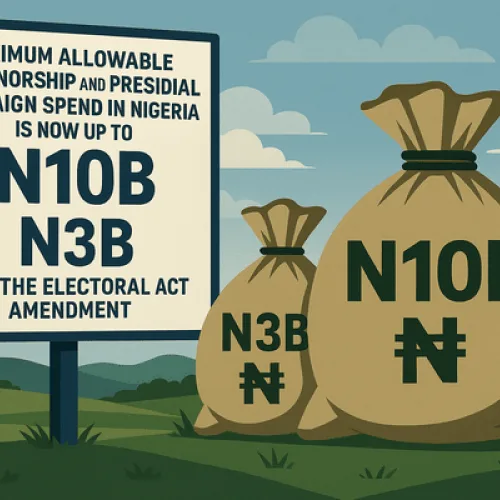
The Electoral Act 2026 has doubled the legal campaign spending limit for presidential candidates from N5 billion to N10 billion, while raising the limit for governorship candidates from N1 billion to N3 billion.
The spending ceiling for Senate candidates has increased fivefold to N500 million from N100 million, while House of Representatives candidates can now spend up to N250 million, compared with N70 million previously.
The government has attributed the increases to inflation and the rising cost of election campaigns.
But the higher limits come as campaign financing is becoming more complex, involving political parties, candidates, support groups, advertising agencies, event organisers, media organisations, transport companies, influencers and digital platforms.
The central challenge for the Independent National Electoral Commission (INEC) will therefore not simply be determining whether a candidate has declared spending below the N10 billion threshold, but establishing how much was actually spent on the candidate’s behalf.
A presidential candidate, for instance, could declare N8 billion in campaign expenditure while support groups separately spend hundreds of millions of naira on billboards, television advertising, rallies and online campaigns promoting the same candidate.
INEC would then have to determine who authorised the expenditure, who paid for it, whether the candidate was aware of it and whether the spending should legally be attributed to the candidate.
Bigger donation limits
The law also raises the maximum amount an individual or company can donate to a political campaign tenfold, from N50 million to N500 million.
The threshold at which a donor’s name and address must be recorded has also increased 100-fold, from N1 million to N100 million.
The changes potentially allow substantially larger sums to enter political campaigns before detailed donor information is required to be recorded, increasing the importance of effective disclosure and enforcement.
The Policy and Legal Advocacy Centre (PLAC) has raised concerns that higher donation limits could increase the influence of wealthy individuals and companies if disclosure requirements are not effectively enforced.
The combination of higher spending and donation ceilings means that INEC will have to monitor not only how much candidates and parties spend, but also where campaign money comes from and how it is ultimately deployed.
The third-party spending problem
Support groups could present one of the biggest challenges to enforcing the new spending limits.
Political campaigns frequently involve organisations that publicly support candidates but operate separately from their official campaign structures. Such groups can organise rallies, purchase advertising space, mobilise voters and engage influencers and other service providers.
The question is whether expenditure by such organisations should count towards a candidate’s statutory spending limit.
That determination could depend on evidence showing whether the expenditure was coordinated with, authorised by or otherwise attributable to the candidate.
This creates an enforcement problem because a campaign could potentially appear to remain within its legal spending limit while substantial expenditure is incurred by organisations operating around it.
The issue becomes even more difficult where payments are made through intermediaries such as advertising agencies, consultants, event companies or media organisations.
Six-month reporting window
The Electoral Act 2026 requires political parties to maintain financial records and submit audited returns on election expenses within six months after an election.
The returns are expected to provide details of expenditure, the market value of donated goods and services, and the identities of donors.
Parties must also publish the returns in at least two national newspapers and on their websites, potentially allowing journalists, civil society organisations and members of the public to scrutinise campaign finances.
But retrospective disclosure does not necessarily establish that all campaign spending has been captured.
By the time financial returns are submitted, campaign offices may have closed, temporary workers may have left and vendors may no longer have easily accessible records.
This makes monitoring during the campaign period particularly important.
Digital campaigns create new blind spots
The rapid growth of digital campaigning adds another layer of complexity.
Political campaigns increasingly use Facebook, Instagram, X, YouTube, TikTok and WhatsApp, with spending covering online advertising, influencers, video production, data analysis, website development and digital campaign management.
An advertisement can be purchased by an agency or organisation and targeted at voters in a particular state or constituency, making it visible to regulators without necessarily making its financial trail obvious.
INEC may therefore need to establish not only who placed an online advertisement but who financed it, who authorised it and whether it was coordinated with a candidate or party.
The same challenge applies to influencers and other digital campaign operators who may receive payment through intermediaries.
Campaign finance monitoring must also account for in-kind support. The law requires the market value of donated goods and services to be reflected in financial reporting, potentially creating questions around discounted advertising, donated venues, vehicles, production services and other campaign support.
What INEC says
INEC says it already has systems designed to monitor campaign financing by political parties and candidates.
Under its existing framework, parties are required to declare campaign income, donations and expenditure using prescribed forms and submit financial statements for compliance checks.
The commission is empowered to examine and audit party accounts, while audited reports are to be published as provided by law.
INEC also monitors campaign activities and spending against statutory limits, as well as political advertisements across media platforms, including estimated costs and advertisements placed by third parties and support groups.
To strengthen oversight, parties submit reports electronically through the Political Parties Financial Reporting and Audit System (PFRAS), a centralised platform for analysis and auditing.
The commission says the system enables it to compare declared income with reported spending and flag inconsistencies, while publication of audited reports allows citizens and civil society organisations to scrutinise party finances.
But the effectiveness of the system in identifying spending outside formal party and candidate accounts remains a key question ahead of the 2027 elections.
Efforts to obtain further details from INEC on how the commission will attribute spending by support groups and other third parties to candidates, as well as the extent of its real-time monitoring capabilities, have so far proved unsuccessful.
Testing the declarations
One way of identifying potential under-reporting would be to compare declared expenses with prevailing market prices.
For example, if a campaign declares N50 million in billboard expenditure, investigators could verify the number and locations of billboards, how long they were displayed and prevailing advertising rates.
The same approach could be applied to rallies and other major campaign activities, including venues, stages, sound systems, security, transportation, accommodation and feeding.
Significant differences between declared expenses and verified market costs could provide grounds for further investigation.
But such monitoring would require INEC to have sufficient numbers of trained investigators, auditors and digital monitoring specialists, as well as access to reliable information from vendors and service providers.
Penalties for breaches
The Electoral Act provides penalties for candidates who exceed their campaign spending limits.
A presidential candidate who breaches the N10 billion limit can face a fine of one percent of the applicable limit, equivalent to N100 million, or imprisonment for up to 12 months, or both.
Political parties that exceed their limits can forfeit the excess amount and face a fine of up to N10 million. Accountants who falsify financial records may also face sanctions.
The penalties, however, are only as effective as the regulator’s ability to detect and prove violations.
Nigeria has imposed campaign finance restrictions in previous electoral laws, but enforcement has remained a challenge. PLAC has also raised concerns about INEC’s capacity to investigate and prosecute campaign finance violations.
The enforcement test
The increase in campaign spending limits comes as Nigeria’s electoral campaigns become more expensive, fragmented and increasingly digital.
That means the effectiveness of the N10 billion cap will depend less on the number printed in the law than on INEC’s ability to establish, with evidence, the true cost of a candidate’s campaign.
The commission will need to look beyond official campaign accounts to support groups, donors, vendors, advertising agencies, influencers and digital platforms.
It will also need to monitor expenditure during campaigns rather than rely primarily on financial returns submitted months after election day.
For the 2027 elections, the key test will therefore be whether INEC can move from simply checking what candidates declare to independently determining what they actually spent.
The N10 billion ceiling may set the legal boundary. INEC’s ability to follow the money will determine whether that boundary has any practical force.


Comments
Start the conversation about this story.