





The National Information Technology Development Agency (NITDA) has challenged Jigawa state to reduce its dependence on federal allocations by building a technology-driven economy around its youthful population, land and other resources.
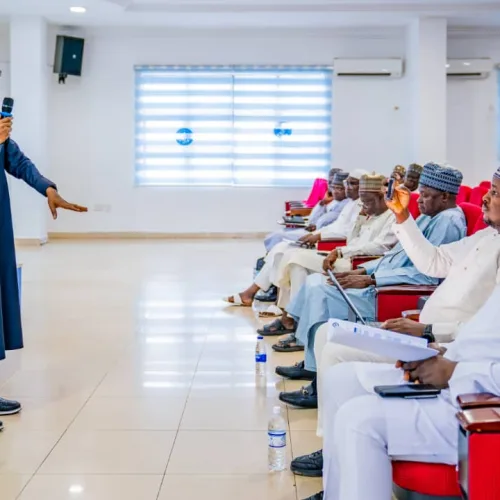
Kashifu Inuwa, director-general of NITDA, made the call at the Galaxy Information Technology and Telecommunications (Galaxy ITT) Repositioning Retreat in Abuja, urging the state to rethink its development strategy and establish clear, measurable targets for the next two to three years.
Inuwa said Jigawa and other parts of Northern Nigeria had abundant human and natural resources that could support sustainable economic growth, but a lack of clear development plans and excessive focus on politics had limited their ability to convert those resources into economic value.
Read also: Nigerians to enjoy lower public transport cost from October 1- Tinubu
He said the state needed to move beyond dependence on allocations from Abuja by identifying sectors where technology could improve productivity, create jobs and generate new sources of revenue.
“Jigawa needs to define what it wants to achieve in the next two to three years and develop practical strategies to achieve those objectives,” he said, stressing that sustainable development required clear goals, strategic planning and measurable outcomes.
The NITDA chief also pointed to Jigawa’s early investment in information and communication technology as evidence that the state had previously recognised the potential of technology to transform its economy.
He recalled the role of Ibrahim Saminu Turaki, former governor of Jigawa State, in establishing Galaxy ITT and championing ICT-driven development. According to Inuwa, the initiative demonstrated foresight at a time when technology was yet to become as central to economic activity as it is today.
However, he said the absence of continuity under subsequent administrations prevented Jigawa from fully capitalising on the foundation laid by the former governor, allowing other states and economies to move ahead.
Inuwa therefore tasked Galaxy ITT with developing a clear strategic direction for its repositioning and using its experience and knowledge of Nigeria’s technology landscape to become a major driver of digital transformation in Jigawa.
He said technology was no longer a standalone sector but a horizontal enabler of virtually every part of the economy, noting that many of the world’s leading companies are technology-driven businesses.
For Jigawa, he said, this presents an opportunity to use digital infrastructure and innovation to unlock the economic potential of its young population and other resources.
But the NITDA DG cautioned that Galaxy ITT could not drive the transformation alone. He called for stronger legal, policy and institutional frameworks to support the company and urged closer collaboration between Galaxy ITT and the Jigawa State Information Technology and Digital Economy Agency.
Such collaboration would be particularly important for implementing digital policies and building the state’s digital economy, he posited.
The call comes as governments increasingly look to digitalisation not only to improve public services but also to create jobs, attract investment and expand the productive capacity of local economies.
Inuwa also used the retreat to trace NITDA’s evolution since its establishment in 2001. He said the agency was created at a time when fewer than 500,000 Nigerians had access to computers and ICT contributed less than 0.5 percent to Nigeria’s Gross Domestic Product.
The agency’s mandate has since expanded from promoting technology adoption to developing policies, regulations and legal instruments designed to make technology a key enabler of economic activity.
He said the adoption of Nigeria’s digital economy policy in 2019 marked a significant change in the country’s approach, with technology increasingly viewed as an enabler across sectors rather than an industry operating in isolation.
NITDA subsequently developed a strategic roadmap and action plan focused on using regulation and policy to create markets, generate employment and promote inclusive economic growth through technology.
Inuwa said the agency’s broader vision was to build a digitally empowered Nigeria capable of achieving inclusive economic growth through technological innovation.
Turaki, who attended the retreat, also commended NITDA for its efforts to advance Nigeria’s digital transformation agenda.
Read also:NITDA warns Zoom users over critical vulnerability that could enable account takeover
The former governor established Galaxy ITT as part of Jigawa’s early ICT development drive, with the institution later evolving into Galaxy Backbone.
The retreat ultimately placed the future of Galaxy ITT within a broader question facing Jigawa: whether the state can turn its youthful population and resource base into productive assets through sustained investment in technology, backed by policy continuity and long-term planning.
For NITDA, the challenge is no longer simply getting Jigawa to adopt technology, but ensuring the state uses it to create a more productive economy capable of generating opportunities and reducing its reliance on federal revenue.


Royal Ibeh is a senior journalist with years of experience reporting on Nigeria’s technology and health sectors. She currently covers the Technology and Health beats for BusinessDay newspaper, where she writes in-depth stories on digital innovation, telecom infrastructure, healthcare systems, and public health policies.
Comments
Start the conversation about this story.