





Nigerian singer Augustine Okechukwu, popularly known as Tekno, has sparked a fresh debate over the history of Afrobeat and Afrobeats after arguing that late music icon Fela Anikulapo-Kuti should not be regarded as the sole originator of the sound.
Tekno made the comments during a Thursday interview on Hot 97, where he discussed Fela’s influence on Nigerian music and called for greater recognition of other musicians whose contributions, he said, helped shape the country’s musical heritage.
 Tekno…Photo Credit: Pulse NG
The singer, who grew up in eastern Nigeria, recalled listening to highlife music and cited legendary musician Oliver De Coque as one of the artistes whose works influenced his understanding of African music.
“They’re legends like Oliver De Coque. He’s a legend that makes pure highlife music, and highlife is also Afrobeats,” Tekno said.
“I have a record of mine, Rara, that is really big and is heavily inspired by Fela because I heard his tune as well and he’s a legend.”
Tekno acknowledged Fela’s influence and credited him with taking Afrobeat to international audiences. However, he argued that other Nigerian music pioneers also deserved recognition.
“He obviously stamped the Afrobeats thing on the world map, but we have some other legends that sang very good music that if you heard today, you wouldn’t even believe that those songs were made in those times,” he said.
“People don’t know them as much, but my dad used to play these records, and it was so many artistes that made it, but Fela gets the credit because he kind of travelled and he had the band that went around the world.
“To some people, he’s the originator of Afrobeats, but to me, there are a lot of them.”
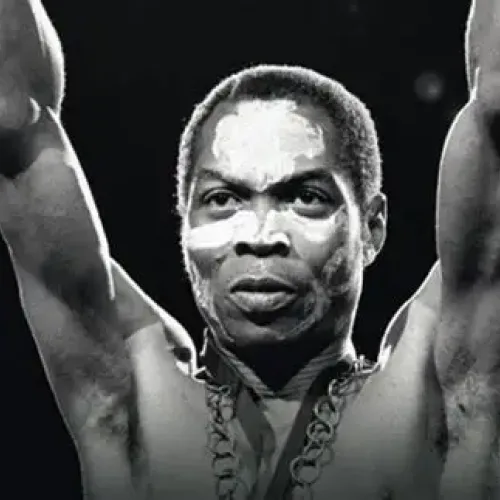
 Fela Anikulapo-Kuti..Photo Credit: iamhistory.uk
His comments triggered a heated debate on X, with Nigerians divided between those who supported his argument, those who accused him of distorting music history and others who argued that the controversy stemmed largely from the difference between Afrobeat, without the “s”, and Afrobeats, the broader contemporary term.
Those who supported Tekno
Some users agreed with Tekno’s argument that Nigeria’s musical history should not revolve around Fela alone.
Eshin iwaju, #purnishmentmar1, said Tekno had been careful with his comments and deserved credit for drawing attention to musicians from earlier generations.
“Yeah he’s been careful with his words but kudos to him putting their legends on the map as well,” the user wrote.
“Even though Fela was popular and the face of Afrobeat, there are more artists then too that deserve recognition, and his upbringing was about this artist coming from the East.”
Obiahu Emmanuel Egwu, #macofbillions, also said Oliver De Coque deserved greater recognition for his contribution to Nigerian music.
“Whenever I listen to Oliver De Coque’s music, I feel genuinely disappointed that his enormous contribution to Nigeria’s entertainment and music industry isn’t talked about enough,” he wrote.
“Oliver De Coque belongs in the same conversation as legends like Fela Kuti.”
Umeh, #UmehWrites, argued that several Nigerian musicians and musical traditions contributed to the evolution of contemporary Afrobeats.
“Tekno said what a lot of people are afraid to say. Oliver de Coque, Osadebe, Sunny Ade, Ebenezer Obey and co. contributed to highlife music, part of which transitioned into Afrobeats,” the user wrote.
“Fela is a catalyst to the revolution, but he is not the originator of Afrobeats.”
Pascal Ayinor, #pascalayinor, argued that African rhythms existed long before Fela and that the late musician should not be credited with creating all forms of African music.
“Afro + beat = African rhythm. Any music made with African percussion and vocals before, during, or after Fela’s time is an ‘afrobeat,’” the user wrote.
“Therefore, Fela didn’t create it; he just gave the existing African sound a catchy, shortened name.”
DJ BRYTOS, #DJbrytos, also backed the broader argument that other musicians and circumstances helped shape the global story surrounding Fela and Afrobeat.
“If Seun Kuti comes for Tekno over that ‘Fela no start Afrobeat’ talk, Tekno go start regretting why him mouth no get brake,” the user wrote.
“But honestly, Fela’s family got the money, history and global platform to tour, record and sell the pioneer story worldwide. Fighting governments just added premium PR to the whole movement.”
Another user, Umetex, #ChigEmic, said Tekno’s comments could encourage Nigerians, particularly those from the eastern part of the country, to learn more about the history of their music.
“Tekno will be vilified for that utterance, but it should be an eye-opener for some eastern folks to learn about their music history,” the user wrote.
“We had acts like Semi-Colon, The Funkees, and Co. with sounds similar to Fela, but the media pushed only one act because he was on govt’s neck.”
 Fela Anikulapo-Kuti…Photo Credit: Rolling Stone
Those who opposed Tekno
Other users strongly disagreed with Tekno, insisting that Fela created Afrobeat and that highlife should not be confused with either Afrobeat or Afrobeats.
Begin, #Inviiin, argued that much of the controversy came from a failure to distinguish between Afrobeat and Afrobeats.
“People are actually getting the whole thing wrong. Afrobeat is completely different without the ‘s’. With the ‘S’, it is a fusion of afro sounds and not a genre,” the user wrote.
“Without the ‘S’, it is a solid genre created by Fela! Period.”
Drawn Out of Water, #meo_joule, similarly argued that highlife and Afrobeat were separate genres.
“Highlife is highlife. Afrobeat is afrobeat. S/o to Tekno for shining a light on the highlife legends, but highlife is not afrobeat,” the user wrote.
“Highlife music is a well defined genre. Afrobeats is a constant but changing fusion of sounds from different musical genres.”
Uncle Jay, #Joeitatu, accused Tekno of failing to understand the differences between the musical traditions he mentioned.
“I’m sure you really don’t know better! High Life is not Afrobeat,” the user wrote.
“While soukous, makossa and even rumba share certain similarities and origins, they are unique genres. The differences between High Life and Afrobeat is much wider.”
Amenze Iyamu, #AmenzeIyamu, also maintained that Fela created Afrobeat, while the term Afrobeats emerged later to describe contemporary African pop music.
“How can he be ignorant about music history? Fela created Afrobeat. Ghana owns High Life. What we call Afrobeats today is not what Fela sang,” the user wrote.
“Because we couldn’t name what we did, the world called it Afrobeats and it stuck. DJ Abrantee is credited with the name Afrobeats.”
Damilare Samuel, also known as Quiv, #_Quivira, said Fela should not be denied recognition for his contribution to African music.
“Fela doesn’t even get any credit beyond the work he did, he did put Afrobeat on the global map,” the user wrote.
“All the people you say we don’t know about, they might be legends in their own right too, but I don’t know them.”
Ade Of Nigeria, #Hammdriller, challenged Tekno’s reference to Oliver De Coque, pointing to the late musician’s own apprenticeship and musical influences.
“Let’s pretend, for a sec, that Highlife music is also Afrobeats. How does he now intend to smuggle through the backdoor the fact that Chief Oliver De Coque was an apprentice to Sunny Agaga and Jacob Oluwale?” the user wrote.
“At least, be educated in your craft, Alhaji Tekno.”
Nononsense, #NoNonsensezone, also highlighted Oliver De Coque’s early experiences in Yoruba juju music.
“TEKNO, do you know that Oliver De Coque didn’t just appear as an Igbo highlife king? He first sharpened his guitar and musical sense in Yoruba juju bands,” the user wrote.
“He apprenticed under Sunny Agaga and then Jacob Oluwole in Lagos in the late 1960s and early 1970s.”
Adeleke, #Laykay1103, dismissed Tekno’s comments entirely.
“This Tekno is so loud in ignorance,” the user wrote.
Bayo Bilisi, #Bayo_Bilisi, suggested that Tekno was deliberately making the argument controversial.
“‘Fela is not the originator of Afrobeat. Lagos people and the Yorubas might say he’s the one but I am from the East, and we had legends like Oliver,’” the user wrote, attributing the remarks to Tekno.
“For him to even apologise to Yorùbás and Lagos people, he knows what he’s doing.”
Burna’s Archive, #Burna_Archive, argued that Fela remained underappreciated despite his global impact.
“Fela was touring around the globe in the 1980s. US, UK, Germany, France, Belgium, Austria, Netherlands, Japan,” the user wrote.
“Unless you’re Tekno or a Wizkid fan, you’ll probably agree with me that Fela doesn’t even get enough credit for what he did for African music.”
Those who took a middle-ground position
Some users did not entirely reject Tekno’s argument but said he had failed to explain his point clearly.
RN_Gabriella, #gabriella_oma, argued that highlife influenced Afrobeat but should not be described as the same thing.
“People insulting Tekno in the comments. I think he didn’t describe it well. Highlife inspired Afrobeat. Without Highlife, there wouldn’t be Afrobeat,” the user wrote.
“Fela drew his influence from genres like Highlife. So technically, we can still say that Fela kinda started Afrobeat, but with the influence of Highlife which originated from the Eastern part of Nigeria.”
Iyanda Koko Bi OTA, #Pentroi2, said Tekno had raised a valid question about the need to recognise other musical pioneers but argued that Oliver De Coque was not among the earliest musicians whose styles directly fed into Afrobeat.
“Oliver is not even among the first 3 pioneers of music that generated into Afrobeat,” the user wrote.
“Bobby Benson, Victor Olaiya and Orlando Julius’ style of music were blended more into Afrobeat.”
The debate comes months after Fela’s legacy became the subject of another heated argument involving his son, Seun Kuti, and fans of Wizkid.
At the time, Seun Kuti fiercely defended his father’s influence after online debates emerged over comparisons between contemporary Nigerian artistes and the late Afrobeat pioneer.
Tekno’s comments have now reopened the conversation, with the argument extending beyond Fela himself to questions about highlife, juju, African rhythms and the many musicians who contributed to the evolution of Nigerian popular music.
While Fela remains widely recognised as the pioneer of Afrobeat, the renewed debate has highlighted the importance of distinguishing the genre he created from the broader Afrobeats sound associated with contemporary African music.
For some Nigerians, recognising other pioneers does not diminish Fela’s legacy. For others, however, describing highlife and other older musical traditions as Afrobeats risks blurring established distinctions in Nigerian music history.
The disagreement, however, appears far from over.
Comments
Start the conversation about this story.