






As Edo state records growing demand for family planning services, data-driven community mobilisation, provider training, counselling and outreach are helping to expand access. Blueprint.ng correspondent reports.

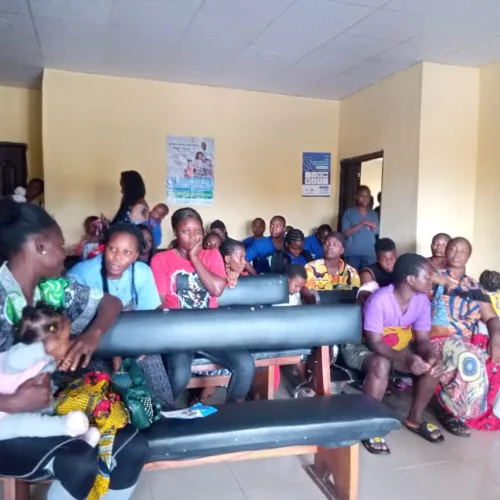
Mrs. Blessing Okaka, Officer-in-charge of Iwogban primary health centre in Ikpoba-Okha Local Government Area of Edo State, sensitizing women on various family planning methods and its benefits.
For 34-year-old Rebecca Odu, choosing a contraceptive method was meant to give her greater control over when to have another child.
Instead, she said her experience with a contraceptive implant left her worried about a number of changes she noticed after adopting the method.

Edo State Commissioner for Health, Dr. Cyril Oshiomhole
Odu shared her experience with this reporter at Ikoha Primary Health Centre in Edo State, where she had gone to have her baby immunised.
She said the implant was inserted about two years ago after health workers presented her with different family-planning options.
Odu said no laboratory test was conducted before the implant was inserted. She subsequently experienced absence of menstrual bleeding for a long time, as well as symptoms including sensations in her hand, numbness in her big toe and changes to her toenail.

At one point, she recalled passing her house without immediately realising she had reached home.
Concerned, Odu said she returned to the facility where the implant had been inserted and was advised to allow her body to adjust.
“I was told it was going to adjust and that I should be patient. But the whole thing was getting worse by the day,” she said.
She eventually had the implant removed and said the symptoms subsequently disappeared.
At the time of the interview, Odu said she was otherwise comfortable with the injectable as she is now considering an intrauterine device, IUD- subject to clinicals.
But her account does not, on its own, establish that the implant caused the symptoms.
What the clinical evidence says
Dr Efoze Aya, a family medicine expert at Care Medical, said there is no single routine laboratory test that every woman must undergo before receiving a contraceptive implant.
Rather, she said eligibility is primarily determined through proper history-taking and clinical assessment.
According to Aya, providers should consider a woman’s reproductive goals, menstrual and pregnancy history, previous contraceptive experiences, medications and relevant medical conditions before insertion.
She said additional laboratory tests should only be requested where clinically indicated.
The expert also explained that changes in menstrual bleeding are among the common effects associated with contraceptive implants, including irregular bleeding, spotting, prolonged bleeding, lighter flow or absence of menstruation.
However, symptoms such as numbness, forgetfulness, vaginal dryness or reduced libido should not automatically be attributed to an implant simply because they began after insertion.
“Temporal association does not necessarily establish causation,” Aya said, stressing that healthcare providers should investigate complaints rather than dismiss them.
She added that improvement after removal of an implant could be clinically relevant but does not, by itself, prove that the device caused the symptoms.
For women experiencing unusually heavy or persistent bleeding, severe pain, dizziness, fainting, severe abdominal pain or other worrying symptoms, she advised prompt medical assessment.
Aya’s intervention provides an important clinical context for Odu’s account while reinforcing a central issue in family-planning care: women need accurate information before choosing a method and professional support when concerns arise afterwards.
A response beyond contraceptive commodities
That need is being addressed through a combination of community mobilisation, provider training, outreach and supportive supervision in Edo State.
Mrs Adja Abieyuwa, Coordinator, Reproductive Health for Family Planning, Edo State Ministry of Health, said the State uses service data to identify areas where family-planning uptake is low or where services require strengthening.
“We don’t just go. But we look at our database, we see the area we need to strengthen,” she said.
The approach involves taking community engagement to places such as markets, churches and rural communities, depending on identified needs.
Abieyuwa said community and women leaders are also involved because cultural beliefs, husbands, religion and other community influences can affect reproductive-health decisions.
The Commissioner for Health, Dr Cyril Adams Oshiomhole, said Edo’s modern contraceptive prevalence rate currently stands at 19.4 per cent.
He identified commodity shortages and inadequate numbers of trained personnel capable of providing long-acting methods among the major challenges to further uptake.
According to him, the government is expanding outreach to hard-to-reach communities and engaging senior secondary school students through peer-to-peer support involving sexual and reproductive health rights ambassadors.
He said the State also works with MSI Nigeria Reproductive Choices and other partners on in-reach, outreach and supportive supervision.
The Commissioner said more than 350 primary healthcare centres currently provide family-planning services across Edo, with services offered free or significantly subsidised.
He further disclosed that more than 90,000 women accessed family-planning services across health facilities in 2025, representing an increase of more than 30 per cent compared with previous years.
In the first quarter of 2026 alone, he said, more than 20,000 women had accessed family-planning services.
Oshiomhole also said family-planning uptake across the State had increased by an average of 25 per cent annually since 2022.
The Commissioner attributed the progress broadly to partnerships, including MSI Nigeria Reproductive Choices as well as the commitment of health workers.
He said the government was also working to domesticate the Task Sharing and Task Shifting policy, which would enable trained senior community health extension workers to provide some long-acting family-planning services.
What is happening at the frontline?
At Iwogban Primary Health Centre in Ikpoba-Okha Local Government Area, Officer-in-Charge Blessing Okaka said demand for family-planning services had increased following provider training, community outreach and other support.
Okaka said the facility recorded as many as 35 family-planning clients in one week, while at other periods attendance ranged between 20 and 30 clients.
She attributed part of the improvement to MSI-supported training, which equipped health workers with counselling tools, including flip charts and technical questions designed to help providers understand clients before recommending methods.
“MSI contributed largely to the increase. The training has helped us to reach the heart of these individuals and understand how to counsel them properly,” she said.
She said the support had also improved the facility’s ability to manage side-effect concerns and refer cases requiring specialised attention.
Some women referred to other facilities, she added, later returned to Iwogban after receiving the required care.
Okaka also cited improved reporting, provision of family-planning consumables and outreach activities as other areas where the partnership had strengthened service delivery.
But she identified misconceptions about side effects as a continuing challenge.
Some first-time users, she said, abandon methods when they experience prolonged bleeding or absence of menstruation because they were not adequately prepared during counselling.
“When they are properly counselled and know the possible side effects, they will not be surprised when they experience them. Instead, they come back to us for assistance,” she said.
The figures from Iwogban provide useful facility-level evidence of increased demand, although they do not establish that MSI training alone caused the increase.
Community mobilisation is also changing demand
At Ikoha Primary Health Centre in Ovia South West Local Government Area, the Officer-in-Charge Ayokunle Yusuf said community mobilisation had also changed the pattern of family-planning demand.
He said the number of women registered for family planning had increased from about five to eight previously to between 30 and 40, while the facility now attends to between 12 and 15 family-planning clients each week.
“People were not so much aware before, but with the mobilisation and support of the community, people are now fully aware,” Yusuf said.
The facility offers implants, injectables and oral contraceptive pills, with clients choosing methods after counselling.
Yusuf said prospective clients undergo appropriate screening, including pregnancy assessment and checks such as blood pressure and HIV status where applicable.
But increased demand has exposed gaps in the facility’s capacity.
Ikoha has no medical doctor or midwife, according to Yusuf, and relies mainly on available community health personnel. The facility also has no ambulance for emergencies.
“When we have any emergency or critical situation, we refer them. We don’t have an ambulance. We use the community motor; we call our driver to help us,” he said.
The situation illustrates an important limitation of the response: increasing demand must be matched by adequate staffing, commodities and referral systems.
MSI’s role
Omeche Enemaku, Regional Manager, South South and South West, MSI Nigeria Reproductive Choices, said the organisation’s approach combines access to accurate information with service delivery.
According to Enemaku, MSI uses healthcare-provider training, community-based services, outreach, social marketing, contact centres and supported facilities to reach women who may face geographical, social or economic barriers.
In Edo, MSI works with the State government on provider training, supportive supervision, outreach and the provision of family-planning commodities and consumables.
Abieyuwa said more than 100 family-planning providers had been trained, while 51 facilities were being supported by MSI.
She said supportive supervision takes place quarterly, with continuous training necessary because trained workers can be transferred and new personnel can join facilities.
The model therefore seeks to strengthen an existing public-health system rather than operate separately from it.
Counselling beyond the health facility
The response also recognises that family-planning decisions are influenced by people outside the clinic.
The Chief Imam of Benin, Sheikh Abdul Fatah Enabulele, said Islam does not oppose family planning when it is used for responsible child spacing and care.
“Islam is not against family planning. It is about how to space your children and how you take care of them,” he said.
He recalled encountering a family in Edo North where misconceptions held by a husband had reportedly influenced opposition to family planning.
For him, engaging men and religious leaders is therefore essential. “It is a continuous process,” he said.
Lady Christina Ijegede, a retired nursing director, midwife educator and a Member of Christian Association of Nigeria (CAN), similarly stressed that family planning should not be treated as a one-method-fits-all service.
“The beauty of family planning is that you have a variety of methods. If this method is not good for you, there is another choice, another opportunity,” she stated.
She urged providers to understand each woman’s circumstances and encouraged partners to participate in the counselling process.
A promising response, but evidence gaps remain
Blessing Iyare, a mother of four from Ikoha community, offers a different account from Odu’s.
Iyare told this reporter at Iwogban Primary Health Centre that she once had limited knowledge of family planning and became pregnant while still nursing a six-month-old child.
For Iyare, family planning was once something she knew little about. She said her limited knowledge affected how she approached pregnancy and child spacing.
At one point, she became pregnant while still nursing a six-month-old baby.
The experience became a turning point in her understanding of the importance of planning pregnancies and spacing children.
She said counselling subsequently changed her understanding of pregnancy spacing and contraceptive choices.
Rather than simply being given a method, she was able to discuss her concerns with health workers, understand available options and learn how family planning could help her determine when to have another child.
The result, she said, has been greater confidence in using family planning.
“I can see the benefits clearly. Since I started using family planning, I have peace of mind,” Iyare said.
Her testimony suggests that sustained counselling can influence a woman’s confidence in using contraception.
The broader evidence shows a response with several interconnected elements: community mobilisation creates demand; trained providers improve counselling; commodities make services available; supportive supervision strengthens implementation; and engagement with men and religious leaders addresses social barriers.
Yet important questions remain unanswered
There is limited evidence in the material available on how many women discontinue methods after experiencing side effects, how many switch to another method, how many return for follow-up and whether trained providers are consistently documenting continuation.
Those measures matter because increased uptake alone does not necessarily mean sustained, informed use.
For Odu, the next decision remains unresolved. She is considering an intrauterine device but wants to know whether it is suitable for her.
Her case now sits within a clearer evidence chain: she needs a trained provider to take her history, assess her circumstances, explain the available options and discuss the benefits, possible side effects and warning signs before she makes another choice.
For Iyare, sustained counselling helped build confidence. For the health system, the challenge is to make that quality of conversation available consistently—before a woman chooses a method, while she uses it and whenever she needs help afterwards.
That is where the success of Edo’s family-planning response is ultimately tested.
Comments
Start the conversation about this story.