





There is a very specific, sacred kind of education that comes from growing up inside a household where a mother’s devotion to Dolly Parton is absolute, unyielding, and daily.

You did not just listen to music as a child, you lived inside an audio biography, an ongoing domestic soundtrack that filled the hallways whether you asked for it or not. Long before you ever understood the complex architectures of heartbreak, professional ambition, or Appalachian folklore, you knew the exact cadence of that high, piercing, crystal-clear soprano.
It was the background music to sweeping the floors, cooking dinner with fresh, natural ingredients on quiet afternoons, and waking up on slow mornings when the rest of the world felt too loud.
Back then, as a child just wanting to hear whatever else the modern world had spinning, you might have occasionally rolled your eyes at the endless rotation of the same voice. But looking back across the landscape of time, you realize something profound and unshakeable: your mother wasn’t just playing songs. She was passing down a masterclass in survival, grace, resilience, and how to remain soft and generous in a world that constantly tries to harden you.
When your mother’s favorite artist becomes the rhythm of your own upbringing, that artist stops being a distant celebrity. They become a member of the family. And so, the news of Dolly Parton’s passing at the age of eighty, following a brief battle with cancer, feels like an anchor cutting loose.
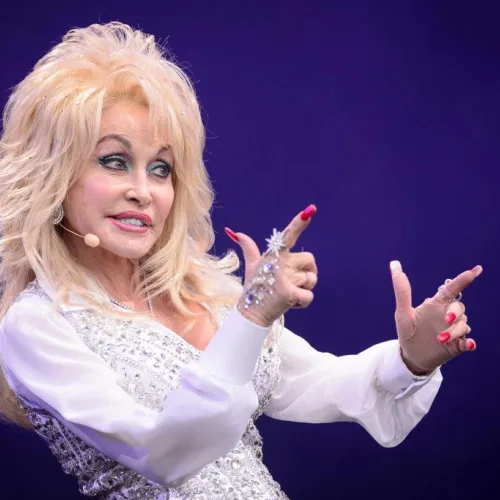
To understand why the world feels so abruptly and profoundly dimmer now, we have to look past the rhinestones, the towering wigs, and the glittering public persona sometimes too colorful to look at especially with the improper fraction with her large boobs and slim body, look directly into the astonishing, six-decade career and the private heart of the woman who built a sanctuary out of song.
Dolly’s career span was nothing short of monumental,stretching more than sixty years from her childhood singing on local East Tennessee radio and television all the way to becoming a cross-genre global titan.
She wrote roughly 3,000 songs and sold over 100 million records, crossing effortlessly from traditional country and bluegrass into pop superstardom. Yet, the numbers only tell half the story.
The real grit of her journey lies in the obstacles she defied. When she first arrived in Nashville as a teenager, record executives tried to pigeonhole her into bubblegum pop, telling her that her high soprano voice wasn’t suited for traditional country music. With characteristic backbone, she refused to fold, eventually proving them all wrong by writing tracks that defined the American songbook.
Behind the microphone, Dolly was a masterclass in contrasts, possessing a razor-sharp business intellect hidden beneath self-deprecating jokes about how “it costs a lot of money to look this cheap.
But her exaggerated look was a deliberate armor,a cartoonish self-awareness that allowed people to underestimate her while she quietly wrote over 3,000 songs, retained ownership of her master recordings, and built a multimillion-dollar empire. While male executives controlled the industry, Dolly quietly executed one of the boldest business moves in music history.
She bought back her own master recordings and fiercely guarded her publishing catalog. She knew precisely what she was worth, famously turning down Elvis Presley when his management demanded half the publishing rights to “I Will Always Love You”. That single “no” preserved her family’s financial security and created the foundation for the “mailbox money” she later used to build her empire, including Dollywood, and fund massive community outreach.
Her personal life was defined by a similar, fierce independence, most notably her legendary, nearly sixty-year marriage to Carl Dean. While Dolly lived under the blinding glare of stadium lights and global cameras, Carl was an intensely private asphalt contractor who famously attended zero major red-carpet events or award shows. Their unconventional romance built on deep mutual trust, humor, and immense space,defied every Hollywood cliché. They never had biological children, a topic Dolly addressed with characteristic candor over the years, noting that while she and Carl had imagined a family early on, not having children ultimately freed her up to dedicate her entire existence to her songwriting, her businesses, and a much larger, global family.
And what a family she claimed. Though she had no children of her own, Dolly’s maternal footprint expanded to encompass millions. Through the Dollywood Foundation’s Imagination Library, founded in honor of her father who could not read, she mailed hundreds of millions of free books to children from birth until school age across the globe.
She also took on mentoring younger artists, most famously serving as the godmother and protective guide to pop star Miley Cyrus, ensuring that young women navigating the brutal machinery of fame had someone who understood the trapdoor of stardom.
The mythology of her catalog is filled with these surreal, deeply human moments. Take “Coat of Many Colors,” a track born from a literal act of maternal survival. Growing up in a one-room cabin in Sevier County as one of twelve children, Dolly’s mother, Avie Lee, had no money for a winter coat. Instead, she meticulously pieced together scraps of colorful rags, whispering the biblical story of Joseph while sewing them. At school, children mocked young Dolly for wearing literal garbage, but she stood tall because her mother had told her the patchwork made her rich. Decades later, Dolly called it her favorite song because it captured the ultimate truth: they were rich in things money could never buy.
Then there was the staggering truth behind “I Will Always Love You,” universally misunderstood as a traditional romantic breakup ballad, when it was actually born out of a moment of immense professional courage. For seven grueling years, Dolly was bound to The Porter Wagoner Show, but she knew she had to break away to find her own wings. When Porter grew furious and blocked every conversation, Dolly went home, picked up her guitar, and wrote a song that communicated what her tongue could not,that even as she walked away, she would carry the gratitude forward. When she sang it across his desk, the hardened mentor wept and let her go.
Even her biggest hits carried hidden histories. The haunting, desperate plea of “Jolene” about a woman begging a stunning red-headed bank teller with striking green eyes to stay away from her husband,did not come from a bitter domestic war.
It was born from a brilliantly absurd moment of pure human connection when an eight-year-old fan named Jolene walked up to her autograph line, and Dolly laughed, promising to immortalize her name. Even her rhythm section had a story rooted in clever improvisation. While starring in her debut film and writing “9 to 5,” she found herself unable to tap her boots to keep time on set, so she clicked her long acrylic fingernails together to simulate the mechanical cadence of a typewriter, creating the iconic heartbeat of the anthem.
Her award shelf overflowed across her lifetime,multiple Grammy Awards 12 to be precise, Country Music Association honors, the Presidential Medal of Freedom, and inductions into every major hall of fame imaginable. Yet, awards were never what drove her. Her true legacy is woven into the fabric of everyday life,in the books delivered to a child’s doorstep, in the quiet resilience of women who learned how to laugh at their own hardships, and in the memories of mothers and children who listened to her voice echo down the hallway
The Imagination Library is her true masterpiece. Through her literacy program, she has mailed well over 200 million free books to children worldwide from the day they are born until they start school. She once remarked that of all the awards she has won,Grammys, medals, and hall-of-fame inductions,she hopes people remember her most for putting books into the hands of children who otherwise wouldn’t have them..
For anyone who grew up captive to their mother’s unending, beautiful devotion to Dolly’s records,hearing those high, crystalline notes floating through every season of childhood,the silence she leaves behind now is deafening. Dolly Parton did not just leave behind a catalog of music, she left behind a blueprint for how to live a large, brave, compassionate life. The music has not stopped playing, it is simply echoing a little louder in our memories now, safe inside the hearts of every mother who played her songs out loud, and every child who learned, whether they knew it at the time or not, what true greatness sounds like.
The post The Soundtrack of Our Lives: A canonical farewell to Dolly Parton my mother’s only artist, by Stephanie Shaakaa appeared first on Vanguard News.
Comments
Start the conversation about this story.