





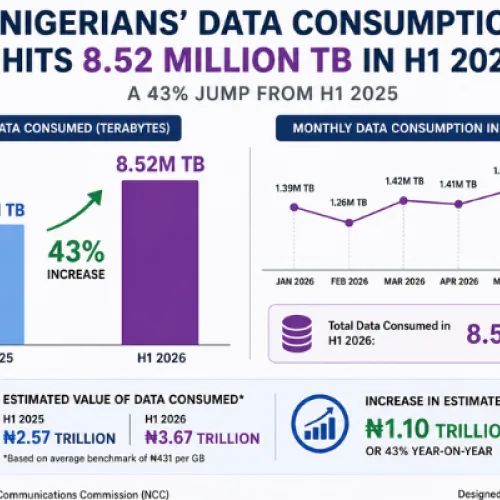
Nigerians consumed an estimated N3.67 trillion worth of internet data in the first half of 2026, representing a 43 percent increase from an estimated N2.57 trillion in the corresponding period of 2025, as rising smartphone adoption, broadband penetration and demand for digital services continue to transform the country’s telecommunications market.
The estimate is based on data consumption figures released by the Nigerian Communications Commission (NCC), which show that Nigerians consumed 8.52 million terabytes (TB) of internet data between January and June 2026, compared with 5.96 million TB in H1 2025.
Read also: NCC, Tax Ombudsman move to tackle multiple taxation in telecoms sector
To arrive at the estimated spending value, the total data consumed was converted from terabytes to gigabytes and multiplied by an average benchmark of N431 per GB. On that basis, the 8.52 million TB consumed in H1 2026 translates to about 8.52 billion GB, which at N431 per GB produces approximately N3.67 trillion.
Applying the same methodology to the 5.96 million TB consumed in H1 2025 gives approximately N2.57 trillion, meaning the implied value of data consumed increased by about N1.10 trillion, or 42.9 percent, year-on-year.
The underlying NCC numbers reveal the extraordinary scale of Nigeria’s transition from a voice-led telecommunications market to one increasingly driven by data.
The regulator’s figures show monthly data consumption rising from 1.39 million TB in January to 1.53 million TB in June 2026, with the latter representing a 46.7 percent increase from the 1.04 million TB recorded in June 2025.
The surge coincided with a broader expansion in connectivity. Nigeria’s broadband subscriptions rose from 115.04 million in January to 123.11 million in June 2026, pushing broadband penetration from 53.07 percent to 56.79 percent during the six-month period.
Total telecommunications subscriptions also climbed from 182.23 million in January to 192.23 million in June, while teledensity increased from 84.06 percent to 88.67 percent.
The technology mix is changing alongside the growth in consumption. The NCC data shows that 4G accounted for 54.31 percent of mobile-generation market share in June, up from 53.41 percent in January. 5G rose from 3.94 percent to 4.61 percent over the same period.
By contrast, 2G’s share fell from 36.97 percent to 36.22 percent, while 3G declined from 5.67 percent to 4.86 percent.
Aminu Maida, executive vice-chairman of the NCC, described the shift as evidence that connectivity has moved beyond being a convenience.
“We have crossed a threshold where internet connectivity is no longer a luxury or a secondary utility. It is now central to how people learn, work, trade, access services and participate in society,” Maida said.
According to him, Nigerians increasingly depend on connectivity for education, employment, financial services, government services, healthcare information, entertainment, entrepreneurship and creative expression.
The NCC chief also argued that the growing demand makes fibre infrastructure and home connectivity increasingly important, particularly as homes become places of work, learning, commerce and entertainment.
That demand is already showing up in operators’ financial results.
MTN Nigeria, the country’s largest mobile operator, reported N1.699 trillion in data revenue in H1 2026, up 38.4 percent from N1.229 trillion a year earlier. The company also recorded a 25.8 percent increase in network data traffic, while average data usage per subscriber rose 15.2 percent to 14.8GB.
Karl Toriola, chief executive officer of MTN Nigeria, said the company’s first-half performance reflected sustained commercial momentum and resilience in demand.
He identified rising data demand, underpenetrated home broadband and accelerating enterprise digitalisation as major structural growth opportunities for the company in the second half of the year.
The acceleration is not limited to MTN. Airtel Africa’s latest results also show data becoming an increasingly important component of telecom revenue. At group level, data revenue rose 27.2 percent in constant-currency terms in the quarter ended June 2026, supported by a 15.5 percent increase in its data customer base and a 10.3 percent increase in data average revenue per user.
Airtel Nigeria’s subscriber base also expanded from 62.04 million in January to 66.12 million in June, according to NCC figures supplied for the period.
Globacom is similarly positioning itself for the data-led market.
At its recent 23rd anniversary event in Lagos, Globacom unveiled its “Never Settle For Less” campaign alongside new products including Magic Data Bundle, an enhanced Welcome Bonus, Talkmasta Reloaded and a revamped Glo Café self-service application.
Uche Ogwuda, representing Globacom at the event, said digital services had become a transformative tool for Nigerians, stressing that telecommunications products can help people pursue their ambitions and improve their lives.
Globacom’s subscriber base increased from 22.46 million in January to 23.68 million in June 2026, according to NCC data.
The rapid rise in data consumption, however, is creating a corresponding infrastructure challenge.
Maida disclosed that the Nigerian telecommunications industry recorded more than 27,685 fibre-cut incidents, over 27,000 access denials and 4,210 theft cases in 2025, warning that protecting telecom infrastructure must be treated as a national responsibility.
The NCC is therefore pushing for stronger protection of telecommunications infrastructure as Critical National Information Infrastructure, while the Federal Government’s Project BRIDGE seeks to deploy approximately 90,000 kilometres of additional fibre across the country, starting October, 2026.
Read also: Middle East tensions, trade wars threaten Ghana’s telecom boom, MTN warns
The scale of the H1 data numbers suggests why that infrastructure expansion is becoming increasingly urgent. With Nigerians consuming more than 8.5 million TB of data in just six months, the country’s challenge is no longer simply getting people online. It is ensuring that networks, fibre infrastructure, power systems and last-mile connections can keep pace with a population that is becoming progressively more dependent on the internet.
In effect, Nigeria’s H1 2026 telecom figures point to a fundamental shift, in that, data is no longer merely another telecom product. It is becoming a major household and business expenditure, while simultaneously emerging as one of the most important engines of the country’s digital economy.
Get Newsletter Updates
Enjoying our column?
Subscribe to our specialised **Tech Pulse** feed to receive fresh reports and analyses directly in your inbox.


Royal Ibeh is a senior journalist with years of experience reporting on Nigeria’s technology and health sectors. She currently covers the Technology and Health beats for BusinessDay newspaper, where she writes in-depth stories on digital innovation, telecom infrastructure, healthcare systems, and public health policies.
Comments
Start the conversation about this story.