





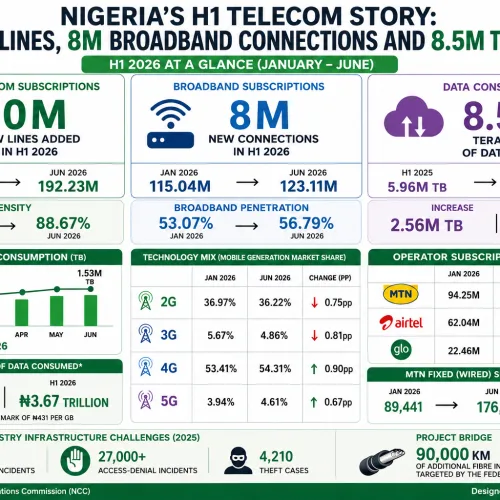
Nigeria’s telecommunications industry recorded a sharp expansion in the first half of 2026, with the country adding about 10 million active telecom subscriptions, more than eight million broadband connections, and consuming 8.52 million terabytes (TB) of internet data, according to data from the Nigerian Communications Commission (NCC).
The figures point to more than a rise in subscriber numbers. They show a fundamental change in how Nigerians connect, communicate and participate in the economy, with broadband and data rapidly becoming more important than traditional voice services.
Read also: Telecoms giant MTN eyes banking licences as it pushes deeper into lending
Total telecom subscriptions increased from 182.23 million in January to 192.23 million in June, representing a gain of approximately 10 million lines in six months. On a year-on-year basis, the June 2026 figure was 20.5 million, or nearly 12 percent, higher than the 171.73 million subscriptions recorded in June 2025.
Teledensity consequently rose from 84.06 percent to 88.67 percent during H1, bringing Nigeria closer to the symbolic 90 percent mark.
But the more significant transformation is occurring beneath the headline subscriber numbers.
Broadband subscriptions climbed from 115.04 million in January to 123.11 million in June, an increase of about 8.07 million connections. Broadband penetration rose from 53.07 percent to 56.79 percent over the same period.
That means roughly 57 out of every 100 Nigerians were represented by broadband subscriptions by June, although subscriptions should not be interpreted as an exact count of unique individuals because one person can hold multiple connections.
The broadband expansion is increasingly being driven by demand for services that require faster and more reliable connectivity, including video streaming, online education, financial technology, cloud applications, social media, e-commerce, remote work and increasingly artificial-intelligence-enabled services.
Aminu Maida, executive vice-chairman of the NCC, captured the change in consumer behaviour by saying that connectivity has moved from convenience to necessity.
According to Maida, Nigerians now depend on internet access for education, jobs, financial services, government services, health information, entertainment, entrepreneurship and creative expression.
The data consumption figures provide perhaps the clearest evidence of this transformation.
Nigerians consumed 8.52 million TB of data between January and June 2026, compared with approximately 5.96 million TB during H1 2025. That represents an increase of about 2.56 million TB, or 42.9 percent, in just one year.
Monthly consumption remained above one million TB throughout the period, rising from 1.39 million TB in January to 1.53 million TB in June.
The financial implication is also significant. Using an average benchmark of N431 per gigabyte, the H1 2026 consumption translates into an estimated N3.67 trillion worth of data, compared with approximately N2.57 trillion in H1 2025.
The estimate is not the same as telecom industry revenue because consumers pay different prices for data depending on operators, bundles, promotions and services. Rather, it provides an indication of the economic value of the enormous quantity of data consumed.
The technology mix is changing alongside the explosion in consumption.
4G accounted for 54.31 percent of mobile-generation market share in June, up from 53.41 percent in January. 5G also increased its share from 3.94 percent to 4.61 percent.
At the same time, 2G declined from 36.97 percent to 36.22 percent, while 3G fell from 5.67 percent to 4.86 percent.
The shift suggests that Nigeria is gradually moving away from networks designed primarily around voice and basic data services toward technologies capable of supporting heavier digital consumption.
Operator numbers reinforce the changing competitive landscape.
MTN Nigeria remained the dominant operator, increasing its subscriber base from 94.25 million in January to 98.64 million in June, putting it within touching distance of 100 million subscribers.
Airtel rose from 62.04 million to 66.12 million, while Globacom increased from 22.46 million to 23.68 million. Together, MTN and Airtel accounted for more than 164 million subscriptions by June.
Globacom is also responding to the changing market with new data-focused products. Its “Never Settle For Less” campaign was accompanied by the launch of Magic Data Bundle, enhanced Talkmasta and Welcome Bonus offerings, as well as an upgraded Glo Café application featuring Gloria, an AI-powered voice and text assistant.
Uche Ogwuda, representing Glo, said digital services had become a transformative tool capable of helping Nigerians pursue their ambitions.
The next frontier, however, is increasingly moving beyond mobile.
MTN’s fixed wired subscriber base rose from 89,441 in January to 176,468 in June, almost doubling within six months. The sharp increase provides early evidence of growing demand for reliable home and office connectivity.
For Maida, this is why Fibre-to-the-Home (FTTH) has become critical. As homes increasingly double as offices, classrooms, businesses and entertainment centres, mobile broadband alone may not be sufficient to meet future demand.
Yet the infrastructure required to support this growth remains vulnerable.
The NCC recorded more than 27,685 fibre cuts, over 27,000 access-denial incidents and 4,210 theft cases across the industry in 2025.
This makes the Federal Government’s Project BRIDGE, which targets approximately 90,000 kilometres of additional fibre infrastructure, strategically important. The national backbone must ultimately be complemented by last-mile connections into homes, businesses, schools and hospitals.
Nigeria’s H1 telecom figures therefore tell a story bigger than subscriber growth.
Read also: FG to deploy 3,700 telecom towers from October to connect 20m Nigerians
The country is becoming more connected, but more importantly, Nigerians are becoming more dependent on connectivity. The 10 million new lines show expansion of access; the additional eight million broadband subscriptions show migration toward higher-speed connectivity; and the 8.52 million TB of data consumed shows how deeply the internet is becoming embedded in everyday economic and social life.
The challenge for the second half of 2026 is therefore no longer simply to connect Nigerians. It is to ensure that the infrastructure, spectrum, fibre networks, power systems and investment required to support their rapidly expanding digital appetite can keep pace.
Get Newsletter Updates
Enjoying our column?
Subscribe to our specialised **Tech Pulse** feed to receive fresh reports and analyses directly in your inbox.


Royal Ibeh is a senior journalist with years of experience reporting on Nigeria’s technology and health sectors. She currently covers the Technology and Health beats for BusinessDay newspaper, where she writes in-depth stories on digital innovation, telecom infrastructure, healthcare systems, and public health policies.
Comments
Start the conversation about this story.