





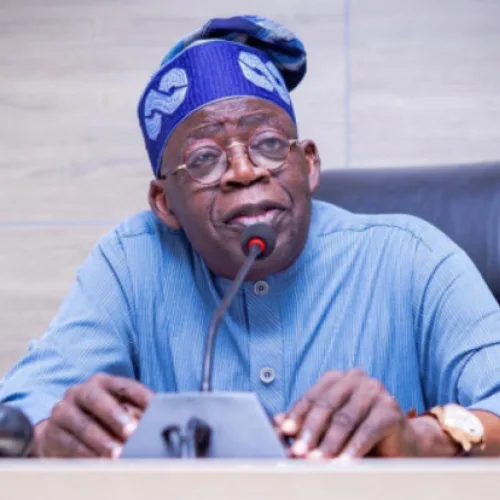
President Bola Tinubu has asked a United States federal court to block the release of unredacted records held by the Federal Bureau of Investigation and the Drug Enforcement Administration relating to him.
In filings published on Saturday, his lawyers argued the records are protected under US privacy laws and that disclosure would not serve any legitimate public interest under American freedom-of-information laws.
The filings were made by Christopher Carmichael, Victor Henderson and Oluwole Afolabi on behalf of the President. They were responding to a request by US transparency activist Aaron Greenspan.
Tinubu’s reasons for blocking the records
Tinubu’s legal team said the US Freedom of Information Act and the Privacy Act restrict disclosure of personal information in federal law-enforcement files.
They cited FOIA Exemption 7(C), which protects personal information in law-enforcement records where release could constitute an unwarranted invasion of privacy.
The lawyers argued that Tinubu’s status as President of Nigeria does not strip him of privacy rights under US law.
They said Greenspan’s request is driven by political interests in Nigeria and seeks private information about the President because of his office.
They cited the 1989 US Supreme Court decision in Department of Justice v. Reporters Committee for Freedom of the Press, which held that FOIA is meant to shed light on government activities, not to provide information about private individuals.
Releasing records simply because they contain Tinubu’s name, they argued, would improperly turn FOIA into a tool for investigating individuals.
The legal team also rejected suggestions that the files could reveal a secret prosecution, an undisclosed investigation or a non-prosecution agreement, describing such claims as speculative and unsupported.
The records in dispute
The dispute traces back more than three decades and has featured repeatedly in Nigerian politics.
During the 2023 presidential election, attention returned to a 1993 US civil forfeiture case involving $460,000 in an account linked to Tinubu. US authorities alleged the funds were proceeds of narcotics trafficking or prohibited financial transactions. The money was later forfeited.
Tinubu’s camp has consistently maintained the matter was a civil forfeiture and did not result in a criminal conviction.
The issue was raised at the Presidential Election Petition Court, where the Labour Party and its candidate Peter Obi argued the forfeiture affected Tinubu’s eligibility.
In September 2023, the court ruled the petitioners had not established that Tinubu was arrested, arraigned, convicted or sentenced for a criminal offence in the United States.
Greenspan is seeking the full FBI file on Tinubu, including FBI Form 302 interview records from 1992 and 1993. He argues disclosure is in the public interest because Tinubu is Nigeria’s sitting President.
In April 2025, US District Judge Beryl Howell ordered the FBI and DEA to move beyond their earlier “Glomar” responses — where agencies neither confirm nor deny the existence of records — and to process the requests subject to lawful exemptions.
The agencies have since sought to withhold parts of the files, citing exemptions covering law-enforcement information, personal privacy, investigative techniques and safety of persons linked to investigations.
Tinubu’s lawyers are now asking the court to uphold those protections and block release of unredacted records.
The FOIA case itself does not establish that Tinubu committed a criminal offence or was prosecuted for drug trafficking. It is not a criminal case against the President.
Opposition reacts
The filings have renewed calls from opposition parties for full disclosure.
The African Democratic Congress said the President should support release if he has nothing to hide.
Its spokesman, Bolaji Abdullahi, said voluntarily backing disclosure could end the long-running controversy and protect both the President’s reputation and Nigeria’s image.
The Nigeria Democratic Congress also called for disclosure. Its National Publicity Secretary, Osa Director, said Nigerians have a legitimate interest in resolving questions about the President’s past and that the possibility of political opponents benefiting from the information is not grounds to withhold it.


Comments
Start the conversation about this story.