





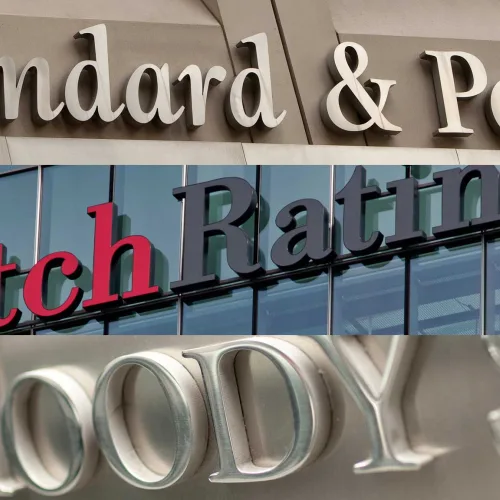
Global credit rating firms are deepening their bet on Africa by acquiring some of the continent’s leading domestic ratings agencies, just as African policymakers prepare to launch the continent’s first homegrown credit rating agency in a move that could reshape how global investors assess African sovereigns and companies.
S&P Global’s acquisition of Nigeria’s Agusto & Co., following Moody’s purchases of Global Credit Ratings (GCR), West Africa Rating Agency (WARA) and Egypt’s Middle East Ratings and Investors Service (MERIS), signals that international rating firms increasingly view local expertise as a competitive advantage rather than something that can be replicated from London or New York.
The acquisitions come as African governments rely more heavily on domestic debt markets to finance infrastructure and budget deficits, while private companies increasingly tap local capital markets for long-term funding.
At the same time, criticism of global rating methodologies has intensified, with African leaders arguing that sovereign ratings often fail to reflect the continent’s economic realities, inflating borrowing costs.
Local expertise takes centre stage
For years, African policymakers argued that assessing the continent remotely overlooked critical political, institutional and market dynamics. The latest acquisitions shows global firms now recognise the value of being closer to the markets they rate.
“These transactions are to strengthen their domestic ratings presence in Africa,” said Misheck Mutize, lead country expert at the African Peer Review Mechanism (APRM) on Linkedin. “But for several years, we have argued that rating Africa remotely limits analysts’ ability to fully appreciate local realities, institutions and market dynamics. The dominant response was that global methodologies and remote analysts were sufficient.”
Mutize said the acquisitions validate longstanding concerns that proximity matters in credit analysis.
“Risk assessments are not produced by algorithms alone; they are strengthened by local knowledge, continuous engagement with issuers, constant access to decision-makers and a deep understanding of domestic political, economic and institutional realities. The closer analysts are to the markets they assess, the better informed and more accurate their opinions can be.”
His comments follow debate on social media over whether the acquisitions undermine the long-held argument that global methodologies alone are sufficient to assess African credit risk.
Africa becomes the industry’s next growth frontier
Africa’s growing economic importance is also making the world’s most populous black nation harder for global ratings firms to ignore. Despite a wave of downward revisions to global growth forecasts triggered by the conflict in the Middle East and broader geopolitical uncertainty, Africa continues to dominate the list of the world’s fastest-growing economies.
The International Monetary Fund (IMF), in its April 2026 World Economic Outlook, projects that Ethiopia, Guinea, Uganda, Rwanda, Benin and Côte d’Ivoire will rank among the world’s fastest-growing economies this year, reinforcing the continent’s long-term appeal to investors and financial institutions. As sovereign borrowing, corporate debt issuance and domestic capital markets expand, global ratings firms are positioning themselves closer to issuers, regulators and investors.
An Agusto & Co. analyst, who requested anonymity, said to BusinessDay that the continent has become one of the few remaining expansion opportunities for global ratings firms.
“Most global rating agencies already have a strong presence in Europe and much of Asia. Africa remains one of the last major growth frontiers, although the ratings market is still underdeveloped in many countries. Outside South Africa, Nigeria is probably the most advanced market, but across much of the continent, credit ratings are not yet widely used.”
According to the analyst, acquiring established African agencies provides immediate access to local relationships, regulatory knowledge and market intelligence.
“If these firms want to drive growth, Africa is where the opportunity lies. Acquiring local agencies helps them better understand the continent’s unique characteristics and market dynamics.”
“For the acquirers, these deals broaden their market base and strengthen their methodologies. Having an on-the-ground presence allows them to better understand the nuances of African economies and incorporate those insights into their credit assessments.”
The analyst said the transactions also diversify revenues away from mature markets while giving African firms access to decades of global expertise.
“For the African rating agencies, the benefits include access to decades of global experience, stronger analytical capabilities, international best practices and wider distribution networks.It also gives African agencies greater exposure to international markets and how global investors assess credit risk. In my view, it is a symbiotic relationship where both sides stand to benefit.”
Strategic expansion
For S&P Global, acquiring Agusto provides immediate access to one of Africa’s most established domestic credit assessment platforms, strengthening its presence in local capital markets.
“We are delighted to partner with Agusto & Co. to strengthen our domestic ratings presence across Africa,” said Yann Le Pallec, president of S&P Global Ratings in a statement.
He said combining S&P’s international analytical capabilities with Agusto’s regional expertise would improve transparency, strengthen local credit markets and enhance investor confidence.
Moody’s completed the full acquisition of GCR in July 2024 after first buying a majority stake in 2022, significantly expanding its footprint across Africa’s domestic credit markets.
According to a United Nations Development Programme (UNDP) report, GCR’s presence across South Africa, Kenya, Mauritius, Senegal and Nigeria gives Moody’s deeper access to local issuers, regulators and market intelligence across more than 20 African countries.
Africa’s response
The expansion of global firms comes as Africa prepares to establish its own continental ratings institution.
During an interview with CNBC Africa on Wednesday, Mutize revealed that the African Credit Rating Agency (AfCRA) will launch in Mauritius in October as an independent, private sector-led institution offering sovereign and corporate ratings based on African market realities.
“It means a new dimension has come. We are seeing more confidence in Africa because the investors who are investing in this are private,” he said.
He added that AfCRA will operate without government shareholding, reinforcing its independence and commercial orientation.
The agency follows years of criticism from African governments that global rating methodologies overstate political and institutional risks, contributing to what policymakers describe as an “Africa premium.”
In a Financial Times opinion article published in February, Nigerian President Bola Tinubu renewed calls for an African-owned credit rating agency, arguing that the continent continues to pay an unjustifiably high premium to access international capital markets.
Tinubu cited a 2023 UNDP report estimating that rating inefficiencies cost African economies about $75 billion annually through higher borrowing costs and missed financing opportunities.
The debate has been reinforced by divergent assessments of African issuers. Over the past year, Fitch downgraded Afreximbank to BB+ before withdrawing its rating after the bank ended its mandate, while S&P later assigned the lender an investment-grade BBB+ rating. Similar differences have emerged in assessments of the African Finance Corporation and Kenya’s sovereign credit profile.
Debate continues
Not everyone believes the acquisitions represent a fundamental shift in global rating methodologies.
“In my opinion, the acquisition of African agencies by the global credit rating agencies should be viewed as attempts to be more effective in local capital markets and ultimately capturing clients that cannot access global capital markets,” said Matt Pirnie, an Africa credit expert.
He said the deals should not be interpreted as an admission that offshore analysts are incapable of assigning accurate global-scale ratings.
Sovereign credit strategist Sophie-Aurore de Saint-Marcq also cautioned against drawing that conclusion.
“Going on-site is obviously necessary, but I don’t think remote work is any less efficient. Moreover, analysts are generally not assigned to assess their own country to avoid potential bias,” she said.
She added that greater visibility for alternative approaches to measuring African creditworthiness would strengthen investor understanding of the continent while allowing established firms to deepen their presence in one of the world’s fastest-growing capital markets.
Bunmi holds a degree in Economics from the University of Lagos and has over eight years of experience in content writing and journalism. Her career spans roles as a financial and business journalist at BusinessDay Media and TechCabal, and as Head of Research at SBM Intelligence, an Africa-focused market intelligence and strategic consulting firm. She also served as Editor at Finance in Africa, a subsidiary of Businessfront and is currently Assistant Editor, Finance (Africa), at BusinessDay.

Comments
Start the conversation about this story.