





Nigeria’s broad money supply growth slowed to 13.65 percent year-on-year in June 2026, as the Central Bank of Nigeria’s tight monetary policy stance continued to curb the pace of liquidity expansion in the economy.
Data provided by the Central Bank showed that M3, a broad measure of money supply, rose to N133.25 trillion in June 2026 from N117.25 trillion a year earlier. Although the stock of money reached a new high, its annual growth rate moderated from 15.56 percent in June 2025.
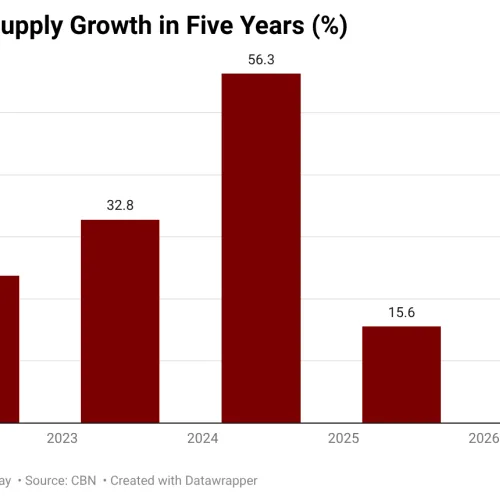
The latest slowdown extends a trend that emerged after the sharp expansion recorded in 2024. M3 grew by 56.31 percent year-on-year to N101.46 trillion in June 2024, before growth slowed to 15.56 percent in June 2025 and 13.65 percent in June 2026.
Over the five-year period, broad money supply increased by 172.55 percent, rising from N48.89 trillion in June 2022 to N133.25 trillion in June 2026. The figures indicate that while liquidity has continued to expand, the pace of monetary expansion has moderated significantly.
Oyinpereye Forcados, fixed income broker at Parthian Partners, attributed the slower growth in money supply to the CBN’s largely orthodox monetary policy stance and its focus on containing inflationary pressures.
He said the current CBN administration inherited several monetary policy bottlenecks from the previous administration and had since focused on addressing issues within the banking system and broader monetary policy framework.
According to Forcados, the prolonged period of monetary tightening has been a key factor behind the slower growth in money supply through June 2026.
“The CRR, for instance, was raised from 32.5 percent in 2023 to around 50 percent before being reduced to 45 percent in 2026,” he said, adding that the monetary policy rate also increased from 18.5 percent in May 2023 to 26.5 percent as of June 2026.
The combination of higher cash reserve requirements and elevated policy rates has helped reduce excess liquidity in the banking system and slowed the pace of monetary expansion, he said.
The moderation in money supply growth has also helped ease demand-pull inflationary pressures, with recent price pressures driven largely by the pass-through effects of global shocks rather than domestic bottlenecks, Forcados said.
He added that the slower growth in money supply gives policymakers room to pause further rate hikes and assess the impact of the existing monetary policy stance on the broader economy.
However, despite the moderation, Forcados said liquidity remains elevated relative to the size of the economy.
“With a broad money supply above N133 trillion and still growing by over 12 percent year-on-year, liquidity still remains high for an economy growing below four percent annually,” he said.
The moderation in M3 growth has occurred alongside continued expansion in private sector credit, highlighting a shift in the composition of bank lending.
Private sector credit rose to N83.26 trillion in June 2026 from N76.13 trillion a year earlier, representing a 9.37 percent year-on-year increase. This was faster than the 4.02 percent growth recorded in June 2025, although significantly below the 38.59 percent and 34.62 percent growth rates recorded in June 2024 and June 2023 respectively.
Private sector credit has more than doubled over the five-year period, rising from N32.63 trillion in June 2021 to N83.26 trillion in June 2026, representing a cumulative increase of 155.16 percent.
Forcados said the stronger growth in private sector credit, despite the tight monetary policy environment, was partly linked to developments in government borrowing.
“Ideally, the CBN’s overall policy stance should be driving private sector credit growth lower. However, what we have observed, particularly this year, is that while FG borrowing has continued, outstanding bank credit to the government declined slightly between May and June as the FG shifted towards other domestic funding sources through increased DMO securities issuance,” he said.
He said this had been a key reason private sector credit growth outpaced government borrowing.
Muda Yusuf, chief executive officer of the Centre for the Promotion of Private Enterprise, attributed the growth in private sector credit partly to improving investor confidence in the Nigerian economy.
He said exchange-rate stability, improving GDP growth, stronger capital-market performance and positive trade balances were among the factors supporting the improvement in economic sentiment.
“These are indicators that also attract private sector investment. And investment grows with private sector credit,” Yusuf said.
He noted that the increased interest of portfolio and foreign direct investors was also having a positive effect on domestic investors, potentially supporting increased demand for credit.
On the moderation in money supply growth, Yusuf said the trend reflected the impact of the CBN’s tight monetary policy regime.
“The whole idea is to moderate money supply,” he said, pointing to the cash reserve requirement, monetary policy rate and asymmetric corridor as measures intended to contain liquidity growth.
Hope Moses-Ashike is an Associate Editor, Banking and Finance, with more than a decade of experience reporting on Nigeria’s financial system and broader economy. She closely tracks market movements, monetary policy decisions, company disclosures, regulatory actions, economic indicators, and global developments, and interprets what they mean for businesses, investors, policymakers, and households. Her reporting helps readers understand complex issues such as inflation trends, foreign exchange market dynamics, interest rate decisions, bank performance, and investment risks. She also covers major international events and periodically travels to Washington, D.C., to report on the World Bank/IMF Spring and Annual Meetings. Her dedication to financial journalism has earned her multiple recognitions and invitations to high-level professional development programmes. She is an alumna of the International Visitors Leadership Programme (IVLP) in the United States and holds an Advanced Financial Journalism Certificate from the Press Association Training in London, UK. Her other notable achievements include completing the Lagos Business School CMC Programme, the Bloomberg Media Africa Initiative Programme, and a Master Class in Journalism at Rhodes University in South Africa.

Comments
Start the conversation about this story.