





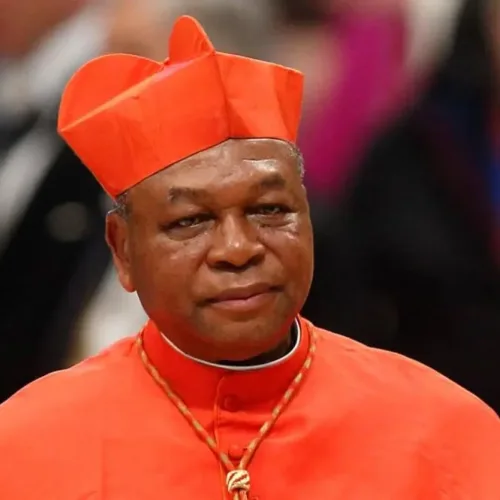
The Presidency has again criticised Archbishop Emeritus John Cardinal Onaiyekan over remarks attributed to him during his appearance on Arise TV’s Prime Time programme last Friday.
During the interview, the cleric said President Bola Tinubu had rebuffed observations by the Catholic Bishops’ Conference of Nigeria (CBCN) concerning the state of the economy and insecurity in the country during their recent meeting with him at the State House.
In a fresh statement issued on Sunday, the Presidency maintained its criticism of Onaiyekan, accusing him of acting “as a proxy for opposition political elements”.
Sunday Dare, Special Adviser to the President on Media and Public Communications, in a statement entitled, “When the Cassock Abandons the Pulpit: The Bishops’ Partisan Mirage and Opposition Echoes”, alleged that Archbishop Onaiyekan acted in bad faith when he appeared on television to discuss what transpired during the meeting between President Tinubu and the Catholic Bishops’ Conference of Nigeria, led by Most Rev. Matthew Ndagoso.
“The nation anticipated a holy synod offering profound spiritual counsel, constructive statesmanship and puritanical guidance to a leader steering a complex nation away from structural ruin.
“Instead, what unfolded — and what Cardinal Onaiyekan subsequently magnified across television screens — was a disappointing spectacle of partisan posturing, cynical broadsides and unpatriotic outbursts.
“By abandoning the sacred detachment required of their revered offices to act as proxies for opposition political elements, the prelates delivered a performance that was as superficial as it was banal.
“The cassock does not desert its wearer simply because he challenges the king.
“It begins to lose its unique moral force when conviction overtakes balance, when measured judgement yields to partisanship, and when personal sentiment, longstanding disagreement or visible sympathy begins to cloud the discipline that the episcopal office requires.
“The authority of the cassock has always rested on the perception that its wearer speaks above political passions, not from within them. In this instance, we see partisanship.
“Nigeria benefits when respected clerics contribute to national debate. But their greatest influence comes not from taking political sides; it comes from remaining trusted moral voices whose authority rises above partisan contest.”
Dare, who reeled out the achievements of President Tinubu’s administration over the past three years, expressed dissatisfaction that Cardinal Onaiyekan had glossed over the challenges inherited from the administration of the late President Muhammadu Buhari.
“To reduce President Bola Ahmed Tinubu’s monumental, multi-sectoral transformation agenda to a narrative of failure is not merely an act of intellectual dishonesty; it is a scathingly uncharitable assault on a patriotic leader who inherited a crumbling, bankrupt estate in May 2023 and possessed the rare political courage to rebuild it from the foundation up.
“To understand the weight of President Tinubu’s achievements, one must first measure the abyss Nigeria faced on the eve of his inauguration. In May 2023, the Nigerian nation was hovering on the precipice of total economic collapse and structural paralysis.
“The unsustainable petrol subsidy regime was draining trillions of naira from the national treasury monthly, enriching a parasitic cabal of smugglers and middlemen while starving subnational governments of funding for basic infrastructure.
“A fraudulent, multi-tiered foreign exchange system had turned the Central Bank of Nigeria into an arbitrage engine, crippling legitimate manufacturing, discouraging foreign direct investment and depleting scarce external reserves.
“The nation’s debt-service-to-revenue ratio had spiralled to an unsustainable 97 per cent, meaning Nigeria was literally borrowing money to pay interest on past loans while governance operated on fiscal fumes.
“This was the broken and bleeding nation handed over to President Tinubu. It required bold surgery, not diplomatic sedation. Yet, when the President applied the sharp scalpel of structural reform, armchair critics and political opponents decried the incision while ignoring the terminal tumour it removed.”
“The Catholic Bishops’ Conference of Nigeria and Archbishop Emeritus John Onaiyekan possess a historic duty to serve as unifiers, moral anchors and partners in national rebirth.
“By choosing instead to echo opposition talking points, downplay tangible national progress and reduce complex economic restructuring to simplistic slogans, they diminish their own moral standing.”
Comments
Start the conversation about this story.