





- Advertisement -
Warning that the world has entered “uncharted territory,” United Nations Secretary-General, António Guterres, delivered a stark assessment of the accelerating global climate emergency on Friday, warning that record-breaking summer temperatures, devastating wildfires, and ocean heating are merely a prelude to worse conditions ahead.
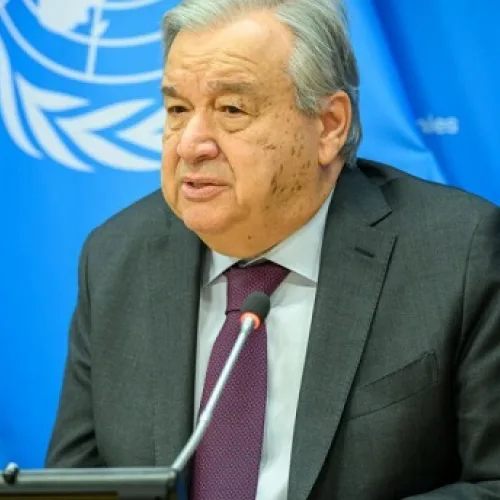
Addressing journalists at UN headquarters on July 31, 2026, Guterres revealed alarming new seasonal forecasts from the World Meteorological Organisation (WMO), pointing to an intensifying El Niño event that threatens to shatter seasonal heat records across nearly every landmass on Earth through October.
“Two months ago, I warned that El Niño was arriving on our doorstep. Now it is inside the house – and turning up the heat,” Guterres said. “According to the latest science, this is only a warm-up act.”
Pacific Ocean Warms at Unprecedented Rate
The WMO’s latest outlook indicates that key ocean monitoring regions are averaging nearly 3 degrees Celsius above normal – a level of early-season warming never previously recorded. Combined with record-high global sea-surface temperatures observed in June and July, the phenomenon is expected to drive hotter-than-normal conditions across virtually all terrestrial regions over the next three months.
The consequences extend beyond temperature spikes. Guterres highlighted severe disruptions to global precipitation patterns, pointing specifically to India’s monsoon season, which is already running significantly below average. Hotter, drier conditions are simultaneously projected for:
- Central America and the Caribbean
- Parts of South America and South Asia
- The Southwest Pacific
- Large swathes of Europe and Africa
“The verdict is clear: the climate crisis is in overdrive,” Guterres stated.
The Hidden Toll of the ‘Silent Killer’
Guterres stressed that extreme heat remains a vastly understated global threat. Because fatalities directly linked to heat stroke, cardiovascular failure, and respiratory distress are frequently unrecorded or attributed to underlying conditions, official death tolls represent only a fraction of the actual casualties.
Beyond loss of life, the Secretary-General outlined how extreme heat acts as an economic and social multiplier of inequality, threatening global workforce productivity and straining vital infrastructure.
Sector / DomainPrimary Impacts Highlighted by the UNWorkforce & LaborBillions exposed to dangerous working conditions; loss of income during enforced stops.Public HealthSurge in heat-related illness; severe risk to children, older persons, and disabled individuals.Critical InfrastructureBuckling roads, failing railway lines, and overloaded power grids and hospitals.Supply Chains & FoodDisrupted logistics networks and escalating food prices deepening global hunger.“Behind all of the numbers are people,” Guterres remarked. “Workers forced to choose between their health and their income. Children unable to learn. Entire cities struggling to function.”
A Four-Point Call to Action
While acknowledging progress since the launch of the UN Call to Action on Extreme Heat two years ago – including over 250 cities joining the Beat the Heat initiative – Guterres warned that “the planet is heating faster than our response.”
To bridge the gap, the UN chief outlined a four-pillar framework requiring immediate, government-wide coordination:
1. Protect Vulnerable Populations
Governments must roll out heat-health action plans, expanding early warning coverage and rapidly scaling up equitable, sustainable cooling infrastructure.
2. Implement Worker Protections
Highlighting sectors like the global garment industry – where 90 million workers face sharp spikes in dangerous heat days – Guterres called for mandatory heat standards, flexible working schedules, and guaranteed income protection when conditions force work to halt.
3. Build Climate-Resilient Urban Spaces
Urban planning, housing projects, schools, and health facilities must be retrofitted or newly built specifically to withstand extreme heat scenarios.
4. End the Subsidisation of Fossil Fuels
Framing fossil fuel consumption as the ultimate driver of climate instability, energy insecurity, and geopolitical volatility, Guterres criticised governments planning to produce more than double the fossil fuels allowed under the 1.5-degree Paris Agreement threshold by 2030.
‘We Cannot Afford to Wait’
Concluding his press briefing, Guterres urged world leaders to stop viewing heatwaves and wildfires as isolated tragedies, demanding an immediate pivot away from fossil fuel expansion and subsidies.
“We are spending too much public money fuelling the crisis – and too little protecting the people from it,” Guterres declared. “The warm-up act is over. We cannot afford to wait for the main event.”
Comments
Start the conversation about this story.