





- Advertisement -
West Africa’s coastline is a mosaic of ecological riches comprising mangroves, estuaries, lagoons, seagrass beds, and nutrient-rich upwelling zones. These ecosystems sustain fisheries, protect shorelines, store carbon, and underpin the livelihoods of millions. Yet they are under siege from rapid urbanisation, port expansion, extractive industries, overfishing, pollution, and climate change impacts.
Clearly, the issue is no longer whether these ecosystems matter, but whether the various countries and people can act in time to save them. This was focus of the Regional Workshop on Marine and Coastal Other Effective Area-Based Conservation Measures (OECMs) held in Accra from July 28 to 31, 2026.
IUCN convened the workshop in collaboration with Ghana’s Ministry of Fisheries and Aquaculture Development, and support from the European Union (EU). It brought together government representatives of some of the 13 West African coastal countries, some partner organisations and a private sector, specifically the West African Gas Pipeline Company Limited to forge a collective path toward the Global 30×30 Target. This is the commitment to conserve 30 percent of the world’s land and oceans by 2030. It is captured as Target 3 of the Kunming–Montreal Global Biodiversity Framework (the “30×30” target) under the Convention on Biological Diversity (CBD).
Why the OECMs Approach
The regional dialogue was purposely to promote a common and operational understanding of OECMs and support their recognition and integration into public policies. It was further to explore complementary effective conservation mechanisms appropriate to West African realities as well as define harmonized approaches for monitoring contributions to the 30×30 target.
This focus was informed by the fact that conservation experts now appreciate OECMs as providing a way to bridge local realities with global commitments, expanding conservation coverage without creating new protected areas.
The relevance of this measure is that while Marine Protected Areas (MPAs) are essential, they remain insufficient and unevenly distributed. Besides, many community-led initiatives including regulated fishing zones, sacred groves, and spatial restrictions tied to infrastructure already deliver conservation outcomes but lack formal recognition. Moreover, the OECM approach to conservation is a recognition that communities have long been custodians of biodiversity, and that their practices deserve a place in national and international frameworks.
Voices from the Opening Session
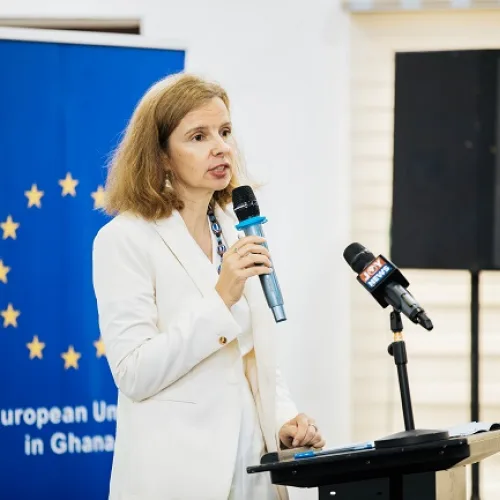
The workshop opened with strong messages from international and national partners. In her keynote address, Paulina Rozycka, Head of Section for Infrastructure and Sustainable Development of the EU Delegation to Ghana, underscored Europe’s commitment. “The success of this workshop should be measured not only by discussion, but by the partnerships, sites, tools and decisions that follow from it.”
She announced a €59 million investment in sustainable ocean governance across the 13 West African countries under the West Africa Sustainable Ocean Programme (WASOP), with €17 million dedicated to marine ecosystem protection through IUCN.
Madam Rozycka commended Ghana for declaring the Greater Cape Three Points Marine Protected Area in April 2026, calling it crucial for restoring collapsing small pelagic fish stocks. Yet she cautioned that effective protection must address threats such as gold mining and pollution.
Her remarks framed OECMs as a “practical and strategic opportunity” to recognise areas already delivering conservation outcomes, including community-managed zones and fisheries measures. She strongly supported the proposed transboundary OECM initiative involving Ghana, Togo, Benin, and Nigeria, emphasizing that shared monitoring mechanisms and stronger data systems are essential for credible progress.
In her statement, read on her behalf, the Minister of Fisheries and Aquaculture Development, Emelia Arthur, emphasised the national stakes. “Our oceans sustain life and livelihoods across West Africa. Protecting them requires cooperation beyond borders, and policies that go beyond fisheries to address pollution, resilience and the wellbeing of our communities.”
She reaffirmed Ghana’s commitment to the 30×30 target and highlighted the Greater Cape Three Points MPA as a milestone. Yet Madam Arthur stressed that conservation must extend beyond fisheries management to tackle pollution and ecosystem resilience. Importantly, she called for recognition of community-led initiatives and traditional practices, urging that conservation strategies respect local rights and socio-economic realities.
Welcoming participants, Mrs. Dorcas Owusuaa Agyei of IUCN Ghana, highlighted the unifying power of the Atlantic Ocean. “Although we come from different countries and institutions, we are united by one ocean. Fish stocks move across borders, mangroves protect shared coastlines, and the impacts of climate change affect us all.”
She stressed that achieving the 30×30 target requires more than expanding MPAs. It requires recognizing and strengthening places where biodiversity is already conserved through sustainable management and good governance.
Mrs. Agyei showcased IUCN’s internationally recognised WCPA OECM Guidance and the Site-level Tool for Identifying OECMs, as helping countries assess and recognise OECMs using global standards while respecting local knowledge.
She highlighted Platforms like the West African Biodiversity and Protected Areas Observatory (OBAPAO) as crucial for monitoring and knowledge sharing. Thus, IUCN’s greatest contribution lies not only in tools but in building the capacity of countries to use them effectively.
Capacity building, Case studies group work
The dialogue session commenced with Daniel Marnewick of IUCN East and Southern Africa presenting a Global overview of biodiversity, Marine & Coastal Biodiversity, and Introduction to OECMs. While Elise Belle of UN Environment Programme World Conservation Monitoring Centre (UNEP-WCMC) presented on OECM Identification and Assessment Tools. They also led the ensuing discussions.
Over the four days, participants engaged in capacity building, case studies, and group work. Country teams identified potential OECM sites including mangroves, fisheries zones, and community-managed areas, and mapped stakeholders. Teams from Ghana, Togo, Benin and Nigeria examined the possibility of establishing OECMs along the coastal stretch linking the four countries where the West African Gas Pipeline corridor is located, with a potential to link conservation to infrastructure governance.
Regional stakeholders assessed the OBAPAO Monitoring Framework, exploring how to strengthen data systems for tracking progress toward 30×30. By the final day, plenary sessions validated national and regional roadmaps, outlining priority actions, timelines, and budgets.
The workshop delivered: a harmonised understanding of OECM criteria and identification processes, preliminary mapping of OECM opportunities across the sub-region, made recommendations for integrating OECMs into National Biodiversity Strategies and Action Plans (NBSAPs), made committment to strengthen OBAPAO’s monitoring system and validated regional roadmap for OECM recognition and monitoring.
The Regional Action anchored in WASOP3
The Accra workshop is firmly embedded in Pillar3 of the West Africa Sustainable Ocean Programme (WASOP3), funded by the EU and implemented by IUCN. This pillar focuses on protecting and restoring marine and coastal ecosystems across the 13 West African coastal countries, from Benin and Cabo Verde to Nigeria, Ghana and Senegal.
WASOP3 promotes an integrated seascape approach, reconciling biodiversity conservation with economic uses and governance across multiple scales. Its priorities include strengthening scientific knowledge, improving the management of Marine Protected Areas, diversifying conservation instruments, and supporting local initiatives. Through them all advancing countries’ commitments under the Kunming–Montreal Global Biodiversity Framework’s 30×30 target.
Within this vision, OECMs are a strategic lever. They expand conservation coverage by recognising places and practices that safeguard biodiversity outside formal protected areas. WASOP3 places particular emphasis on integrating OECMs into national and regional strategies, aligning them with fisheries and blue economy policies, and ensuring they contribute meaningfully to monitoring progress toward 30×30.
The Accra workshop gave practical expression to these priorities. By promoting a shared understanding of OECMs, supporting their integration into public policies, and defining harmonised monitoring approaches, the meeting strengthened the regional network of conservation areas and consolidated multi-stakeholder collaboration. In essence, it demonstrated how WASOP3 is turning global commitments into regional action and local impact.
By Ama Kudom-Agyemang
Comments
Start the conversation about this story.