





Nigeria’s campaign at the Glasgow 2026 Commonwealth Games has delivered a solid if not spectacular medal haul, underscoring both enduring strengths and structural gaps in the country’s multi-sport programme.
With the Games wrapping up on 2 August 2026, Team Nigeria sits sixth on the official medal table with 10 gold, 7 silver and 7 bronze for a total of 24 medals.
Comparison with Previous EditionsThis total matches the 24 medals from Gold Coast 2018 (9 gold) but falls short of Birmingham 2022’s 35 medals (12 gold, 9 silver, 14 bronze).
It also trails the 11-gold peaks achieved in Delhi 2010 and Victoria 1994.
The 2026 edition was deliberately scaled down to just 10 sports, reducing opportunities compared with fuller programmes in prior Games.
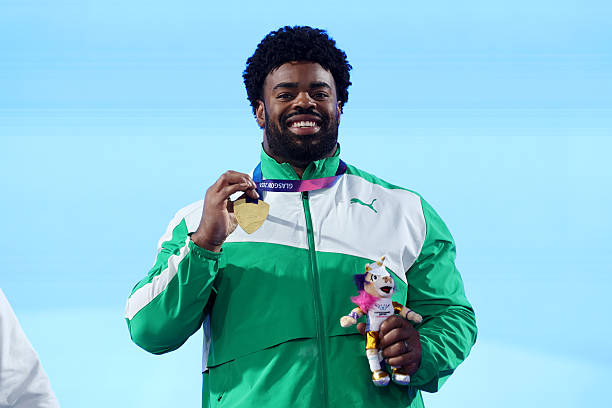 Gold medalist Chukwuebuka Enekwechi poses for a photo. Photo | Getty Images
Nigeria’s gold count of 10 is competitive with recent outings and keeps the nation among Africa’s top performers, ahead of South Africa and Kenya in golds.
Key successes came in traditional strongholds. Para powerlifting yielded multiple golds and world records early on, including efforts from Folashade Oluwafemiayo and Esther Nworgu.
Weightlifting produced three golds (Edidiong Umoafia, Onome Didih, Rafiatu Lawal).
Athletics contributed golds from Chukwuebuka Enekwechi (shot put), Ezekiel Nathaniel (400 m hurdles), Samuel Ogazi (400 m) and Goodness Nwachukwu (para discus with a world-record 39.66 m throw).
NSC Medal Target and Outcome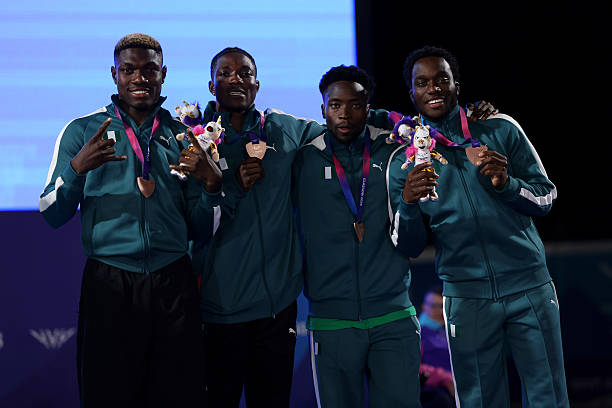 Bronze medalists Favour Oghene Tejiri Ashe, Kayinsola Ajayi, Adekalu Nicholas Fakorede and Udodi Chudi Onwuzurike of Team Nigeria during the medal ceremony for Men’s 4×100 Metres Relay Final during the Glasgow 2026 Commonwealth Games. Photo | Getty Images
The National Sports Commission (NSC), under DG Bukola Olopade and Chairman Shehu Dikko, set ambitious projections ranging from 16 gold medals to 22 medals overall, with athletics expected to deliver 6 golds.
Increased cash incentives ($10,000 gold, $5,000 silver, $3,000 bronze) aimed to boost motivation.
While the gold tally of 10 fell short of the higher targets, the overall medal count and ranking reflect a focused, high-quality effort in fewer events rather than broad underperformance.
Challenges and SuccessesChallenges included the reduced sports programme, which limited entries in areas where Nigeria has historically competed; preparation and funding constraints that often affect depth; and the absence of medals from boxing and limited returns from other disciplines.
Heavy reliance on para sports and a narrow set of able-bodied events remains a structural issue.
Successes stand out clearly: world and Games records, Nigeria’s first men’s 400 m gold, continued para dominance, and strong early medal-table positioning.
These highlight effective talent identification in power events and individual excellence under pressure.
Prospects and Projection for India 2030Looking ahead to the 2030 Commonwealth Games in Ahmedabad (Amdavad), India—the centenary edition with a fuller 15–17 sport programme—Nigeria has a clear runway.
Sustained investment in athletics depth, weightlifting and para sports, combined with improved high-performance systems and youth pathways, could push the gold tally beyond 12–15 and elevate the overall ranking.
Hosting logistics in India will be familiar after Delhi 2010, while lessons from Glasgow’s leaner format should encourage broader squad development.
With consistent NSC support and private-sector backing, Team Nigeria is well placed to convert current momentum into a stronger showing in four years’ time.
Overall, Glasgow 2026 confirmed Nigeria’s status as a consistent Commonwealth medal contender while exposing the need for wider sporting investment.
The foundation is solid; the next cycle will determine whether the nation can convert promise into historic dominance.
Comments
Start the conversation about this story.