





- Advertisement -
The Silk Road Caravan, a global outreach campaign shining the spotlight on rangelands and pastoralists, on Friday, August 7, 2026, began its journey across Mongolia, just days before the start of the seventeenth session of the Conference of the Parties (COP17) to the United Nations Convention to Combat Desertification (UNCCD) in Ulaanbaatar on August 17.
For millennia, the Mongolian steppe has witnessed the movement of people, goods and ideas across Eurasia. The Orkhon Valley, one of Mongolia’s most important historical landscapes, served as the political and cultural centre of successive nomadic empires, while generations of pastoralists developed a way of life that still defines Mongolia today.
This August, that story continues. Ahead of UNCCD COP17, the UNCCD Silk Road Caravan arrives in Mongolia after travelling more than 6,000 kilometres, across Eurasia. Along the way, it has brought together pastoralists, scientists, policymakers, young people and local communities to share experiences and practical solutions for restoring rangelands and building resilience to increasing drought conditions.
Launched by the UNCCD in support of the International Year of Rangelands and Pastoralists 2026 (IYRP 2026), the Silk Road Caravan follows the spirit of the historic routes that once linked Asia and Europe. Since departing Türkiye in May, participants have travelled through the Russian Federation, Uzbekistan, Kazakhstan, Kyrgyzstan and China, visiting restoration initiatives and meeting local communities along the way. The journey has highlighted how dedicated efforts and cooperation at all levels can help restore degraded land.
Dr. Yasmine Fouad, Executive Secretary of the UNCCD, said: Throughout the Silk Road Caravan journey, we have seen how countries and communities are managing and restoring rangelands that are inseparable from their identities, cultures, economies and ways of life. Every stop along the journey has reinforced one simple truth: people are at the heart of restoration. Those experiences remind us that there is no single path to restoration. As we gather in Mongolia for COP17, our responsibility is to turn these local experiences into global action, strengthening international cooperation and investing in the people who have been caring for these landscapes for generations.”
Tsagaankhuu Iderbat Minister of Food, Agriculture and Light Industry of Mongolia, said: “Mongolia has a long tradition of pastoralism and a deep connection to its vast rangelands, which have shaped our nomadic culture for generations. Recognising the global importance of rangelands and pastoralists, Mongolia was proud to initiate the proposal that led the United Nations General Assembly to proclaim 2026 the International Year of Rangelands and Pastoralists.
“The arrival of the Silk Road Caravan in Mongolia, followed by UNCCD COP17, provides a unique opportunity to bring global attention to rangelands, land degradation and climate change. It also reminds us that the knowledge and experience of pastoralists, developed over generations of living in harmony with nature, remain an essential part of the solutions we need today.”
Rangelands cover 54 per cent of the Earth’s land surface, support around two billion people, provide nearly 70 per cent of global livestock feed and store vast amounts of carbon. Yet up to half are already degraded, putting biodiversity, food production and rural livelihoods at risk. The experiences gathered along the Caravan will now be carried into COP17, where countries will consider the next steps for restoring and protecting rangelands.
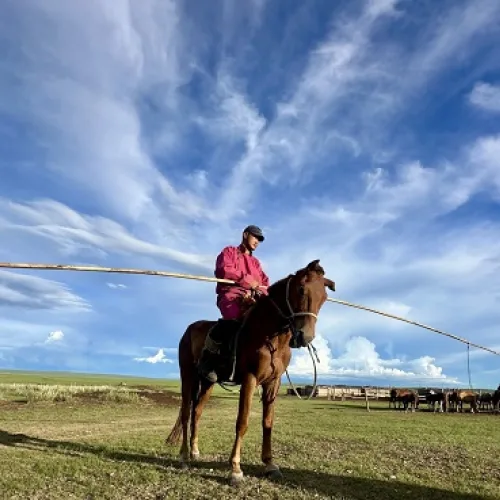
In Mongolia, rangelands are the foundation of pastoral life. Covering around 70 per cent of the national territory, they support the livelihoods of approximately one third of the population and form one of the world’s largest remaining pastoral landscapes.
Yet these same landscapes are under increasing pressure. Nearly 77 per cent of Mongolia’s land is affected by degradation. Droughts are becoming more frequent, while the annual number of sand and dust storm days has more than tripled since the 1960s. In 2023–2024, a devastating combination of summer drought followed by the harsh winter known as dzud resulted in the loss of more than seven million livestock. The disaster showed how exposed pastoral communities are to drought and climate extremes.
Avirmed Gan-Ochir, an Animal Breeding Specialist at the Greengold Mongolian Rangeland Research Centre and a participant in the Silk Road Caravan, said: ” As someone who grew up on Mongolia’s rangelands, it has been inspiring to travel through Uzbekistan and Kazakhstan and meet pastoralists whose lives are so different, yet so similar to my own.
“Every community has taught us something new, from how they adapt to a changing climate to how they preserve traditions that have been passed down through generations. I am proud that the Caravan is now arriving in Mongolia, and I look forward to welcoming everyone to our country, sharing our own experiences, and continuing this exchange of knowledge ahead of COP17.”
Aldarjavkhlan Jukov Minister of Culture, Sports, Tourism and Youth of Mongolia, said: “For centuries, the Silk Road connected countries, peoples and civilisations. As the Silk Road Caravan reaches Mongolia, it offers an opportunity to share our nomadic culture, traditions and long-standing heritage of living in harmony with nature. Hosting the Caravan’s final stage and welcoming the world to UNCCD COP17 creates a meaningful connection between Mongolia’s cultural heritage and today’s global challenges, including land degradation, desertification and ecosystem restoration. It is an opportunity to learn from the knowledge of the past while working together towards a more sustainable future.”
The challenges facing Mongolia are shared by many dryland countries. FromAugust 17 to 28, COP17 will bring together governments, scientists, Indigenous Peoples, pastoralists, civil society organisations, businesses and international organisations in Ulaanbaatar to discuss practical solutions for land restoration, drought and sustainable rangeland management.
As the first of this year’s three Rio conventions’ Conferences of the Parties (COP), it is expected to help shape the international agenda on land. Coinciding with the International Year of Rangelands and Pastoralists, UNCCD COP17 will also highlight the vital role of rangelands in supporting food security, biodiversity conservation, climate resilience and rural livelihoods.
Silk Road Caravan participants will spend a week travelling across Mongolia, from the Gobi Desert to the forests and grasslands of the country’s centre. They will meet nomadic herder families, researchers, local authorities and pastoral cooperatives, and visit land restoration projects.
The route includes Hustai National Park, the UNESCO World Heritage-listed Orkhon Valley Cultural Landscape, the Ramsar-listed Ugii Lake and the Mini Naadam festival. Participants will see first-hand how people across Mongolia’s rangelands are responding to land degradation and drought. They will also join activities marking the International Year of Rangelands and Pastoralists before reaching Ulaanbaatar in time for COP17.
Comments
Start the conversation about this story.