





The overlapping Riyadh and Cape Town conferences expose a deeper challenge: whether African states can build strong continental institutions while still competing for capital in a global energy market.
The scheduling clash between the 2026 WPC Energy Congress and African Energy Week is developing into more than a contest between two conferences.
It is becoming a test of whether African governments can protect the institutions they have built to advance their own energy priorities while remaining fully engaged with the global industry.
The 25th WPC Energy Congress will run in Riyadh from October 11 to 15, while African Energy Week is scheduled for Cape Town from October 12 to 16. The programmes therefore overlap almost completely. The WPC gathering had earlier been planned for April before moving to October.
For ministers, national oil companies, investors and global operators active in Africa, the immediate difficulty is obvious: senior executives cannot easily be in both cities at once.
But the larger consequence may be institutional.
Africa has spent years arguing that decisions about its oil, gas, power and industrial development should not be made exclusively in global centres outside the continent. African Energy Week has emerged as one of the platforms attempting to give that position organisational weight.
Its 2026 edition is expected to bring policymakers, investors, companies and development institutions together around oil, gas, power, infrastructure and investment opportunities. Organisers have also positioned deal signing, licensing rounds and project development at the centre of the programme.
The simultaneous gathering in Riyadh now creates a difficult question: when global and African platforms compete directly, which one will African governments treat as indispensable?
A Contest for Influence, Not Just Attendance
The WPC Congress has considerable pulling power.
Its October programme includes ministerial dialogue on global oil and gas markets, while the wider “Energy Week in Riyadh” will also feature engagements involving the International Energy Forum, OAPEC and the launch of OPEC’s Annual Statistical Bulletin.
That gives governments and companies powerful commercial and diplomatic reasons to be in Saudi Arabia.
For African states, however, prioritising Riyadh at the expense of Cape Town would carry its own cost.
The continent is trying to mobilise capital for upstream developments, refineries, natural gas infrastructure, power projects, transmission networks and industrial facilities. These projects need sustained engagement between governments, financiers and operators.
An African-focused event offers something a broader global congress cannot easily replicate: concentrated attention on African projects.
That difference matters.
In Riyadh, an African gas development may compete for investor attention against projects from the Middle East, Asia, North America and Latin America. In Cape Town, the same project sits within a discussion centred on African infrastructure, market access and development.
The concern is therefore not simply that AEW could lose delegates. It is that Africa could lose an opportunity to concentrate political and commercial attention around its own priorities.
Africa Cannot Afford Institutional Fragmentation
The scheduling problem also exposes a weakness that predates either conference: African energy diplomacy remains fragmented.
Oil and gas producers frequently pursue investment individually. Power markets remain divided by national borders. Infrastructure is often planned country by country even where pipelines, electricity interconnectors and regional refining capacity would benefit from coordinated strategies.
African countries consequently enter global negotiations with substantial resources but often without a sufficiently unified commercial position.
Platforms such as AEW matter because they can help reduce that fragmentation.
The 2026 gathering is expected to include country investment presentations, policy discussions and project announcements, with several African energy ministers already listed among participants.
But an institution only becomes influential when governments consistently support it.
If African ministers routinely prioritise overseas conferences whenever schedules conflict, continental platforms risk becoming secondary venues attended mainly by regional executives and officials without full decision-making authority.
That would weaken Africa’s ability to build its own centres of influence.
The answer, however, should not be retreat from global institutions.
Africa needs Riyadh as much as it needs Cape Town.
International capital, technology and global markets remain essential to the continent’s energy development. The strategic challenge is therefore to avoid turning the dispute into a false choice between African sovereignty and international engagement.
Global Energy Security Changes the Equation
The clash is occurring during a volatile period for global energy markets.
Geopolitical tensions and disruption risks around major oil-shipping routes have renewed concerns about supply security. OPEC+ agreed this month to increase September output quotas as producers respond to shifting market conditions, while disruptions linked to conflicts involving Iran have underscored the fragility of global supply routes.
That environment potentially strengthens Africa’s position.
The continent contains both mature and emerging producing regions and could become an increasingly important source of supply diversification.
But African governments are arguing that production alone is no longer enough.
The development model in which crude oil and other resources are exported while higher-value products are imported has placed considerable pressure on currencies, employment and industrial growth.
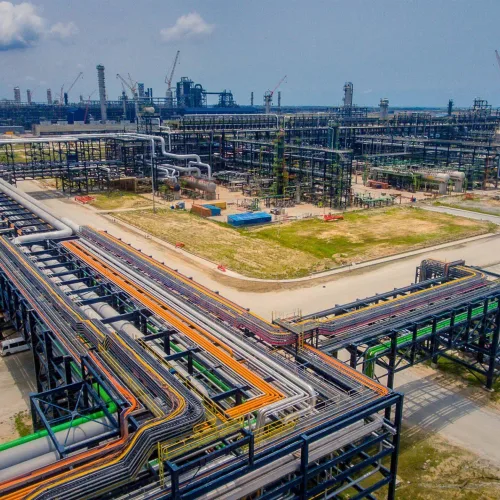
Nigeria’s Dangote refinery illustrates how rapidly that structure could change.
The refinery, with an official capacity of 650,000 barrels per day, processed more than 700,000 barrels a day during a performance test earlier this year and has become an increasingly important supplier of refined fuels. Its owners are also preparing a multibillion-dollar public offering and expansion plans.
The significance goes beyond Nigeria.
It demonstrates that African energy policy is increasingly moving from resource extraction towards value capture.
The same logic is driving interest in gas-based industrialisation, petrochemicals, fertiliser, electricity generation and regional energy trade.
These ambitions require investment forums capable of connecting projects directly with capital.
Angola Offers a Warning
Africa’s sensitivity towards international energy institutions also has recent precedent.
Angola withdrew from OPEC in 2023 after disagreements over production quotas, choosing to pursue its national production strategy outside the organisation.
The country has since sought to maintain output at around 1.1 million barrels per day while attracting fresh investment and developing natural gas opportunities.
Angola’s exit demonstrated that African producers are increasingly willing to challenge institutional arrangements when they believe national development priorities are being constrained.
The WPC-AEW situation is fundamentally different. There is no evidence that WPC Energy deliberately rescheduled its congress to undermine the Cape Town event.
But the political sensitivity comes from the same underlying issue: whether African priorities receive sufficient weight within international structures.
That makes accusations of deliberate sabotage difficult to establish but the institutional consequences impossible to ignore.
Nigeria Will Be Closely Watched
Nigeria could become especially important in determining how African states handle the conflict.
As one of the continent’s largest petroleum producers and its largest refining centre, Nigeria has significant interests in both global and African energy platforms.
Its priorities include increasing crude production, monetising gas, expanding indigenous participation and building domestic value chains.
Nigeria therefore has every reason to engage in Riyadh.
But it also has a strategic interest in ensuring that African-led forums remain credible.
A balanced approach could involve dividing senior delegations while ensuring that both events receive officials with genuine decision-making authority.
Other African countries may adopt similar strategies.
The risk is that Cape Town receives nominal participation while political authority and corporate leadership migrate overwhelmingly to Riyadh.
That would send a message extending far beyond AEW.
AEW Must Compete on Results
African Energy Week cannot rely solely on the argument that African governments should support it because it is African-led.
Institutional loyalty ultimately depends on value.
AEW will have to demonstrate that attending Cape Town produces outcomes that justify the time of ministers, chief executives and investors.
That means advancing bankable projects, facilitating financing discussions, supporting licensing processes and generating commercial agreements.
Its organisers say the event is expected to host thousands of participants and hundreds of companies, with deal signing and investment promotion central to its programme.
Those ambitions now face an unusually direct test.
If the gathering retains high-level international participation despite the WPC Congress, it will suggest that AEW has moved beyond being merely another regional conference.
If senior participation falls significantly, it will expose how dependent African platforms remain on a global calendar largely shaped elsewhere.
A Test of Africa’s Institutional Confidence
The WPC-AEW collision should therefore not be reduced to an argument over dates.
The larger question is whether Africa has reached the point where its own energy institutions command enough political and commercial loyalty to survive direct competition from established global platforms.
That matters because control of the energy agenda increasingly extends beyond production.
It includes financing, refining, infrastructure, technology, trading and the ability to determine how resources support domestic development.
Africa cannot exercise greater influence in those areas without building institutions capable of bringing governments and capital together.
The continent should continue attending global forums. Riyadh will remain important, as will Houston, London, Paris and other major centres of the industry.
But if African governments want their own platforms to matter, they must also be prepared to sustain them when participation carries an opportunity cost.
The October clash will reveal whether that institutional confidence exists.
What happens between Riyadh and Cape Town may therefore tell the industry something larger than which conference attracted the most delegates.
It may show whether Africa is finally developing the capacity not merely to participate in the global energy conversation, but to convene part of it on its own terms.
Please follow and like us:
Comments
Start the conversation about this story.