





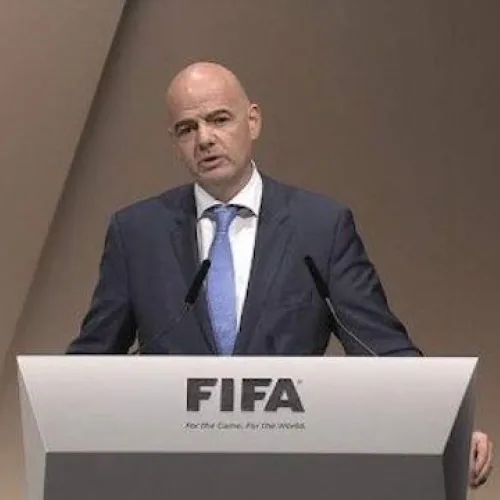
FIFA has launched a strong defence of president Gianni Infantino, accusing unnamed critics of mounting a coordinated campaign to undermine both his leadership and the credibility of football’s world governing body.
The statement, issued on Saturday, came amid intensifying scrutiny of Infantino over allegations concerning his personal life and growing opposition to his leadership from sections of European football.
FIFA rejected what it described as “unsubstantiated assertions and demonstrably false claims”, insisting that speculation and insinuation should not be presented as established fact.
The organisation was responding to a report by The Daily Telegraph concerning an alleged relationship involving Infantino during his time as UEFA general secretary.
The report claimed that a woman described as his former lover received a severance payment from UEFA following the relationship.
A FIFA spokesperson said Infantino “strongly denies” the allegations and described them as “categorically untrue”.
The controversy comes at a particularly difficult moment for Infantino, who is facing increasing resistance from UEFA and several European football associations over his abandoned FIFA Forward Enterprise proposal.
The proposed FFE structure would have created a new company to manage FIFA’s commercial and ticketing rights, with a 21 per cent stake reportedly intended for sale to a private investment company.
According to BBC, the proposal triggered concern among parts of European football, with UEFA subsequently declaring that it had lost confidence in Infantino. Norway’s Football Federation president, Lise Klaveness, went further on Friday by calling for the FIFA president to resign.
UEFA has also maintained that the possibility of boycotting FIFA events remains open, arguing that it has yet to receive sufficient assurances that the controversial commercial structure cannot be revived in another form.
Against that backdrop, FIFA sought to emphasise the legitimacy of Infantino’s position, pointing out that he was democratically elected by FIFA’s member associations and continues to govern with their mandate.
“It is increasingly evident that there is a concerted and ongoing effort by some to undermine FIFA and its president,” the organisation said.
FIFA added that those who lack sufficient support among its member associations should not attempt to achieve through allegations, insinuations or misinformation what they cannot accomplish through the organisation’s established democratic processes.
The opposition to Infantino has been particularly pronounced in Europe, although the FIFA president continues to enjoy significant support elsewhere.
The Mexican Football Federation has publicly backed Infantino, breaking with its regional governing body, CONCACAF. Mexico joined South America’s CONMEBOL in arguing that any attempt to remove the FIFA president should require a vote involving all 211 FIFA member associations.
Infantino also retains the unanimous backing of the 54 member associations of the Confederation of African Football.
The FIFA president’s administration has nevertheless been forced into a more defensive posture following the collapse of the FFE proposal.
Infantino summoned members of the FIFA Management Board to a meeting in Rabat, Morocco, on Wednesday, after which FIFA issued a statement jointly attributed to Infantino and Secretary General Mattias Grafström.
The statement apologised for the FFE proposal but warned that FIFA would no longer tolerate what it described as attacks on the organisation’s integrity, governance and established procedures.
The latest statement adopted a similarly combative tone, arguing that legitimate disagreement with Infantino’s reforms should not be confused with attempts to weaken his democratic mandate.
“Change inevitably challenges established interests,” FIFA said, while stressing that opposition to change could not justify efforts to undermine the authority of the FIFA president or the institution he leads.
The organisation also insisted that it remained open to legitimate scrutiny but drew a distinction between scrutiny and what it considers inaccurate reporting or unsupported allegations.
“Scrutiny is not a licence to distort facts,” FIFA said, adding that it would challenge reporting it considers inaccurate or misleading “directly and vigorously”.
Comments
Start the conversation about this story.