





Amina Adamu runs a tailoring shop in Kano. In late 2023, she enrolled in the Group, Individual and Family Social Health Insurance Programme, the NHIA’s window for Nigerians who are not civil servants, paying an annual premium of N22,000 for herself and her two children. It felt, for the first time, like insurance was actually built for someone like her. In 2025, her renewal notice quoted N38,718, a 76 percent jump in two years. She let the cover lapse and went back to paying hospital bills in cash, the same arrangement she had before the Act existed.
Her story sits on one side of Nigeria’s biggest healthcare financing reform in two decades. On the other side are enrolment numbers growing faster than at any point since the old scheme launched in 2005, hospitals receiving nearly double what they were paid two years ago, and a regulator that finally has the legal teeth its predecessor never had. Both stories are true. Neither cancels the other out.
On May 19, 2022, the late former President Muhammadu Buhari signed the National Health Insurance Authority (NHIA) Act, replacing the National Health Insurance Scheme (NHIS), which had covered fewer than 5 percent of Nigerians after nearly two decades in operation, according to the Nigerian Medical Association. The Act made health insurance mandatory for every resident and gave the new Authority far stronger regulatory powers over insurers, health maintenance organisations (HMOs) and healthcare providers than its predecessor. Four years on, the question is no longer what the Act promised, but what it has delivered, and at what cost.
Why the policy was introduced
Nigeria’s pre-2022 health financing system was failing by almost every measure. The NHIS, established in 1999 and launched in 2005, was voluntary, and voluntary health insurance in a country where most work is informal rarely reaches the people who need it most. After nearly two decades of operation, the NHIS had failed to achieve broad national coverage, with multiple health sector assessments estimating enrolment remained below 5 percent of the population.
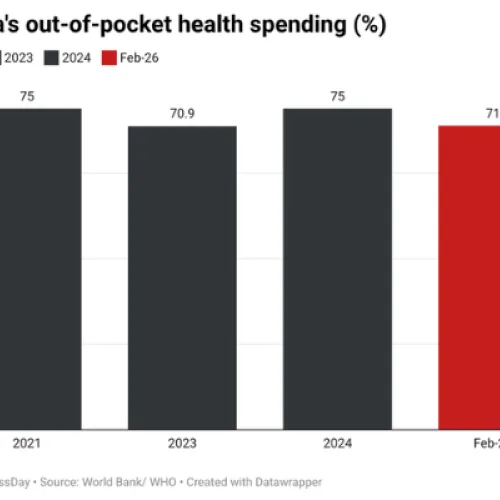
A NOIPolls survey cited by Nigeria Health Watch around the Act’s passage found that 80 percent of adults were still paying for healthcare directly out of pocket, with only 17 percent holding any form of cover. Out-of-pocket payments remained the dominant source of healthcare financing in Nigeria, accounting for more than 70 percent of total health expenditure in recent international health financing estimates, pushing families into debt or into forgoing treatment altogether. The World Health Organization, the World Bank and successive Nigerian health ministers had all named voluntary, fragmented insurance as the core design flaw. The Act’s answer was to make coverage compulsory, centralise regulation under one authority, and create a dedicated fund for people too poor to pay premiums at all.
Did the government deliver what it promised?
Four things were promised: expand coverage nationwide, keep that coverage affordable, make provider payment reliable enough that hospitals would actually treat NHIA patients, and reach the poorest Nigerians who cannot pay premiums at all. The record is split roughly down the middle.
On coverage growth, the numbers are real. Enrolment reached 22.03 million by July 2026, according to Kelechi Ohiri, Director-General of the National Health Insurance Authority (NHIA), who disclosed the figure at an event organised by the Nigerian Association of Insurance and Pension Editors, representing a 35 percent year-on-year increase. This is against a government target of 44 million enrollees by 2030, announced by Iziaq Salako, Minister of State for Health and Social Welfare. Nigeria is therefore roughly halfway toward that target with four years remaining, a reasonable trajectory rather than a triumphant one, given that 22 million enrollees still represent less than 10 percent of a population estimated at about 240 million.
On provider payment, the government delivered more than it promised. Capitation fees, the fixed amount HMOs pay hospitals per enrolled patient, rose from N750 to N1,450 per person, a 93 percent increase compared with December 2023 rates, while fee-for-service reimbursements rose 378 percent, according to figures Ohiri and Minister Pate have both confirmed publicly. NHIA has assessed 7,592 healthcare facilities under the SafeCare quality framework to back the higher payments with a minimum standard of care.
On affordability and reaching the poorest, the government has not delivered. The same actuarial review that raised provider payments also raised what enrollees pay. The GIFSHIP premium that covers self-employed and informal-sector Nigerians rose from N22,000 to N38,718 per person a year, a 76 percent increase, according to NHIA officials speaking at stakeholder forums in 2025.
Affordability remains one of the reform’s biggest challenges. While higher provider payments were designed to improve healthcare quality and sustainability, they also increased pressure on contribution levels. For informal-sector workers without employer support, even modest increases can determine whether insurance remains affordable or becomes another household expense competing with food, transport and education.
Who won? Who lost?
The winners
Healthcare providers won clearly. Hospitals and clinics now receive nearly double the capitation they did two years ago and more than four times the fee-for-service reimbursement, a shift the NHIA describes as the most significant provider payment adjustment in over a decade. HMOs won too: higher premiums and higher reimbursement rates both expanded the revenue base of an industry that had operated on thin margins for years. Formal-sector workers with employer-backed cover are better off than before, since the Act requires their plans to match the benefit package available to federal civil servants. Lagos State is a clear institutional winner: the ILERA EKO scheme, running under its own state law since 2015, had enrolled 1.15 million residents by December 2024, according to the Lagos State Health Management Agency, well ahead of most other states.
The losers
Self-employed and informal-sector Nigerians remain the hardest group to bring into the insurance system. Unlike formal-sector workers whose employers can contribute to healthcare plans, traders, artisans and small business owners must pay directly from often unpredictable incomes. The affordability challenge highlights the central tension of the reform: expanding insurance coverage requires contributions, but the people most in need of protection are often those least able to pay.
The Vulnerable Group Fund was created to bridge this gap by supporting Nigerians who cannot afford premiums. However, its success will depend on sustained financing, effective targeting and the ability of states and institutions to translate legal commitments into actual coverage. The wider challenge is that healthcare financing remains heavily dependent on households. Out-of-pocket payments still account for roughly 71–76 percent of total health expenditure in recent estimates, meaning many Nigerians remain exposed to financial hardship whenever illness occurs.
What the critics get right
The mandate outran the state-level machinery meant to enforce it. Nigeria Health Watch’s two-year review of the Act, published in 2024, found that even within the formal sector, where enforcement should be easiest, current coverage falls short of the sector’s own size, evidence of non-compliance by private employers who face little practical penalty. A 2022 review in the Nigerian Postgraduate Medical Journal warned that the Act would still face low government funding priority, shortage of healthcare workers, and poor coverage in its early years, a forecast that has largely held. Academic comparative work on NHIS and NHIA enrolment patterns has found that enrolment among vulnerable groups has not significantly improved despite the innovations the Act introduced, precisely the population the Vulnerable Group Fund exists to protect. The critics are not arguing the old NHIS was better. They are arguing that Nigeria wrote a universal mandate without first building the state-level enforcement and subsidy financing that mandate requires, the same sequencing problem that shows up whenever ambitious social policy meets thin fiscal and institutional capacity.
Policy scorecard: Did the reform succeed?

NHIA Act Policy Scorecard (May 2022 – July 2026)
The NHIA Act fixed something that was genuinely broken. A voluntary scheme that reached under 5 percent of Nigerians in twenty years has been replaced by a mandatory system with real regulatory teeth, a provider payment structure hospitals can plan around, and enrolment growing faster than at any point in the country’s history. On those measures, the reform has done what the old NHIS never managed.
But it has not protected the people who were supposed to benefit most. The same actuarial logic that made the system more sustainable for hospitals made it less affordable for the informal-sector Nigerians the mandate was written to capture. The Vulnerable Group Fund exists in law far more than it exists in practice. And the national out-of-pocket ratio, the single number that should move if this reform is working, has barely shifted.
Four years on, Nigeria has a stronger health insurance authority. It does not yet have universal health coverage. Blessing’s premium notice still arrives every year, and it is still cheaper for her to skip it and pay in cash when she has to. The Act bought Nigeria the machinery for financing healthcare fairly. Whether that machinery reaches people like her before 2030 depends on a financing and enforcement agenda that legislation, on its own, was never going to deliver.


Oluwatobi Ojabello, PhD, is a dynamic and multi-dimensional Assistant Editor for Economy and Markets with over two years of professional journalism experience. He delivers authoritative, data-driven coverage of fiscal policy, financial institutions and capital markets, using clear analysis to explain Nigeria’s most complex economic developments. His work focuses on macroeconomic policy, financial stability and corporate performance, turning technical issues into accessible narratives that inform both experts and everyday readers.
Comments
Start the conversation about this story.