





Former President Olusegun Obasanjo has called for a fundamental rethink of the democratic model practised across Africa, arguing that the Western liberal system inherited by many countries has failed to adequately reflect the continent’s history, culture and social realities.
Obasanjo said the current model had fostered a winner-takes-all political culture, in which victory by a narrow margin often gives the winner control of virtually everything while leaving those who lose with little influence in governance.
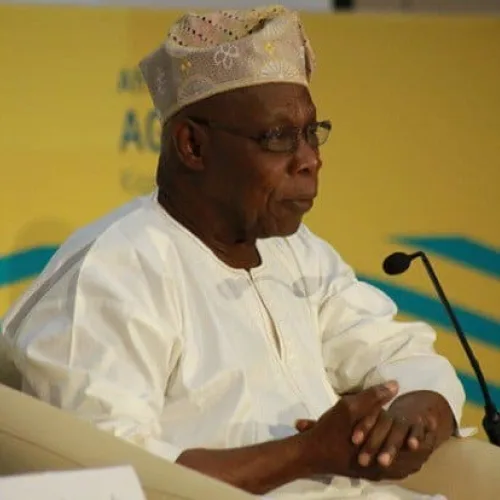
The former president spoke on Tuesday at the 2026 Goodluck Jonathan Foundation Democracy Dialogue in Bauchi, where he questioned the suitability of transplanting Western political structures into African societies without adapting them to local circumstances.
He likened the situation to wearing a garment that was not tailored to fit.
“The democracy we practice has no African context, no African content,” Obasanjo said, arguing that a political system designed elsewhere could become ineffective when applied without considering the peculiarities of African societies.
According to him, the political meaning attached to opposition in many African societies also differs significantly from the concept of a “loyal opposition” associated with Western liberal democracy.
He said the result was often a hostile political environment in which opponents were treated as enemies to be defeated and eliminated from political relevance.
“In practice, we have winner takes all, first past the post. If you beat me by one vote then you take it all and whatever I have does not matter,” he said.
Obasanjo also warned that Nigeria and other African countries must learn to manage diversity more deliberately, stressing that pluralism was an essential part of the continent’s political and social identity.
He said Nigeria’s diversity was fundamental to the country’s existence and should be protected rather than treated as a source of division.
“That diversity must be nourished and be taken care of,” he said.
The former president also expressed concern over the growing influence of money and inducements in African politics, saying the trend had increased dramatically and continued to undermine democratic values.
He linked the challenge to broader socioeconomic conditions, noting that widespread poverty and illiteracy could weaken democratic institutions and make voters more vulnerable to manipulation.
Obasanjo further criticised the limited representation of women in Nigerian politics, noting that the country had not elected a female governor since the beginning of the Fourth Republic more than two decades ago.
He questioned the quality and character of some political leaders who have emerged through the existing system, arguing that leadership should be measured by values and character as much as electoral victory.
For Obasanjo, the solution lies not merely in importing political institutions but in developing a democratic system rooted in African realities.
He argued that democracy should be viewed as an evolving process rather than a finished product.
“Call it what you like, just make sure it has history, culture and values that are African,” he said, adding that the system could be called “African democracy” if necessary.
The dialogue, chaired by Obasanjo, was attended by former President Goodluck Jonathan, former Vice President Namadi Sambo, constitutional experts and civil society representatives, while Bauchi State Governor Bala Mohammed hosted the gathering.
Comments
Start the conversation about this story.