






The irony in governance is that the projects that capture public imagination are often the least difficult to appreciate. A newly commissioned road, a modern school, a renovated hospital or a flyover bridge speaks for itself. Fiscal discipline does not. Yet, behind every lasting development lies an often-overlooked virtue – the prudent management of public resources. Governments are judged ultimately not by the abundance of their income but by the wisdom of their choices in spending that income. Though prosperity is desirable as we all know, but we have to admit that stewardship is equally indispensable. When public finance is guided by discipline rather than expediency, governments create not only projects but also the confidence that today’s development will not become tomorrow’s burden.
It is against this backdrop that Kaduna state’s fiscal journey deserves careful reflection.
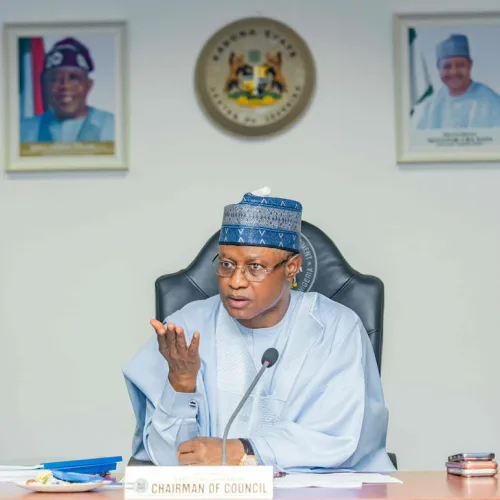
Governor Uba Sani assumed office in May 2023 at a time when the state, and by extension the country’s economic landscape was anything but forgiving. The removal of fuel subsidy, exchange-rate volatility, persistent inflation, and rising debt-service obligations placed unprecedented pressure on governments at every level. States were confronted with a difficult reality: revenues were uncertain, the demands of citizens were increasing, and the cost of delivering public services was rising sharply. In such circumstances, leadership is tested less by ambition than by restraint. The challenge is not merely to spend, but to spend wisely.
One of the defining features of Kaduna’s public finance strategy has been its emphasis on fiscal prudence. The evolution of Kaduna’s budgets illustrates this approach. The approved 2023 budget stood at approximately ₦376 billion, with about 64 per cent allocated to capital expenditure. By 2026, the state’s budget had expanded to approximately ₦985.9 billion, with nearly 71 per cent earmarked for capital projects. While a larger budget does not automatically translate into better governance, the increasing share devoted to capital expenditure suggests an intention to invest more heavily in assets capable of generating long-term social and economic value.
It is important to note that Kaduna’s fiscal philosophy appears to rest on the belief that sustainable development cannot be separated from responsible financial management. Whether this approach ultimately delivers all the expected outcomes will be judged by history. But the effort to align expenditure with development priorities represents a significant dimension of governance, one that often receives less public attention than it deserves.
Like most Nigerian states, Kaduna relies on a combination of statutory allocations from the Federation Account and internally generated revenue (IGR). Available fiscal reports indicate that Kaduna has continued efforts to strengthen its internally generated revenue through reforms in tax administration and improved collection mechanisms. While revenue generation alone is not evidence of economic prosperity, it provides government with greater fiscal flexibility and resilience, particularly during periods of national economic uncertainty. Equally important is the principle that expanding the revenue base should not be confused with imposing heavier burdens on taxpayers. The more sustainable path lies in improving efficiency, reducing leakages, and encouraging economic activity that naturally broadens the tax net.
Another pertinently salient aspect of Kaduna’s fiscal approach that deserves attention is the administration’s stated commitment to avoiding new borrowing while continuing to service inherited debt obligations. In a federation where public borrowing has become a common instrument for financing development, such a position reflects a cautious philosophy of public finance. According to official statements, the government has prioritised meeting existing debt commitments while financing new projects through budgetary allocations, statutory revenues, and other available funding sources rather than contracting fresh loans. The most overlooked measure of fiscal discipline is not the size of a budget or even the amount of revenue collected. It is the willingness of a government to treat public funds as a trust rather than an entitlement. Financial prudence is rarely dramatic, but it is often decisive. It is the quiet habit of making difficult choices today so that tomorrow’s opportunities are not compromised by yesterday’s excesses.
There is, pertinently, external evidence to suggest that Kaduna’s emphasis on fiscal discipline is not merely a government narrative. In the 2025 Transparency and Integrity Index of the Centre for Fiscal Transparency and Public Integrity (CeFTPI), Kaduna ranked first among Nigeria’s 36 states for the second consecutive year, scoring 49.08 per cent and recording the country’s highest score; 80 per cent, in the Control of Corruption variable. The assessment covered fiscal transparency, open procurement, human resources, control of corruption and citizen engagement. This was not an isolated recognition. In the 2024 edition, Kaduna again ranked first among the states, ahead of Kano and Kogi, while in the 2023 Transparency and Integrity Index it placed second nationally with 59.7 per cent.
More recently, the 2025 Phillips Consulting State Performance Index placed Kaduna third among the 36 states and awarded it an Excellent Four-Star rating, with fiscal management among the areas assessed. These assessments do not, by themselves, prove that every naira has been optimally spent, nor do they erase the challenges confronting the state. They do, however, provide an important independent corroboration that Kaduna’s efforts in transparency, accountability and public-sector financial management have been noticed beyond the corridors of government. In public finance, therefore, such external assessments are worth considering.
Yet, no appraisal of public finance can be complete without acknowledging its limits. Fiscal discipline, however commendable, is not a panacea for every economic challenge. Kaduna, like every other state in Nigeria, operates within a national macroeconomic environment over which it has limited control. Inflation continues to erode purchasing power, businesses contend with high operating costs, exchange-rate volatility affects production and investment, and many households still struggle with the rising cost of living. These realities remind us that sound state finances cannot, by themselves, insulate citizens from broader economic shocks.
This distinction is important because it separates governance from circumstance. A prudent administration may not be able to determine the value of the naira or the global price of commodities, but it can determine how efficiently public resources are managed, how transparently budgets are implemented, and how wisely limited revenues are allocated. In that sense, fiscal discipline should not be judged by whether every economic hardship disappears, but by whether government responds to those hardships with responsibility and not recklessness.
Kaduna’s experience suggests an appreciation of this responsibility. The emphasis on capital investment, efforts to strengthen internally generated revenue, and the administration’s declared preference for avoiding new borrowing while servicing inherited obligations point to a philosophy that values sustainability over expediency. These choices contribute to a financial culture that seeks to preserve the state’s capacity to invest, grow, and respond to future challenges.
That is not to suggest that the work is complete. Public finance is never a finished project; it is a continuous exercise in adaptation. As Kaduna’s economy evolves, expectations will also rightly rise; citizens will demand greater efficiency in service delivery, stronger budget implementation, improved transparency, broader private-sector participation, and measurable improvements in living standards. Fiscal discipline must therefore remain dynamic, ensuring that every naira spent delivers the greatest possible public value.
Prudent financial management remains the quiet strength of Kaduna’s fiscal discipline and public finance. It is a strength that is rarely seen or acknowledged by the majority; the strength to prioritise sustainability over excess and fiscal adventurism. It is important to note that the loudest achievements may command today’s headlines, but it is often the quiet virtues; prudence, discipline, accountability, and foresight, that shape tomorrow’s verdict. In public finance, as in life, the strongest foundations are rarely the most visible, yet they are almost always the most enduring.
Sani Abdulrazak, PhD, is a writer, researcher and a public affairs analyst based in Zaria, Kaduna State.
Comments
Start the conversation about this story.