






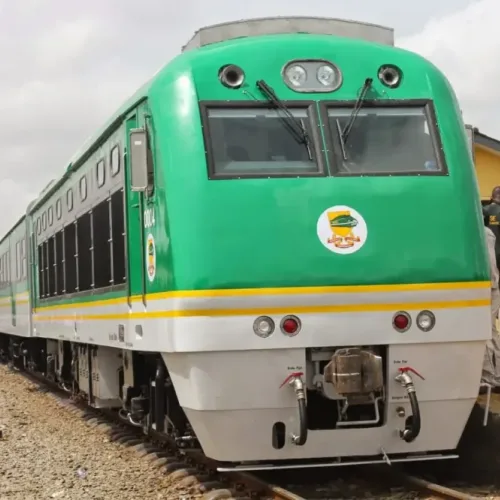
Today, Tuesday, August 11, 2026, I boarded the Abuja–Kaduna train from Rigasa Station, Kaduna.
One of the first things I noticed was an additional layer of passenger screening at the outer barricade. Passengers were required to present their tickets before proceeding to the main ticket-scanning point.
It may appear to be a small administrative adjustment, but it could make a meaningful difference. Beyond improving passenger control, the arrangement has the potential to discourage touting and ensure that only genuine ticket holders proceed towards the boarding area.
Another positive development was the timely departure of the train.
The service left as scheduled something that may appear routine, but which is fundamental to building public confidence in any transportation system.
As the heavy steel machine moved steadily towards Abuja, I decided to walk through some of the coaches.
For me, this was more than simply stretching my legs. It was an opportunity to practise what journalists describe as participant observation: being physically present, observing the environment and listening to passengers in order to gain a better understanding of their experience.
I noticed that very few passengers were standing in the coaches. Some appeared to be stretching their legs, while others may simply have wanted a brief escape from the rather chilly air-conditioning.
The public-address announcements continued, informing passengers of our arrival at Asham, Rijana, Kubwa and eventually Idu.
But another small, recurring issue caught my attention: some passengers appeared confused about the seating arrangements.
Thankfully, the situations were resolved amicably.
The confusion appeared to involve passengers unfamiliar with the numbered seating system, as well as groups travelling together whose allocated seats were not necessarily next to one another.
I also overheard some passengers expressing frustration about difficulties associated with purchasing tickets online.
While there may be several factors responsible for this, the frequency and availability of train services deserve closer attention.
And this brings me to the bigger picture.
We thank Almighty Allah for a safe journey. But a safe and timely journey should also encourage us to ask a broader question:
How can we make the Abuja–Kaduna railway service better, more accessible and more responsive to the growing needs of its passengers?
This is not merely a transportation facility connecting two cities.
The Abuja–Kaduna railway serves a much wider population across the North. It is an important link for citizens, businesses, students, civil servants and other travellers moving between Kaduna, Abuja and communities beyond.
For that reason, I believe the Federal Government should continue to explore greater investment in the service including additional locomotives and coaches, stronger supporting infrastructure, improved ticketing systems and, where operationally and economically feasible, increased daily services.
More trips would give passengers greater flexibility, reduce pressure on available services and potentially make rail transportation a more attractive alternative for people who would otherwise depend on the roads.
But this responsibility should not rest entirely with the Federal Government.
I also appeal to Northern governors, legislators, business leaders, traditional and religious leaders, civil society organisations and other influential stakeholders to make their voices heard.
They should collectively engage the Federal Government and advocate for sustained investment in the Abuja–Kaduna railway.
If we genuinely want to see infrastructure in the North improve, we must move beyond complaints.
We need constructive, persistent and evidence-based advocacy for better public services.
The Abuja–Kaduna train has demonstrated that rail transportation can make a real difference in the lives of Nigerians.
What we need now is not abandonment, but investment, expansion, efficiency and sustainability.
A reliable railway is not simply about moving people from Kaduna to Abuja.
It is about connecting communities, supporting commerce, facilitating movement, reducing pressure on our roads and creating a more efficient transportation network for the region.
The journey today was encouraging.
But it also reminded me that progress should never be the reason we stop asking for improvement.
The train is moving. Let us make sure it keeps moving forward.
Comments
Start the conversation about this story.