





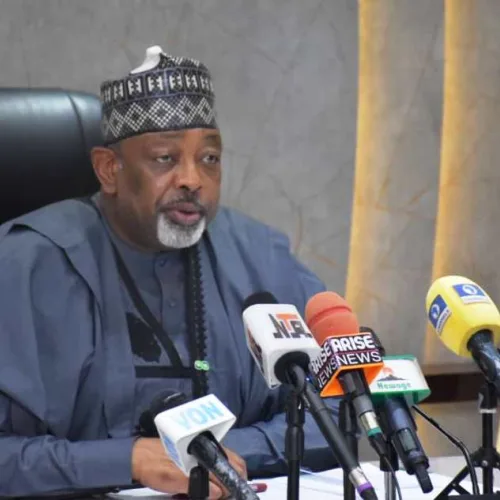
Abubakar Kyari, Minister, Federal Ministry of Agriculture and Food Security (FMAFS)
… plans establishment of mega tractor assembly plant in Nigeria
The federal government through the ministry of Agriculture of food security has unveiled the National Agricultural Mechanization Policy and investment strategy aimed to drive sustainable investment; bankable opportunities; and viable private-sector-enabled mechanisation ecosystem.
Speaking during the national policy dialogue on agricultural mechanization, held in Abuja on Wednesday, Abubakar Kyari, minister of Agriculture and food security said that despite having vast agricultural economy, large domestic food market, and expanding agro-processing activities, Nigeria’s emand for agricultural machinery services still remain largely unmet.
He explained that the mechanisation value chain presents an opportunity to build an ecosystem in which capital, technology, skills and entrepreneurship converge around one objective: making mechanization commercially viable and widely accessible.
Emphasizing that mechanisation is not synonymous with tractors, the minister said that modern mechanization is an ecosystem; from land preparation, planting and irrigation to crop protection, harvesting, threshing, processing, storage, logistics and transportation.
“It includes precision agriculture, digital technologies, appropriate machinery, skilled operators, maintenance networks, spare parts, financing, insurance, data and reliable after-sales services.
“Our ambition, therefore, must be larger than equipment ownership. We must build a Mechanization-as-a-Service economy in which technology reaches the farmer when and where it is needed, at a cost that is commercially viable and sustainably financed. This is the direction in which government is moving.
“The Policy provides the framework for national integration, adoption and implementation of a more coherent mechanization ecosystem,” he said.
Speaking further, the minister said that the new investment strategy also includes plans to establish a mega tractor assembly plant with capacity to produce between 2,000 and 4,000 units annually, aimed at reducing import dependence and building domestic industrial capacity.
This, he said will boost localised production, create jobs, and build a sustainable mechanization economy.
In his remarks, Godson Ohuruogu, chief executive officer, TracTrac MSL said that the policy must be implemented to impact the activities of farmers across the country.
“This policy is that principle, written at national scale. So this policy must be judged not by the strength of its language, but by what a farmer can feel in the field, the service that arrives on time and the price it can afford.
“We must also conduct finance and investment that actually reaches the last mile, which is why the conversation on financing, on inclusion, on technology, matters as much as the policy ractification itself,” he said.
Also speaking at the event, Aliyu Abdullahi, minister of state for Agriculture and food security, stated that that Nigeria’s agricultural transformation will ultimately be measured not by how much margin acquired, but by how much productive hour farmers boast of daily.
He said that farming activities must be enhanced to reflect in reduction of the cost of production, and how effectively convertion of agricultural tools into food, jobs, and prosperity for farmers.
Noting that over 47 percent of Nigerian farmers still rely on crude equipments, Abdullai said, “our problem is not a productivity problem, but more of a policy problem. It is a problem of institutional will.
“Our mechanization investments stand at 0.027 horsepower per hectare, less than 2 perceny as recommended by FAO, and of course below the 2.5 percent which is the African average.
“We must confront this hard reality, how do we get the farmers to be at the center of our actions so that he or she becomes more productive in his agricultural productivity or in her agricultural productivity?
“Therefore, the question before this dialogue is not whether we can buy machines, the question is whether we can build the statutory architecture, the service markets, the human capital and the maintenance systems that turn metal into momentum and our momentum into measurable productivity in our agricultural operations, ” he added.


Comments
Start the conversation about this story.