






Election observer organisation, Yiaga Africa, has raised concerns over the late movement of sensitive electoral materials ahead of Saturday’s Osun State governorship election, warning that the disruption to the Independent National Electoral Commission’s (INEC) logistics could create avoidable risks for the conduct of the poll.
The organisation said the situation requires additional security, closer oversight and contingency measures to ensure that the revised ballot papers and result sheets reach the 30 local government areas on time and are properly deployed to polling units before voting begins.
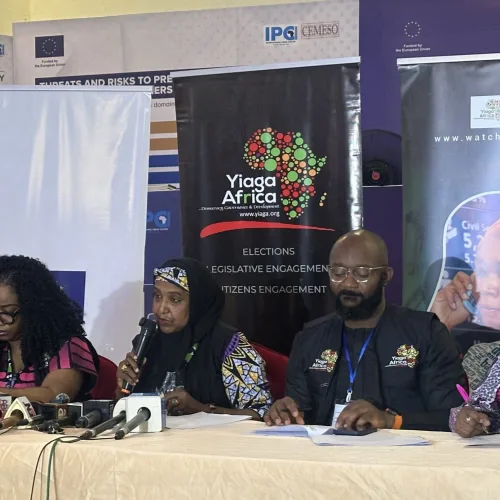
The Executive Director of Yiaga Africa, Samson Itodo, raised the concerns on Thursday at the organisation’s pre-election briefing in Osogbo, the state capital.
His warning came after INEC was forced to reprint ballot papers and result sheets following the late inclusion of the Social Democratic Party (SDP) candidate, Francis Ajala, in the election.
The commission said the revised materials would arrive in Osun on Thursday, 13 August, for onward distribution across the state.

“The Commission wishes to inform the public that the reproduced ballot papers will arrive in Osun State on Thursday, 13th August 2026, and will, same day, be moved to local government Aaea offices across the state, in line with its standard distribution procedure ahead of the election,” an earlier statement by the National Commissioner and Chairman, Information and Voter Education Committee at INEC, Mohammed Haruna read.
The development has therefore compressed the time available for sorting and deployment of sensitive materials ahead of Saturday’s poll.
Mr Itodo said the late arrival had disrupted the commission’s original logistics plan and could result in electoral materials being transported at night in an already tense security environment.
“If as of this morning the revised materials have not arrived, and INEC has issued a statement to the effect that it will come in later, it has disrupted the logistics arrangement,” he said.
“We anticipate, and we are concerned that except extra measures are taken to ensure those materials get to the local government and their rights get activated early enough, then we might have a challenge.”
According to Mr Itodo, the timing of the materials’ arrival was particularly concerning because election logistics normally benefit from daylight movement and adequate preparation time.
He therefore called on security agencies to provide additional protection for election materials and personnel during the movement.
‘Readiness must be judged by performance’
Earlier, the Chairperson of the Osun Election Observation Mission of Yiaga Africa, Asmau Maikudi, said the election would be an important test of the commission’s operational readiness, the neutrality and professionalism of security agencies, the conduct of political parties and candidates, and the resilience of voters.
She described the election as the last major governorship election before the 2027 general election, adding that it would provide an opportunity to assess the implementation of key provisions introduced under the Electoral Act 2026.
These include the use of downloadable Permanent Voter Cards (PVCs) for accreditation and the implementation of INEC’s regulations on electronic EC8A results and validation of polling-unit results within the results management process.
According to her, INEC’s preparations had advanced considerably, including PVC distribution, recruitment and training of election officials, mock accreditation, BVAS configuration and stakeholder engagement.
However, Mrs Maikudi, a former INEC Resident Electoral Commissioner, said preparations should ultimately be assessed by what happens when voters arrive at polling units.
She said INEC must avoid complacency and anticipate predictable points of failure, particularly around logistics, technology and results management.
“Security agencies bear a heightened responsibility to demonstrate neutrality, professionalism, and restraint. They must secure the election without becoming participants in it.”
This, according to Yiaga, is important given that the commission will deploy 4,427 BVAS devices across 3,763 polling units in the 30 local government areas.
A total of 2,339,233 registered voters are eligible to participate in the election.
BVAS problems raise another concern
Mrs Maikudi also raised concerns about the performance of BVAS during INEC’s mock accreditation exercise.
According to her, some devices temporarily failed to recognise voters’ fingerprints, facial features and older PVC records.
INEC, she said, attributed the facial verification failures to an excessively high compatibility threshold affecting older voter data, particularly records that had not been revalidated.
These technical problems, she stressed, must be resolved before Saturday because continued failures could lead to disenfranchisement, delays and tension at polling units.
“If unresolved, these failures could disenfranchise eligible voters, generate tension at polling units and undermine confidence in the credibility and legitimacy of the election,” she said.
Vote buying and violence remain threats
Beyond logistics, Yiaga Africa identified voter inducement as another significant risk to the election’s integrity.
Its observers documented the distribution of money and gift items by political actors. Although some of the activities were presented as social interventions or charitable assistance, the organisation said their timing raised concerns about possible attempts to influence voters.
Mrs Maikudi urged political parties, candidates and their supporters to refrain from vote buying and practices that compromise ballot secrecy.
She called for stronger coordination between security agencies, the Economic and Financial Crimes Commission (EFCC) and the Independent Corrupt Practices and Other Related Offences Commission (ICPC) to arrest and prosecute those attempting to buy votes.
Yiaga to independently track results
To monitor the election, Yiaga Africa said it would deploy its Watching the Vote methodology using two complementary systems.
The first is its Process and Results Verification for Transparency (PRVT), formerly known as Parallel Vote Tabulation.
The organisation plans to deploy 300 stationary observers to a representative random sample of polling units, supported by 32 mobile observers covering all 30 local government areas.
The observers will collect information on accreditation, voting and counting and transmit the data for an independent assessment of the election.
The second mechanism is the Election Result Analysis Dashboard 2.0, known as ERAD 2.0.
The platform will track and independently audit polling-unit result sheets uploaded by INEC to its Election Results Viewing portal.
Yiaga Africa said ERAD would not collate results or declare a winner. Rather, it would monitor the availability, accessibility, timeliness and completeness of uploaded EC8A result sheets.
The organisation said the system would also provide an independent assessment of INEC’s electronic results management system.
The Osun election will therefore serve as a major test of whether the reforms and technologies introduced into Nigeria’s electoral system can withstand the pressure of a closely fought election.
Discover more from Premium Times Nigeria
Subscribe to get the latest posts sent to your email.
Comments
Start the conversation about this story.