





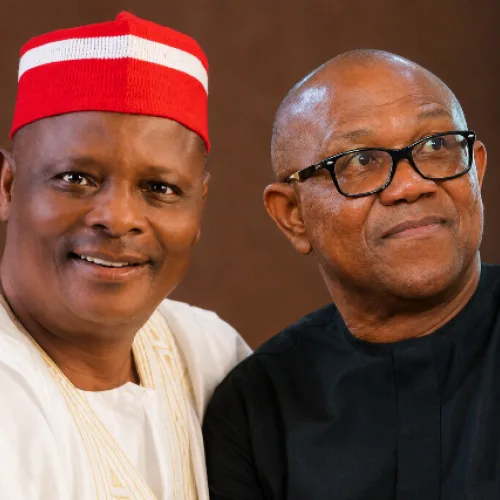
Nigeria Democratic Congress vice-presidential candidate Rabiu Kwankwaso has said he accepted to run with Peter Obi because he is confident the former Anambra governor will treat him as a governing partner rather than a ceremonial “spare tyre.”
Kwankwaso also declared former Kano governors Ibrahim Shekarau and Abdullahi Ganduje, alongside incumbent Governor Abba Yusuf, politically finished in the state.
The former Kano governor spoke during the News Agency of Nigeria Personality Interview Series in Abuja on Sunday.
Kwankwaso said his experience as deputy speaker of the House of Representatives, minister, senator and governor had taught him the importance of allowing deputies to perform meaningful responsibilities.
He argued that presidents and governors strengthen their administrations when they empower their deputies because the success of a deputy ultimately benefits the principal.
Kwankwaso said responsibilities under an Obi presidency would be allocated according to Nigeria’s needs, while competent people would be appointed to assist the administration.
He dismissed suggestions that accepting the vice-presidential slot amounted to a political demotion despite his extensive experience in public office.
According to him, becoming vice president would represent progress, stressing that public office should primarily be viewed as an opportunity to serve rather than satisfy personal ambition.
Kwankwaso said his decision to pair with Obi was driven by national interest, equity, regional balance and the need for democratic change.
He explained that their unsuccessful negotiations before the 2023 election allowed him to study Obi more closely over the following four years.
The former governor said he subsequently became convinced that Obi was someone he could trust and work with in the national interest.
He added that the alliance followed consultations with members of the Kwankwasiyya Movement, his political supporters and the Obidient Movement.
Under the agreement, Obi would serve only one four-year term if elected in 2027, after which the presidency would return to the North in 2031.
Kwankwaso said the arrangement would reassure northern supporters while preserving regional balance following the eight-year presidency of the late Muhammadu Buhari.
He maintained that the Obi-Kwankwaso ticket offered Nigerians credibility, capacity and empathy at a time when the country was battling insecurity, economic hardship, declining agricultural productivity and deteriorating infrastructure.
Turning to Kano politics, Kwankwaso said political figures who abandoned the structure that brought them to power had suffered declining fortunes.
He singled out Ganduje, who served as his deputy for eight years before succeeding him as governor in 2015.
Kwankwaso said Ganduje’s political troubles began when he broke away from their joint political structure and started fighting him.
He argued that the former governor would have retained greater influence in Kano and nationally if he had remained loyal to the political movement they built together.
Kwankwaso also accused Yusuf of abandoning the Kwankwasiyya Movement despite the role it played in his emergence as governor.
He said members of the movement worked tirelessly for Yusuf during the disputed 2019 election and returned in 2023 to secure his victory.
According to Kwankwaso, Yusuf has since distanced himself from the movement but has also failed to become fully integrated into Ganduje’s political camp.
He accused the governor of attempting to replace him as Kano’s dominant political figure, describing the move as an impatient political miscalculation.
Kwankwaso maintained that political success founded on betrayal could not endure, insisting that former allies who turned against their benefactors often slipped into political irrelevance.
Comments
Start the conversation about this story.