





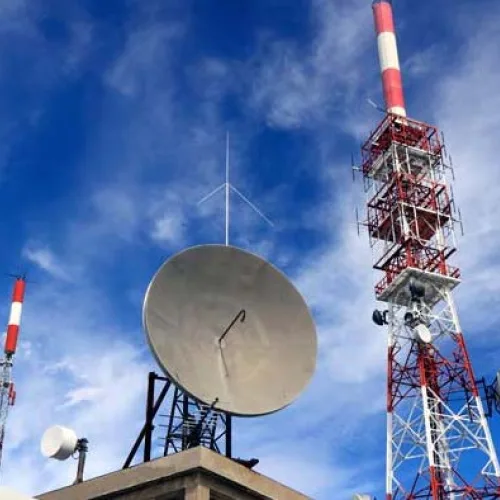
The Federal Government is set to begin the deployment of about 3,700 telecommunications towers across underserved communities in Nigeria from October 2026, as part of efforts to expand mobile and internet access to millions of Nigerians currently outside the country’s digital economy.
Bosun Tijani, Minister of Communications, Innovation and Digital Economy, disclosed this as the government intensifies its efforts to close Nigeria’s digital connectivity gap and extend critical infrastructure to rural, riverine and hard-to-reach communities.
The project is being implemented under the Nigeria Universal Communication Access Project (NUCAP), a major federal initiative designed to bring connectivity to more than 20 million Nigerians living in unserved and underserved communities.
According to Tijani, the Federal Government has completed the resource mobilisation and contractual processes required for the project, paving the way for physical deployment.
“The government plans to begin deploying about 3,700 telecommunications towers from October to improve mobile network coverage in underserved communities,” Tijani said.
The minister said the initiative is part of a broader strategy to strengthen Nigeria’s digital infrastructure and ensure that communities that have historically been excluded from commercial telecommunications investment can gain access to reliable connectivity.
Connecting more than 20 million Nigerians
The NUCAP rollout is expected to target communities where telecom operators have historically found it difficult to justify investment because of low population density, challenging terrain, or limited commercial returns.
The government has argued that leaving these communities disconnected has consequences beyond telecommunications, limiting residents’ access to digital financial services, online education, healthcare, e-government platforms, markets and employment opportunities.
Earlier reports on the programme put the number of Nigerians targeted by the initiative at more than 20 million, while previous government statements have referenced more than 23 million people who could benefit from rural connectivity expansion.
Tijani has framed the investment as infrastructure for economic participation rather than simply a telecommunications project.
The latest push also gives attention to riverine communities, many of which face geographical and infrastructure challenges that make conventional network deployment more difficult.
China-backed infrastructure investment
In June, Tijani announced that China Industrial Bank (CIB) had expressed support for the initiative following a meeting with a delegation led by Peng Shuang, general manager of the bank’s Strategic Emerging Industries Business Headquarters.
CIB’s support is significant because the bank has committed to helping deliver at least 1,000 tower sites by the end of 2026. Tijani described the bank’s involvement as its first investment in Nigeria.
The minister has also described the project as a ‘green’ telecommunications network which reflects the government’s intention to deploy infrastructure capable of providing sustainable connectivity in locations where conventional infrastructure can be difficult to operate.
Towers form part of wider connectivity strategy
The 3,700 towers are only one component of the Federal Government’s wider digital infrastructure programme.
The government is also pursuing the deployment of a 90,000-kilometre fibre-optic backbone intended to extend high-capacity connectivity across Nigeria.
Tijani said the fibre project is designed to cover every state, geopolitical zone, local government area and ward, creating the backbone required to improve the quality and reach of broadband services nationwide.
The government is also working on strengthening satellite infrastructure through NIGCOMSAT, while the Nigerian Communications Commission(NCC) has been pushing network upgrades by operators.
The NCC has said telecom operators committed to upgrading thousands of network sites in 2026, including the migration of legacy infrastructure to 4G and 5G technologies.
Together, these initiatives are expected to address different layers of Nigeria’s connectivity challenge, which is backbone infrastructure and last-mile mobile access.
Rural connectivity becomes economic infrastructure
For Nigeria, the significance of the tower rollout goes beyond improving phone calls or internet speeds. A larger connected population means more people can participate in digital payments, e-commerce, online learning, remote work, and digital government services.
For farmers and rural businesses, connectivity can improve access to market information and financial services. For schools and health facilities, reliable internet can expand access to digital learning and telemedicine.
The government believes these benefits will also support its ambition of building a larger digital economy. The challenge now will be ensuring that the towers do not simply get deployed but remain operational.
Reliable electricity, fibre backhaul, security, maintenance and affordable data services will be critical to translating the infrastructure investment into meaningful connectivity.
For the millions of Nigerians living in communities where mobile coverage remains weak or unavailable, the October rollout could mark an important step toward bringing the country’s digital economy within reach.
Get Newsletter Updates
Enjoying our column?
Subscribe to our specialised **Tech Pulse** feed to receive fresh reports and analyses directly in your inbox.


Folake Balogun is a technology journalist covering Africa’s digital economy, with a focus on startups, fintechs, venture capital, artificial intelligence, and emerging technologies. Her work explores the intersection of technology, business, and society, highlighting how innovation is reshaping industries and everyday life across Africa and global markets. She translates complex trends into insightful and impactful stories for a wider audience.
Comments
Start the conversation about this story.