





When the Nigerian Content Development and Monitoring Board (NCDMB) set out to build a competition that would take raw innovations from university laboratories and startup garages and turn them into technologies that Nigeria’s oil and gas sector could actually buy, few expected it to produce results this quickly.
Two days of final-round judging later, the answer was on the stage at NCDMB Tower in Yenagoa: three winning innovations, fifteen seasoned finalists, and a room full of people who had just watched something that does not happen often enough in Nigeria — a promise kept.
The Tech-Innovation Challenge (TIC) 2026, a flagship programme of NCDMB’s Planning, Research and Statistics Directorate implemented by Entrepreneurship and Innovation Centre Ltd (EICL), concluded its maiden edition on 13 August 2026. More than a hundred applications. Thirty online pitches.
Fifteen finalists. Five months of mentorship, financial modelling, intellectual property clinics, operator engagement coaching, and a five-day physical bootcamp. Then two days of competitive judging. And at the end of it, three technologies that Nigeria’s oil and gas sector should be paying close attention to.
“The TIC is not about discovering talent that did not exist before. It is about creating the conditions under which talent that already exists can become something the oil and gas industry can actually use,” Chika Chinwah, CEO, Entrepreneurship & Innovation Centre Ltd (EICL) said.
The Challenge Behind the Challenge
The TIC was designed to solve a problem that Nigeria’s oil and gas sector has acknowledged for decades without adequately addressing: the gap between what Nigerian engineers and scientists can build and what Nigerian operators are willing to buy.
The programme, which ran from late 2025 through August 2026, was structured in four competitive stages precisely to close that gap — not by lowering the bar for what constitutes a deployable innovation, but by raising the readiness of the innovations themselves.
Thirty teams pitched online between 30 June and 2 July 2026 before a panel of six judges. Fifteen were selected as finalists. Over the following months, those fifteen teams went through sixty-three hours of expert mentorship, eleven structured curriculum sessions covering everything from IP law to financial modelling, and a five-day bootcamp at NCDMB Tower in Yenagoa.
By the time they took the stage for the Stage 4 Final Competition on 12 August, they were, as one observer put it, measurably different innovators from the ones who had submitted applications eight months earlier.
What the Officials Said — and Meant
The ceremony opened with a Welcome Address by Silas Omomehin Ajimijaye, Director of Planning, Research and Statistics at NCDMB. He did not mince words. The innovations on display, he said, were not academic exercises — they were responses to documented operational problems that Nigerian operators are currently paying foreign companies to solve.
“For too long, the conversation around Nigerian Content has been dominated by ownership percentages and workforce numbers. What the TIC has demonstrated is that Nigerian Content must also mean Nigerian technology — innovations conceived, developed, and deployed by Nigerians to solve Nigerian problems. The innovations in this room today belong in the field, not in the laboratory,” Silas Omomehin Ajimijaye, Director of Planning, Research & Statistics, NCDMB
The Keynote Address was delivered by Abdulmalik Halilu, Director of Corporate Services and Chairman of the TIC 2026 Steering Committee, who represented Executive Secretary Felix Omatsola Ogbe.
Halilu’s message to Nigeria’s operators was direct: stop treating indigenous innovations as charity cases and start treating them as procurement decisions.
He called specifically on PETAN, IPPG, and OPTS to become the first customers of the finalist innovations — to open their facilities for field trials, provide that critical first purchase order, and give innovators the space to demonstrate viability in real-world conditions. The industry’s ambition, he said, should shift from ‘Nigerian First’ — a compliance mindset — to ‘Nigerian Preferred,’ driven by performance.
“At NCDMB and through the Tech-Innovation Challenge, we seek to ensure that Nigerian Content evolves beyond service delivery into the vital realm of high-end, sustainable technological ownership, ensuring that the technology powering our oil and gas industry is designed, built and deployed by Nigerians in Nigeria,” Abdulmalik Halilu, Director of Corporate Services & Steering Committee Chairman, NCDMB said.
Goodwill messages were received from the Petroleum Technology Association of Nigeria (PETAN), the Petroleum Training Institute (PTI), NNPC Research and Technology Institute, the NCDMB Centre of Excellence, and the Nigerian Upstream Petroleum Regulatory Commission (NUPRC).
The common theme across all messages was institutional recognition that structured innovation pipelines — not one-off competitions, not academic grants — are what it will take to close Nigeria’s technology gap in oil and gas.
The Judging
The Stage 4 Final Competition on 12 August was assessed by a panel of six independent judges: Amao Ibilola (Chief Judge), Mukhtar Abdulkadir, Sarah Nwinee, Destiny Agbanimu, Chris Awoke, and George Okoyo, who participated virtually. Each of the fifteen finalists presented a five-minute pitch followed by twelve minutes of questions — and the questions were the kind that a procurement officer, not a prize committee, would ask. Technical Readiness, Commercial Traction, Business Viability, IP and Innovation Protection, Nigerian Content and Sustainability, and Pitch Readiness were the six weighted criteria.
The top six finalists from Stage 4 returned the following day for the Final Round. The same five in-person judges assessed them against a tighter set of four strategic criteria: Strategic Fit with NCDMB’s Mandate, Commercial and Industry Impact, Scalability and Ambassadorial Potential, and Team Readiness to Receive Investment. The pitching session was facilitated by Obichi Obiajunwa, Project Manager of the TIC 2026, who also oversaw the independent scoring and results compilation process.
Three Innovations Worth Watching
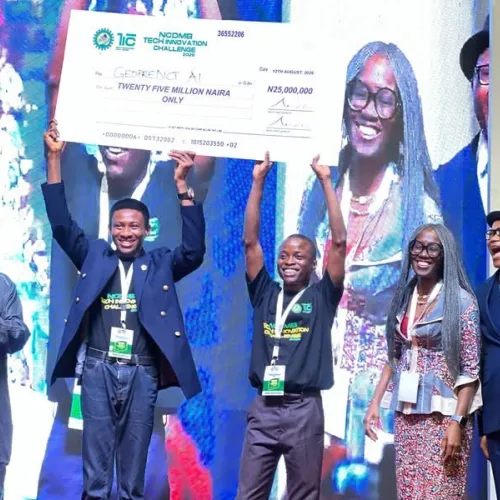
First prize went to GeoPredict AI. The platform uses artificial intelligence to interpret well logs for Nigerian independent operators — returning rock type at every depth, with a confidence score, in seconds. The economics are straightforward: Nigerian independents currently spend significant sums on foreign software licences and expatriate petrophysicists. GeoPredict AI is priced per well, runs entirely in-country, and operates at TRL 7. It is not a research project. It is a product.
FrassPlus took second prize. It is a bio-augmented crude oil spill remediation solution that uses Black Soldier Fly Larvae to break down total petroleum hydrocarbons in contaminated soil — achieving up to 84 percent reduction within fourteen to twenty-one days at 60 percent lower cost than conventional chemical methods. It is 100 percent locally produced, has no chemical footprint of its own, and addresses one of the most persistent and politically sensitive challenges in the Niger Delta.
The Organic Battery — developed under the project name Metallocene — claimed third prize. Built from locally sourced organic and inorganic materials with a sodium-ion and starch composite electrolyte, it provides backup power for pipeline monitoring nodes, control systems, and remote field sensors. As Nigeria’s oil and gas infrastructure becomes increasingly digitised, the demand for locally maintainable, reliable power storage will only grow. This battery is designed for exactly that application.
What Comes Next
The top ten finalists from Stage 4 — not only the three prize winners — qualify for a three-month Post-Competition Incubation Programme jointly managed by EICL and NCDMB, running September through November 2026.
The programme is structured around four readiness milestones: a signed Letter of Intent with an operator, a confirmed funding commitment, or a demonstrated Technology Readiness Level of 7 or above. These are not consolation prizes. They are deployment targets.
A broader community infrastructure is also being established. The Energy Research Innovators Network (ERIN) will serve as the TIC’s permanent nationwide community — open to all applicants, finalists, energy researchers, and industry professionals. The intent is to build a compounding pool of talent and proven innovations that future TIC cycles can draw from, so that each edition of the competition begins further along than the last.
The test of what the TIC 2026 has produced is not what happened in Yenagoa in August. It is whether GeoPredict AI signs an operator contract in the next twelve months. Whether FrassPlus deploys on a Niger Delta remediation site. Whether the Metallocene battery powers a pipeline sensor network. The competition is over. The work is just beginning.


Ifeoma Okeke-Korieocha is the Aviation Correspondent at BusinessDay Media Limited, publishers of BusinessDay Newspapers. She is also the Deputy Editor, BusinessDay Weekender Magazine, the Saturday Weekend edition of BusinessDay. She holds a BSC in Mass Communication from the prestigious University of Nigeria, Nsukka and a Masters degree in Marketing at the University of Lagos. As the lead writer on the aviation desk, Ifeoma is responsible and in charge of the three weekly aviation and travel pages in BusinessDay and BDSunday. She also overseas and edits all pages of BusinessDay Saturday Weekender. She has written various investigative, features and news stories in aviation and business related issues and has been severally nominated for award in the category of Aviation Writer of the Year by the Nigeria Media Nite-Out awards; one of the Nigeria’s most prestigious media awards ceremonies. Ifeoma is a one-time winner of the prestigious Nigeria Media Merit Award under the 'Aviation Writer of the Year' Category. She is the 2025 Eloy Award winner under the Print Media Journalist category. She has undergone several journalism trainings by various prestigious organisations. Ifeoma is also a fellow of the Female Reporters Leadership Fellowship of the Wole Soyinka Centre for Investigative Journalism.
Comments
Start the conversation about this story.