





There is a new kind of power in Nigeria, and it does not always come with a political office, a university degree or a boardroom seat. Sometimes, all it requires is a smartphone, a large following and the ability to keep people angry.
Social media was supposed to democratise voices. It was supposed to give ordinary Nigerians the opportunity to speak, organise, build businesses, expose wrongdoing and hold powerful people accountable. And, to a large extent, it has done exactly that.
But something else has happened.
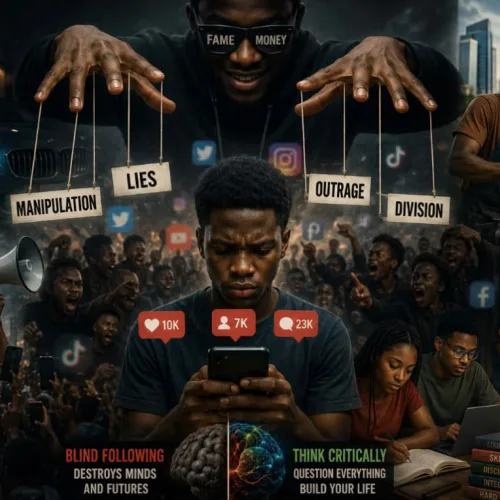
A new generation of online personalities has emerged—people who present themselves as defenders of the Nigerian youth, champions of justice and voices for change, while sometimes building their influence around outrage, personal attacks, sensationalism and division. Some have accumulated enormous followings and financial rewards by keeping their audiences emotionally engaged.
The uncomfortable question is: Are we building genuine agents of change, or are we manufacturing influencers whose greatest product is outrage?
I have often heard Nigerians describe young people as lazy. I disagree with that sweeping conclusion.
Nigeria has millions of hardworking young people. Young Nigerians are building businesses from nothing, learning skills online, creating technology, working multiple jobs, producing music, developing content, studying, farming and finding innovative ways to survive in one of the world’s most challenging economic environments.
The problem is not that Nigerian youths are lazy.
The problem is that a relatively small number of people can create enormous noise online, and that noise sometimes becomes the picture the rest of society sees.
The young entrepreneur working twelve hours a day is unlikely to spend his entire day fighting strangers on social media. The student trying to build a career has little time to become a permanent keyboard warrior. The young person learning a trade, running a business or pursuing an education is generally too busy building a future to spend every waking hour attacking people on behalf of an internet personality.
Yet the loudest voices can dominate the conversation.
And once someone acquires enough followers, influence can quickly become a weapon.
We have seen situations where online personalities become involved in disputes between individuals, businesses or public figures, and their followers are mobilised against whoever has become the target. Sometimes the followers do not know the full story. They simply know who they are expected to support.
This is where fandom becomes dangerous and influence becomes manipulation.
A person with thousands or millions of followers can say something in seconds, and hundreds of people may immediately repeat it without checking whether it is true. A rumour can become a “fact”. An accusation can become a conviction. A disagreement can become a digital mob.
And someone can make money from the entire process.
This should concern all of us.
We must begin asking ourselves why we are so willing to hand enormous power to people simply because they have mastered social media.
A large following does not automatically mean wisdom.
A viral video does not make someone an authority.
Being popular does not make someone truthful.
And calling oneself an activist does not mean everything one says is activism.
There are genuine activists doing important work in Nigeria. There are young people using social media to expose corruption, advocate for human rights, raise money for vulnerable people, educate the public and demand better governance. They deserve recognition.
But genuine activism should be distinguished from influence built primarily around personal attacks, misinformation, manipulation and incitement.
Nigeria must become better at making that distinction.
The danger becomes even greater when powerful individuals recognise that an online personality can be used to fight their battles. Instead of confronting an opponent directly, they may benefit from an army of followers attacking that person online.
The influencer gains visibility.
The supporters believe they are defending a cause.
The person behind the scenes achieves an objective.
And society becomes more divided.
Who, then, is really winning?
Certainly not the young Nigerian who has spent six hours insulting a stranger online.
Certainly not the parent whose child has become obsessed with online battles.
Certainly not the society becoming increasingly comfortable with abuse, threats and misinformation.
And certainly not Nigeria.
This is why parents need to start taking social media education seriously.
We teach children how to cross the road. We teach them not to talk to strangers. We teach them to protect their homes and possessions. But increasingly, we hand them smartphones without teaching them how to protect their minds.
A child who enters social media without critical-thinking skills can easily become somebody else’s audience, soldier and source of income.
Parents should teach children to ask questions before sharing information: Is it true? Who benefits from me believing it? What evidence supports it? Could my reaction hurt someone?
Schools should also teach digital literacy, responsible online communication and media awareness. Young people need to understand that social media content is often designed to provoke a reaction because attention has economic value.
We must also teach them that typing something behind a screen does not remove responsibility.
If you insult someone, threaten someone, spread false information or participate in coordinated harassment, the fact that you were sitting behind a phone does not make the consequences disappear.
There should be accountability.
But accountability must be applied fairly and within the law—not through arbitrary censorship or political manipulation.
The government also has a responsibility to strengthen institutions that deal with online harms while protecting legitimate freedom of expression. Platforms should be encouraged and, where appropriate, legally required to address clearly unlawful content, threats, coordinated harassment and other serious abuses through transparent procedures.
But regulation alone will not solve this problem.
The most powerful regulation may ultimately be the decision of ordinary Nigerians to stop rewarding destructive behaviour with attention.
Every time we share a lie because it is entertaining, we help spread it.
Every time we attack someone because an influencer told us to, we surrender our judgement.
Every time we celebrate cruelty because it is directed at someone we dislike, we lower the standard for everyone.
And every time we blindly defend a personality without knowing the facts, we give away a piece of our independence.
There is nothing wrong with following someone online.
There is nothing wrong with supporting an activist, comedian, journalist, entrepreneur, musician or content creator.
There is nothing wrong with disagreeing passionately.
But we must never surrender our ability to think.
Nigeria does not need more digital soldiers. Nigeria needs more builders.
We need young people who will use social media to learn, create, educate, organise constructive campaigns, build businesses and develop solutions.
We need parents who will ask their children what they are consuming online.
We need schools that teach critical thinking.
We need influencers who understand that influence is a responsibility, not a licence to destroy people.
And we need citizens who understand that every follower is not an instruction to follow blindly.
To those who have built platforms by presenting themselves as champions of the Nigerian youth, there is also a simple warning: influence is temporary.
The internet can make somebody famous overnight, but it can also turn against them just as quickly. A platform built on truth, service and genuine value has a stronger foundation than one built on manipulation, insults and manufactured outrage.
If your platform is being used to spread lies, provoke violence, destroy reputations or manipulate young people for financial gain, sooner or later, society will ask questions.
Everything that rises eventually faces the test of time.
The real measure of social media influence should therefore not be how many people you can mobilise to attack somebody.
It should be how many people you can inspire to become better.
Nigeria’s youth do not need people who will teach them whom to hate.
They need people who will teach them how to think.
And perhaps that is the conversation we should be having before we hand another generation of young Nigerians over to the loudest voice on the internet.
Author Bio
Tomilayo Imade is a Nigerian writer and project management professional based in England. Passionate about social justice and human-interest stories, she writes thought-provoking articles on culture, mental health, gender, and public affairs. Through her writing, she seeks to challenge harmful social norms, amplify everyday experiences, and inspire meaningful conversations that drive positive change.


Comments
Start the conversation about this story.