





Nigerian Universities have been charged to embrace Artificial Intelligence (AI), innovation, stronger governance and strategic partnerships for them to remain relevant in a rapidly changing world and meet the expectations of the country’s growing population.
The charge was made on Tuesday at the 37th Annual General Assembly and Conference of the Committee of Vice Chancellors of Nigerian Universities (CVCNU), hosted by the University of Ilorin, with the theme: “Building Resilient Universities for Nigeria.”
The Chairman of the CVCNU and Vice Chancellor of Igbinedion University, Okada, Prof. Lawrence Ikechukwu Ezemonye, said the Nigerian university system had reached a critical point where mere survival was no longer sufficient.
Ezemonye said universities must transform themselves into centres of innovation, ethical leadership, research and national development rather than remain detached from the needs of society.
“We meet at an hour when the Nigerian university is being tested as it has seldom been tested since the years immediately after independence.
“The test is not of our survival, for we have survived much. It is of our relevance to a young, restless and expectant nation,” he said.
He said the resilience of universities must go beyond coping with inadequate funding, industrial disputes, population pressures, technological disruption and the migration of skilled academics.
According to him, resilient universities must be able to adapt to emerging realities while retaining their core responsibilities of teaching, research, character formation and service to society.
He identified governance and financial sustainability, artificial intelligence and technology-driven transformation, university-government-industry relations, as well as human capital, academic excellence and the welfare of students and staff as critical areas requiring urgent attention.
Ezemonye warned that Nigeria could not achieve sustainable development without a strong university system capable of producing the professionals, researchers and leaders required to drive the economy.
“Those institutions have produced the doctors who staff our hospitals, the engineers who build our infrastructure, the lawyers who argue our cases, the scientists who conduct our research, the administrators who govern our public institutions and the leaders who have shaped our national life,” he said.
He, however, cautioned that the country could not continue to depend on the achievements of previous generations, stressing that universities must be repositioned to respond to artificial intelligence, demographic growth and increasing global competition.
“Inheritance is not destiny,” Ezemonye declared, urging university authorities to rebuild their institutions to become “fit for purpose” in the emerging global environment.
The CVCNU Chairman also called for a change in the perception of universities as isolated “Ivory Towers”, saying they should instead serve as innovation engines, knowledge centres, community anchors and the nation’s compass for ethical leadership.
He urged participants at the conference to confront the challenges facing the sector honestly and produce practical, evidence-based solutions.
“The challenges before us are too grave and too urgent to be obscured by politeness or deference. We must speak plainly about the failures of the past and the demands of the future,” he said.
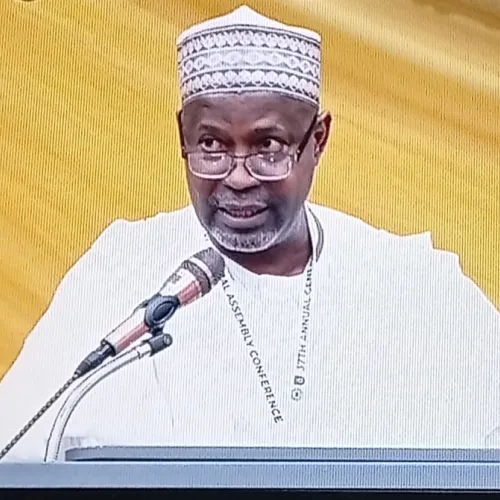
Also speaking at the conference, the Executive Secretary of the National Universities Commission (NUC), Prof. Abdullahi Yusufu Ribadu, warned universities against violating newly approved regulatory guidelines, particularly on the conferment of honorary doctorate degrees.
Ribadu said universities must not award more than three honorary doctorates at a single convocation and warned that serving public office holders should not be recipients of such honours under the new guidelines.
“It has been bastardised in the past. So, for now, we say please, you are doing well. When you leave office, the university will honour you,” he said.
The NUC boss disclosed that institutions that breach the guidelines could face sanctions, including suspension or refusal of resource verification for new academic programmes for up to two years.
“One of which is suspension or refusal by NUC to do resource verification for new programmes,” he said.
He warned that the sanction could affect universities seeking approval for programmes in emerging fields such as artificial intelligence, data science and robotics.
“If you wish to do that and you have violated the guideline, the punishment is we will not resource-verify your institution. And you cannot do it for two years,” Ribadu said.
The NUC executive secretary said the commission was pursuing reforms aimed at expanding access to university education while strengthening quality assurance, digitisation, research, innovation and the academic calendar.
He announced plans to introduce “Blueprint 2.0”, which he described as a roadmap for the sustainable transformation of the Nigerian university system.
“Blueprint 2.0 is not intended to become just another policy document. Its implementation will be monitored continuously with regular assessments of progress and adjustments made when necessary,” he said.
Ribadu said the NUC would also further digitise its operations, particularly resource verification, allowing universities to submit applications and receive responses electronically.
He disclosed that the commission would hold a retreat with vice-chancellors in October to address challenges peculiar to federal, state and private universities.
On curriculum development, Ribadu said universities currently had 30 per cent flexibility to introduce innovations relevant to their institutions, adding that the commission would review the arrangement in two years and could increase the flexibility to 50 per cent.
He, however, stressed that increased access to university education must not be achieved at the expense of quality.
“We have to maintain quality,” he said.
Ribadu also called for greater cooperation between the NUC and university authorities, saying, “Let us work together. We are one government. We can work together. Let us collaborate.”
In a related call for institutional stability, the Chairman of the Committee of Pro-Chancellors of Nigerian Federal Universities, Prof. Ahmed Yayale Ahmed, urged Vice-Chancellors and Governing Councils to end rivalry and embrace partnership in the management of universities.
Ahmed said the complex challenges confronting higher education required trust, transparency and a shared sense of purpose between university management and governing councils.
“Governing Councils are supervisory and advisory organs constituted by Government to support good governance and ensure the smooth and effective running of our institutions,” he said.
He urged councils to provide guidance and oversight without interfering in the day-to-day administration of universities, while also advising Vice-Chancellors to respect the statutory responsibilities of Governing Councils.
“Council must supervise without micromanaging, while Management must exercise its authority without shutting Council out,” Ahmed said.
He warned that universities could ill afford leadership conflicts at a time when they were struggling with funding pressures, technological disruption, global competition and demands for greater accountability.
“Our universities cannot afford leadership conflicts. The challenges confronting Nigerian higher education are simply too significant for Pro-Chancellors and Vice-Chancellors to expend valuable time and resources competing for authority,” he said.
Ahmed called for a shift from rivalry to partnership, suspicion to transparency and confrontation to constructive engagement.
He also advocated closer cooperation between the Committee of Pro-Chancellors and the CVCNU, saying both bodies had important roles to play in building a resilient and globally competitive university system.
“There is much that our two bodies can achieve when we speak to one another, understand our respective responsibilities and work together in the overall interest of Nigerian higher education,” he said.
The conference, which brought together vice-chancellors, pro-chancellors, regulators and other stakeholders in the education sector, is expected to produce recommendations on governance, innovation, funding, digital transformation, academic excellence and institutional resilience.
The CVCNU Chairman expressed confidence that the deliberations would provide practical pathways for repositioning Nigerian universities.
“I am firmly convinced that the deliberations of these two days shall serve, in perpetuity, the cause of a resilient, resurgent, and enduring Nigerian university system,” Ezemonye said.
He commended President Bola Ahmed Tinubu, represented by the Minister of State for Education, Prof. Suwaiba Sa’idu Ahmad; Kwara State Governor AbdulRahman AbdulRazaq; the NUC Executive Secretary, Prof. Abdullahi Yusufu Ribadu; keynote speaker Prof. Emeritus Ishaq Oloyede; and the University of Ilorin, led by its Vice-Chancellor, Prof. Wahab Olasupo Egbewole, SAN, for supporting the conference.
Please follow and like us:
Comments
Start the conversation about this story.