





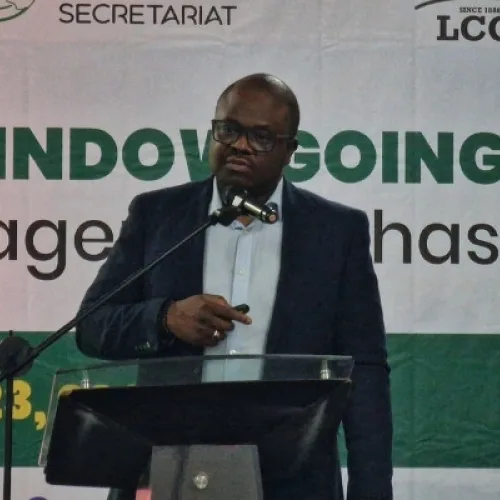
Tola Fakolade, director of the National Single Window (NSW) Secretariat. ©BusinessDay2026
…platform processes N11.27bn worth of payments since March launch
Nigeria’s National Single Window (NSW) will commence its second phase by the end of November, expanding the platform to export-related processes and permits for goods moving through the country’s free trade zones.
Peter Ekunkoya, director of operations at the National Single Window Secretariat, disclosed this on Tuesday during an online engagement with free trade zone operators, saying Phase 2 also involves moving sea manifest submissions onto the platform, an initial part of the first phase.
Phase two will open the NSW to submission and processing of non-oil export licences, permits and certificates, import and export permits for free zones and performance monitoring, operational reports and dashboards.
This month, the secretariat will complete gap analysis and development of future-state export processes, including recommendations for the Central Bank of Nigeria, NEPZA, free trade zones and other export-related MDAs.
System customisation and configuration are scheduled for September, followed by user acceptance testing in October. End-user training for government agencies and private-sector stakeholders will take place in November, followed by pilot testing with selected stakeholders before full go-live at the end of the month.
Spirited participation trails launch
The government went live with Phase 1 of the NSW on March 27 as part of efforts to consolidate trade-related government processes on a single digital platform and reduce duplication in the issuance of permits and approvals.
Read also: Explainer: What to know as Nigeria’s National Single Window goes live March 27
Since the launch, the platform has processed N11.27 billion worth of payments and 114,112 licences and permits, while 10,818 importers and agents have been registered, according to official data presented by the director.
Five government agencies including the Standards Organisation of Nigeria (SON), National Agency for Food and Drug Administration and Control (NAFDAC), Nigeria Customs Service, Nigeria Agricultural Quarantine Service (NAQS) and National Environmental Standards and Regulations Enforcement Agency (NESREA), have been fully integrated into the platform. The five agencies, alongside importers and freight forwarding and clearing agents, have achieved full platform usage compliance.
SON accounted for the largest volume of documents processed, with 78,957 documents valued at N9.02 billion. NAFDAC followed with 34,815 documents valued at N2.20 billion, while NAQS processed 38 documents valued at N30 million and NESREA 311 documents valued at N10 million.
Customs-related transactions, as well as documents processed by importers and freight forwarders, were not assigned monetary values.
Air cargo processing also recorded agile participation, with 24 of 27 airlines onboarded and 2,139 manifests transmitted through the platform. However, adoption among shipping lines remains lower, with 23 of 88 shipping lines onboarded and 43 manifests transmitted.
As of May 22, the platform had registered 7,567 users, 6,935 of which were importers. This was alongside 359 clearing and forwarding agents, 169 licensed customs agents and 104 freight forwarders.
Read also: Foreign carriers join Nigeria’s Single Window as importer adoption nears 7,000
Ekunkoya said the secretariat had identified gaps in the first phase that it intends to address before the second phase is deployed.
One of the major challenges was the integration and migration of data involving Customs, NAFDAC and SON, which affected the timely processing of Licences, Permits and Certificates (LPCOs) by traders.
To keep trade moving, the secretariat introduced a manual LPCO upload option on the B’Odogwu platform to support Form M and Pre-Arrival Assessment Report processing.
It also introduced a temporary SONCAP default option for traders requiring SON regulatory clearance, extended expired licences by two months and engaged the Nigerian Shippers’ Council to negotiate demurrage waivers for affected traders and agents. Operators had initially complained that some traders were still being charged demurrage despite the intervention.
The existing approval backlog at NAFDAC was another constraint, creating a backlog of LPCO applications submitted through the NSW. The secretariat said it engaged the agency’s leadership to deploy additional personnel and resources to clear outstanding applications.
User adoption was also identified as an early challenge, requiring sustained end-user training and targeted learning materials. The timeline for this was therefore extended.
These experiences, Ekunkoya said, would shape Phase 2, with greater emphasis on “change management, broader stakeholder engagement, enhanced training and digital training aids, stronger data governance and wider coverage of customs support centres.”
The NSW currently has two customs support centres, one each in Lagos and Abuja, and plans to establish more, the director said. Meanwhile, the rationalisation of HS codes is also still ongoing.
Read also: National Single Window needs standalone law to survive, maritime lawyers tell FG
Free zones move onto NSW
A major component of the second phase will be the integration of Nigeria’s free trade zones into the NSW, allowing import and export-related permits for the zones to be processed electronically.
The secretariat said it is working with the Nigeria Export Processing Zones Authority (NEPZA) to determine how its existing One-Stop Shop (OSS) platform can be integrated with the NSW.
The aim, according to the secretariat, is to enable the electronic exchange of import and export application data, certificates of origin and bills of lading while allowing NEPZA to retain its existing business processes and systems.
Ekunkoya said the NSW team held a meeting with the managing director of NEPZA on July 28 on the proposed onboarding of NEPZA and the free trade zones, after which the authority nominated staff to work with the NSW team.
The technical teams have since held three engagements and are now working towards implementation.
The NSW and NEPZA teams are expected to assess NEPZA’s end-to-end business processes in August to identify areas for improvement and confirm the key points for integration and data exchange.
A technology readiness assessment of the NEPZA OSS and free zone systems is also scheduled for the third week of August to determine their readiness for integration.
By September, there is a planned stakeholder engagement with free trade zone operators.
“The Integration between the NEPZA OSS and the NSW will enable seamless exchange of Manifest, Bill of Lading, and other trade-related information, improving cargo visibility, strengthening data validation and reconciliation, and supporting more efficient movement of goods between Free Trade Zones and the Nigerian Customs Territory,” the secretariat said.
Phase 3
The third phase of the NSW is scheduled for the second quarter of 2027 and will expand the platform further to cover oil and gas permits, Form M processing, advanced risk analytics, a Trade Visualisation System, declaration process initiation and duties assessment.


Bethel Olujobi reports on trade and maritime business for BusinessDay with prior experience reporting on migration, labour, and tech. He holds a Bachelor's degree in Mass Communication from the University of Jos, and is certified by the FT, Reuters and Google. Drawing from his experience working with other respected news providers, he presents a nuanced and informed perspective on the complexities of critical matters. He is based in Lagos, Nigeria and occasionally commutes to Abuja.
Comments
Start the conversation about this story.