





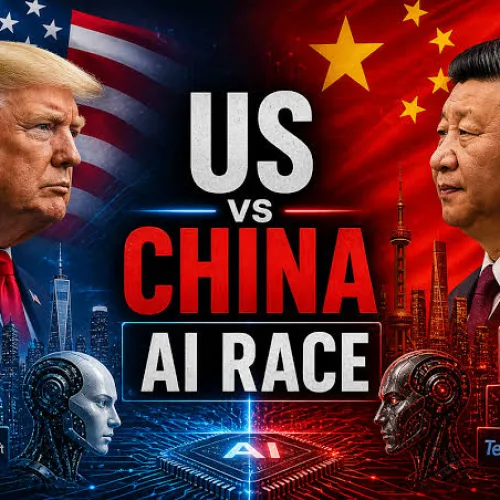
The Artificial Intelligence(AI) race between the United States(US) and China has entered a phase of who can build capable AI more cheaply, distribute it more widely, and turn it into infrastructure for businesses, governments, and consumers.
For years, the US appeared to have an overwhelming advantage. Companies such as OpenAI, Google and Anthropic built some of the world’s most advanced AI models, backed by huge investments, powerful data centres and access to leading AI chips.
China, however, is closing the gap rapidly, and the competition is no longer simply about which country can build the smartest chatbot. Recent developments show why the balance is changing.
Why does the US lead AI?
The US has several major advantages because its technology industry has produced the world’s biggest AI companies and a powerful ecosystem connecting model developers, chipmakers and cloud providers.
Nvidia supplies much of the advanced computing hardware used to train AI models, while Microsoft, Amazon and Google operate enormous cloud infrastructures.
American companies also have access to vast amounts of private capital. This has allowed them to spend billions of dollars developing sophisticated frontier models. OpenAI, Anthropic and Google remain major players in the race for advanced reasoning, coding and AI-agent capabilities.
Having the most expensive and powerful models does not necessarily mean winning every part of the AI market. This is where China is becoming competitive.
How is China catching up?
China’s strategy has focused on efficiency and open-weight AI. Instead of keeping models completely behind commercial APIs, companies such as Alibaba, DeepSeek and Z.ai have released models that developers can download, customise and build upon.
This makes Chinese AI attractive to businesses and developers that cannot afford expensive access to frontier American models.
In August, Alibaba introduced Qwen3.8-Max, which it described as its most capable AI model. The company said its performance was comparable to leading US systems.
More recently, Alibaba said its Qwen models had accumulated more than 3 billion downloads in six months, with hundreds of thousands of derivative models built from the Qwen ecosystem.
This figure is important because downloads show a different kind of AI influence from chatbot subscriptions. An open model can become the foundation for thousands of other AI applications.
What did DeepSeek change?
DeepSeek was one of the biggest turning points, as its emergence challenged the assumption that developing competitive AI requires enormous amounts of computing power and money.
The company demonstrated that highly capable models could be developed with a strong focus on efficiency, creating pressure on American AI companies to reconsider how much users should pay for AI.
DeepSeek’s latest generation has continued that strategy, while Chinese competitors such as Alibaba and Z.ai have increased their own model releases. The result is a competitive Chinese AI market, with companies racing to improve performance while cutting costs.
What is China’s biggest advantage?
Imagine two AI models that perform similarly. One costs significantly more to use and can only be accessed through a company’s platform. The other can be downloaded, modified, and deployed on a company’s own infrastructure.
For many developers, the second option is more attractive, and this is important in emerging markets, where businesses may be more sensitive to AI infrastructure and API costs.
China’s open-weight strategy could therefore give its models a route into international markets even when American companies retain an advantage at the frontier.
A recent analysis by the Financial Times argued that China’s growing strength in low-cost, open AI could become a new form of technological competition, particularly as US restrictions push China towards greater self-reliance.
Does China have better AI than America?
The US still has major strengths in frontier AI, capital, computing infrastructure, and the commercial ecosystem surrounding AI.
Similarly, Chinese models are competitive on coding, reasoning, and agentic tasks. The Center for Strategic and International Studies noted in July that recent Chinese models were performing close to leading US systems on major benchmarks, which suggests that DeepSeek’s earlier breakthrough was part of a broader trend rather than an isolated event.
The gap is narrowing, but it would be misleading to say China has simply overtaken the US across the board.
Why are AI chips so important?
AI models require enormous computing power to train and operate, which makes advanced semiconductors a strategic weapon in the US-China competition.
Washington has imposed restrictions intended to limit China’s access to the most advanced AI chips and semiconductor technology. However, China’s heavy investment has created an unusual dynamic.
The US is trying to slow China’s access to the hardware needed to build frontier AI, while Chinese companies are trying to compensate through more efficient models and domestic technology.
The fact that Chinese companies continue releasing competitive models despite these constraints has become one of the most important developments in the race.
Why is the competition becoming geopolitical?
Artificial Intelligence is connected to national security, defence, telecommunications, cloud computing and economic power. The rivalry has now moved beyond technology companies.
The US is building international partnerships around AI and semiconductor supply chains, while China is promoting its own international AI relationships.
Reuters reported in August that Washington was preparing to push some countries to choose between US-led and China-linked AI initiatives, which illustrates how AI cooperation is becoming part of wider geopolitical competition.
The question will no longer simply be whether a country uses ChatGPT, Qwen, or another AI model. It is about whose technology becomes embedded in its digital infrastructure.
Who is winning?
The US remains extremely strong in frontier AI, computing infrastructure, capital, and commercialisation.
However, China is demonstrating remarkable speed in developing competitive models and has created an influential open-weight ecosystem.
The latest Qwen figures show more than three billion downloads, which means Chinese AI is becoming part of the global developer ecosystem.
The winner may not ultimately be the country with the single smartest AI model, but it could be the country whose AI becomes cheapest to use, easiest to customise and most deeply integrated into everyday technology and business.
For now, the US still has the strongest overall position, but China is no longer simply trying to catch up as it is developing a different route to AI leadership, and the speed at which that strategy is gaining traction is forcing American companies and policymakers to respond.
Get Newsletter Updates
Enjoying our column?
Subscribe to our specialised **Tech Pulse** feed to receive fresh reports and analyses directly in your inbox.


Folake Balogun is a technology journalist covering Africa’s digital economy, with a focus on startups, fintechs, venture capital, artificial intelligence, and emerging technologies. Her work explores the intersection of technology, business, and society, highlighting how innovation is reshaping industries and everyday life across Africa and global markets. She translates complex trends into insightful and impactful stories for a wider audience.
Comments
Start the conversation about this story.