





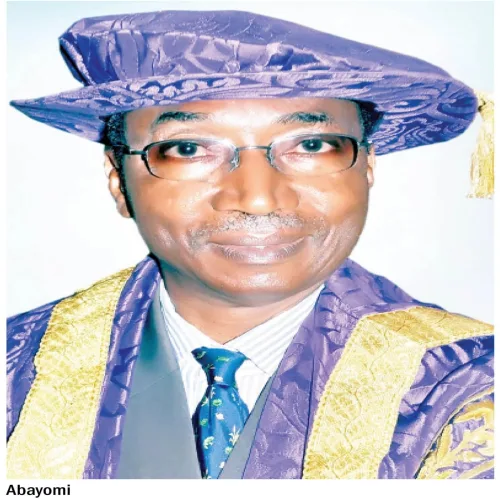
Dr Tunji Abayomi, a human right lawyer is the outgoing Pro- Chancellor and Chairman, Governing Council of Adekunle Ajasin University, Akungba-Akoko (AAUA). After eight years in the saddle, he speaks with HAKEEM GBADAMOSI, and reflects on the institution’s achievements, funding challenges, academic staffing and future prospects, offering advice to the incoming leadership. Excerpts:
Funding is a major challenge for universities. What is AAUA’s Governing Council doing to address it, and why does the problem persist?
There are several things we have done to keep the university running despite the funding challenges. We decided to do whatever we could through our own efforts. For instance, the Senate Building had a serious leakage problem, and after efforts to get government support did not yield the expected result, the Council mobilised resources to fix it. Today, the building is no longer leaking.
We also initiated the construction of a legacy hostel for students, with members of the Council and other stakeholders contributing from their allowances. These are some of the sacrifices we have made internally.
Of course, we continue to engage government because it remains a major stakeholder in funding public universities. The bigger issue is prioritisation. In developed countries, there is a strong understanding that knowledge and education are the foundation of development. That is why universities like Harvard have huge endowment funds to support research and innovation.
Unfortunately, that level of commitment is not yet common in developing countries. Universities are citadels of ideas, and virtually every sector—from agriculture and healthcare to technology—depends on research from universities.
Government, particularly state governments, therefore needs to prioritise university education and provide adequate funding. The problem is that governments are often eager to establish universities but less willing to fund them adequately. Education is expensive, but it is an investment in development. Now that states are receiving more resources, more attention should be given to education, research and development. If our universities are properly funded, they can contribute significantly to solving Nigeria’s development challenges.
But looking back at the AAUA you met years ago, what major changes have you witnessed in the university, and what is your vision for the AAUA you hope to see in the coming years?
When I became the first Chancellor of this university in 2018, I was shocked by the level of infrastructural and funding challenges. I remember requesting some documents and being told they had to be photocopied outside because the university could not afford a photocopying machine. At the time, the machine cost more than what students were paying as tuition. That situation showed us that something had to change and partly informed the modest increase in school fees. Students were then paying between N25, 000 and N35, 000, which was inadequate to provide basic facilities, laboratory reagents and other necessities.
Today, AAUA’s fees remain among the lowest, if not the lowest, among state universities. We have also introduced concessions, including a 50 per cent reduction in fees for students with disabilities and the option of paying in installments. Looking ahead, our vision is to have a university led by capable and visionary administrators. We believe we have achieved that with the appointment of Professor Obamuyi as Vice-Chancellor and other principal officers. We are confident that within the next two years, AAUA will become a 21st-century university, capable of competing with leading universities in Africa and across the world.
Well, I think there is a difference between saying we are finding it difficult to maintain what we have, and saying we are struggling to maintain what we have. What we are doing is struggling very hard and very successfully to maintain what we have. The reason why we have problems, of course, is also dependent on the government. If you have a university that you cannot take for granted, capital budget, capital funds for capital development, where you get nothing from government for capital development, how do you think we will be constructed? And it is important. We should be able to construct our own roads. If we get capital fund support, we should be able to build our own buildings. This university has not received capital vote for several years. We want to develop the environment and make it beautiful. We are located in fantastic places, look at the beaches. We even want to develop tourism. We want to establish power, both for the university and the local community, and make money. But how do you do all of this without capital funding?
READ ALSO: Why Nigerian universities lack sustainable funding — TETFund boss
Given the university’s funding, infrastructure and staffing challenges, how sustainable is this expansion with the creation of new faculties?
Well, I think there is a difference between saying we are finding it difficult to maintain what we have, and saying we are struggling to maintain what we have. What we are doing is struggling very hard and very successfully to maintain what we have. In the same manner, we are struggling to ensure that we maintain the new faculties. Because I talked to the students, and I mean, you obviously know the rating of this university. For the position of the Vice Chancellor, when we advertised, we had 15 extraordinary scholars from all over the world. 15 extraordinary scholars. Out of those 15, we now have to choose three super-extraordinary scholars. Out of 15 extraordinary scholars, we choose three super-extraordinary scholars. You just have to read their profile to know the rating of the university. The reason why we have problems, of course, is also dependent on the government. If you have a university that you cannot take for granted, capital budget, capital funds for capital development, where you get nothing from government for capital development, how do you think we will be constructed? And it is important. We should be able to construct our own roads. If we get capital support, capital fund support, we should be able to build our own buildings. This university has not received capital for several years. It just hasn’t. We want to develop the environment and make it beautiful. We are located in fantastic places, look at the beaches. We even want to develop tourism. We want to establish power, both for the university and the local community, and make money. But how do you do all of this without capital funding? So, yes, it remains a major problem. But we are struggling. And this is also why we are speaking out. We are struggling. We are still alive. But we don’t want to be choked to the point that the university cannot breathe.
Some departments, including mass communication, have very few academic staff. What is being done to address this?
This is one of the priorities of the new Vice-Chancellor. He has assured us that strengthening academic staffing and retaining distinguished academics will receive urgent attention. One of the challenges is the “Japa” syndrome, partly driven by poor remuneration for academic staff. Recruiting and retaining academics also requires adequate funding, infrastructure and other facilities. The Vice-Chancellor is taking the issue seriously, and with increased financial support, we believe these challenges can be addressed. If we get the necessary resources, we will produce some of the best journalists and professionals in the country.
What measures is the university taking to boost internally generated revenue and reduce its dependence on government funding?
The university is doing a lot in this area. Internal revenue generation is one of the priorities of the new management. There are several areas of opportunity, including agriculture, performing arts, ICT and laboratory technology. We are encouraged by the commitment of the new Vice-Chancellor to explore these opportunities. The university has had to generate revenue internally to meet its obligations, including salaries, because government funding has not been sufficient. Ideally, AAUA needs about N12 billion annually to operate effectively. Government should provide at least N6 billion, while the university should be able to generate a significant portion of the balance internally.
As a lawyer leading a Governing Council of distinguished academics and professionals, how challenging was it to lead such a diverse team
The work was challenging, but it was made easier by the quality of people on the council. We had physicians, professors, engineers, architects, financial experts, former university registrars and other distinguished professionals. Despite our diverse backgrounds, we worked together effectively, discussing and resolving issues collectively with the best interest of the university in mind.
It has been a great honour to serve as Pro-Chancellor and Chairman of the Governing Council. Over the eight years, we have worked to build and rebuild Adekunle Ajasin University, and I am proud of what the Council has achieved.
What would you consider your greatest achievement as Council Chairman, and what were your best and most difficult moments?
One of our greatest achievements was the establishment and development of new faculties, particularly the medical and business schools. We also made significant progress in agriculture and established new departments and programmes. Another major achievement was maintaining peace and stability in the university throughout our tenure, alongside increased academic activities such as inaugural lectures. The most difficult period was the COVID-19 pandemic, which disrupted academic and administrative activities. Today, we are proud of the quality of scholars in AAUA. Some of our scientists are ranked among the world’s top two per cent of researchers, which is a major source of pride for us.
What is your advice to the incoming chancellor?
My advice is for the incoming chancellor, council and management to work together in harmony. Conflict only distracts from achievement and weakens the collective strength of an institution. There are often conflicts between governing councils and university management, particularly between the Pro-Chancellor and Vice-Chancellor. The Pro-Chancellor should not be overbearing, while the Vice-Chancellor must also be willing to listen and respect the council. They must work together with humility and mutual respect. I believe excellence can be found in everyone. What often separates people is opportunity. I grew up in Oke-Agbe and lost my father when I was about one and a half years old. My mother was an uneducated woman who struggled to raise me, yet I was later honoured by the University of Toledo as one of nine world-changing leaders.
So, anything is possible. My advice is that everyone should focus on the higher calling, the advancement of this university. We may disagree, but we should never become disagreeable. Issues should be debated vigorously and resolved in the best interest of the institution.
Comments
Start the conversation about this story.