






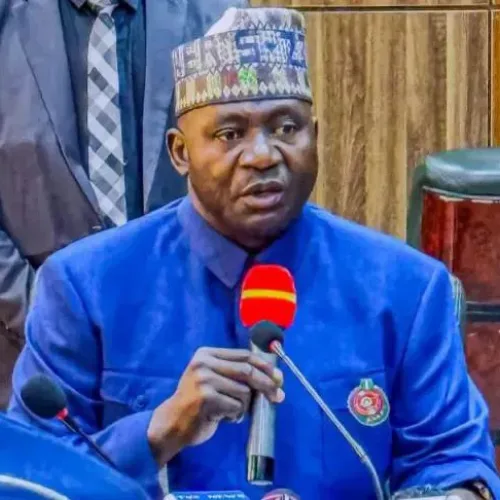
Minister of Defence General Christopher Gwabin Musa (retd.) has identified cyber attacks as the greatest threats to election security, adding that the nature of security threats has evolved over time from physical to cyberspace.
He also said no security architecture, regardless of how sophisticated, can guarantee peaceful elections if political actors choose violence over dialogue.
“The greatest threat to an election today may not necessarily be the individual carrying a weapon near a polling unit. It may well be the anonymous actor operating behind a computer screen, deliberately manipulating information, exploiting social divisions and attempting to weaken confidence in democratic institutions.
“This is why election security must now extend beyond physical protection to include cyber resilience, strategic communication and the defence of truth itself,” he said.
According to him, election security can no longer be viewed simply as the protection of polling stations, but fundamentally, the protection of democratic legitimacy.
The minister stated this Tuesday while delivering the keynote address at the 8th edition of Blueprint Newspapers Public Lecture/ Impact and Awards, with the theme: “Security Challenges and Integrity of Nigeria’s 2027 Elections.”
Represented by his special adviser on policy and research, Major-General Olufemi Akinjobi (retd.), Musa noted that digital revolution has transformed the information environment, adding that artificial intelligence has introduced extraordinary opportunities for development, innovation and governance, but it has also created new vulnerabilities.
“Today, sophisticated technologies can generate convincing but entirely fabricated videos, cloned voices and manipulated images capable of misleading millions of people within minutes.
“Across different parts of the world, we have already witnessed elections influenced by coordinated misinformation campaigns, cyber interference and malicious digital content designed to erode public confidence. Africa is not immune. Neither is Nigeria.”
The minister, however, lauded Nigeria’s resilience in protecting democratic institutions since the return of democracy in 1999, adding that remarkable progress had been made in defending Nigeria’s democracy.
“Confronting that evolving threat picture is not something we are starting from scratch. Nigeria’s democratic journey has been one of resilience, learning and continuous institutional improvement.
“Since the return to democratic rule in 1999, each electoral cycle has presented new challenges while also strengthening our collective capacity to respond to them.
“The 2023 General Elections demonstrated both the progress we have made and the areas where further improvement remains necessary. Security agencies undertook one of the largest coordinated election security operations in our democratic history, working alongside the Independent National Electoral Commission and other stakeholders to provide security across thousands of polling locations nationwide,” he said.
While acknowledging that there were isolated incidents in some areas in the 2023 elections, the minister said “millions of Nigerians exercised their democratic rights peacefully, reflecting both the resilience of our citizens and the dedication of those charged with protecting the process.”
Musa said election security is not achieved through last-minute deployments but achieved through months of planning, intelligence-led operations, inter-agency coordination, effective communication and continuous assessment of emerging threats.
“Security should never be viewed as an event. It is a process that begins long before campaigns commence and continues long after the final vote has been counted,” he said.
According to the minister, “if the threats confronting elections have evolved, then our response must evolve with them.”
Preparations for 2027
He said preparing for the 2027 General Elections should not simply be viewed as an operational exercise for Election Day.
“It must become a national project aimed at strengthening democratic resilience the capacity of institutions to withstand pressure without compromising their constitutional responsibilities, the ability of citizens to reject misinformation without abandoning trust, and the confidence that, regardless of political affiliation, every Nigerian can participate in the democratic process safely and freely,” he said.
Essence of dialogue
Speaking further, the guest speaker said, “No security architecture, regardless of how sophisticated, can guarantee peaceful elections if political actors choose violence over dialogue. No electoral law can succeed where misinformation is allowed to replace truth. No democratic institution can flourish where citizens lose faith in the rule of law.
“The responsibility before us is therefore shared. Political parties must place national interest above partisan advantage, and candidates must recognise that political competition is not warfare.”
Besides, the minister also noted that no electoral law could succeed where misinformation was allowed to replace truth, stressing that ensuring credible and peaceful elections was a shared responsibility among all stakeholders.
He also called on political candidates to recognise that political competition was not warfare and should not be treated as such.
Musa, however, proposed a six-point framework to strengthen election security ahead of next year’s election. The framework comprises strategic intelligence integration, threat assessment, protection of digital infrastructure, electoral cyber resilience, civil-military coordination, and unified strategic communications.
He said the proposed pillars would provide a practical pathway not only to securing elections but also to protecting the democratic legitimacy upon which national stability depends.
The minister assured that, as the country moves towards the 2027 elections, the Ministry of Defence would work closely with the Office of the National Security Adviser (ONSA), the Armed Forces of Nigeria (AFN), the Nigeria Police Force (NPF), the Department of State Services (DSS), the Defence Intelligence Agency (DIA), the Independent National Electoral Commission (INEC) and other relevant institutions.
According to him, the collaboration would ensure that all constitutionally assigned responsibilities in support of the electoral process are discharged professionally, impartially and effectively, stressing that the Armed Forces of Nigeria had no partisan interest in the outcome of the elections.
“Let me emphasise once again that the Armed Forces have no partisan interest in the outcome of elections. Our institutional interest is that Nigeria remains peaceful, united and secure, and that every lawful responsibility assigned to us is carried out with honour, professionalism and accountability. That commitment is unwavering,” he said.
“The Armed Forces owe allegiance neither to political parties nor to individual candidates. Our allegiance is to the Constitution of the Federal Republic of Nigeria. Our loyalty is to the Nigerian people. Our commitment is to peace, stability and the preservation of democratic order,” the minister further added.
The minister charged the media to maintain high standards of accuracy and responsibility in reporting the elections, while calling on civil society organisations to deepen civic education and promote peaceful participation.
The media must continue to report with courage, accuracy and restraint, while civil society deepens civic education and promotes peaceful participation,” he said.
He further urged traditional and religious leaders to remain voices of moderation and reconciliation in their communities, and called on young Nigerians to reject attempts to recruit them as instruments of violence or political manipulation.
“Our young people, whose energy and innovation will define Nigeria’s future, must reject every attempt to recruit them as instruments of violence or manipulation. Their talents are needed not to disrupt democracy, but to strengthen it,” he said.
Comments
Start the conversation about this story.