





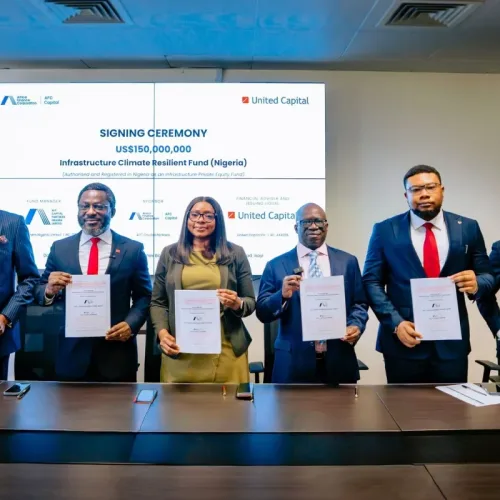
AFC Capital Partners (ACP), the asset management subsidiary of Africa Finance Corporation (AFC), has launched the Infrastructure Climate-Resilient Fund Nigeria (ICRF Nigeria), targeting $150 million to mobilise long-term domestic institutional capital for infrastructure projects.
The ICRF Nigeria, managed by ACP, has been registered with the Securities and Exchange Commission as a closed-end fund. It will channel domestic institutional capital into infrastructure projects in transport and logistics, renewable energy, digital infrastructure, and industrial development.
The Nigerian vehicle is part of ACP’s $750 million Infrastructure Climate-Resilient Fund, which has attracted capital from the Green Climate Fund (GCF), the European Investment Bank, the Development Bank of Southern Africa, Cassa Depositi e Prestiti, the Nigeria Sovereign Investment Authority, and African pension funds.
The wider fund has received a $253 million first-loss commitment from the GCF, its largest equity investment in Africa to date. ACP expects the broader vehicle to mobilise up to $3.7 billion and invest across 10 to 12 infrastructure projects in Africa.
The structure is designed to address a funding gap in infrastructure by combining institutional capital with concessional and commercial financing. The first-loss capital is intended to reduce investment risk and attract additional private capital into projects.
Samaila Zubairu, AFC’s president and CEO, said, “Africa is not short of capital. The continent holds more than $4 trillion in domestic resources, including significant pools of confidential long-term capital in pensions, insurance, and sovereign wealth funds. Yet too much of this wealth remains invested in low-risk, short-term instruments rather than being channeled into productive sectors such as infrastructure, industry, and innovation.
“The opportunity before us is to create investment vehicles that connect Africa’s long-term savings with its long-term development needs. ICRF Nigeria is an important step in that direction, enabling Nigerian institutional capital to participate in the infrastructure that will drive more resilient and sustainable growth across Nigeria and the continent.”
Ayaan Adam, CEO of ACP, said: “ICRF Nigeria gives Nigerian institutional investors a dedicated route into high-quality, climate-resilient infrastructure investments across Nigeria and Africa.
By combining institutional capital with AFC’s infrastructure expertise and the catalytic power of blended finance, we can address both the financing needs of critical infrastructure and the growing risks posed by climate change.
“Importantly, this creates an avenue for Nigeria’s long-term savings to contribute to infrastructure development while giving investors access to a diversified portfolio of opportunities across the continent.”
Gbadebo Adenrele, managing director and CEO, investment banking at United Capital, said, “Nigeria’s investment pool is channeled towards infrastructure, especially in the pension funds, estimated at N31 trillion right now and still growing,” Adenrele said.
He said infrastructure funds have received more investment in recent years, but the financing requirement remains above the capital available.
Africa’s infrastructure financing gap is estimated to be between $130 billion and $170 billion annually, according to Adenrele.
“That tells you that infrastructure financing in Africa is a major deficit there, and we all need to crowd in financing from institutional investors, from DFIs, large banks, and pension funds,” he said.
Adenrele said the success of the capital raise would depend in part on the ability of sponsors and other market participants to reduce risks associated with infrastructure projects.
“There’s a lot of de-risking that needs to continue to play out in the market,” he said. “A lot of market players, advisors, and sponsors are working together to de-risk projects and make sure that those projects are investable by investors.”
He added that investor interest in infrastructure funds has increased and said he expects the $150 million target to attract institutional participation.
David Johnson, chief risk officer of AFC, said ICRF Nigeria is intended to address the shortage of long-term, risk-adjusted capital for infrastructure projects that can generate commercial returns while accounting for climate risks.
“ICRF Nigeria is designed to address a critical market gap: the shortage of long-term, risk-adjusted capital for infrastructure that is both commercially viable and resilient to climate impacts,” Johnson said.
He said the fund will invest across the infrastructure value chain, from projects developed by AFC to projects that have reached maturity and require project finance.
“So the way ICRF will invest, it’s going to invest all along the value chain from projects that the parent company, AFC, will develop to mature projects,” Johnson said.
The Nigerian fund is targeting $150 million and plans to mobilise about 50 percent of its target at first close. It is focused on attracting long-term capital from pension fund administrators alongside other eligible domestic institutional investors.
Chika Dotimi-Beke, CFO of AFC Capital Partners Nigeria Limited, said securing institutional commitments is the next step following the fund’s registration with the SEC.
“Today marks the signing of an approved license from the SEC, and what we want to do is to get institutional investors to invest in the fund,” Dotimi-Beke said.
She said the fund will focus on transport and logistics, renewable energy, digital infrastructure, and platforms.
The first investment is expected before the end of 2026, with transport and renewable energy expected to receive the first allocations after the Nigerian fund reaches its first close.


Chinwe Michael is a financial inclusion advocate and economy journalist who uses compelling storytelling to drive awareness. With a background in Banking and Finance and experience across accounting, media, and education, she applies sharp analysis and attention to detail to every piece. She simplifies complex financial and economy concepts into engaging content for Africa and global audience. Chinwe also doubles as a speaker with global recognition for her expertise.
Comments
Start the conversation about this story.