





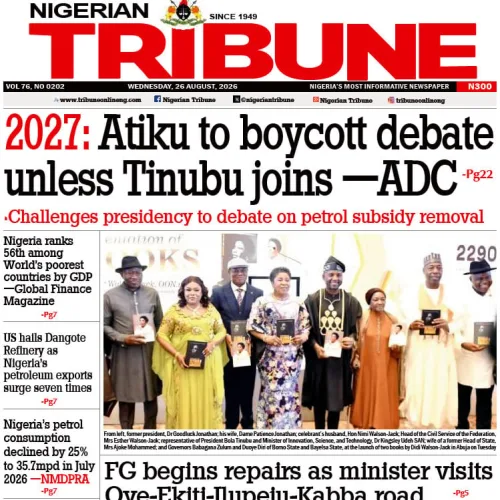
National Association of Nigerian Students (NANS) has faulted former Vice President and presidential candidate of the All Progressives Congress (APC), Atiku Abubakar’s proposal to return fuel subsidy, describing the position as a desperate political statement lacking the structural basis required to address Nigeria’s economic challenges.
NANS President, Comrade Akinteye Babatunde Afeez, said the position of the association was based on patriotism and objective assessment of government policies rather than partisan considerations.
Afeez, in a statement on Wednesday, said NANS had a responsibility to scrutinise policies affecting the country and speak whenever issues of national interest arose.
He said the removal of fuel subsidy was undoubtedly difficult for Nigerians, particularly because citizens had become accustomed to the benefits of the policy, but argued that the reform had become necessary because of its huge cost to the nation.
ALSO READ: Senator Arise tackles Atiku over plan to return fuel subsidy
According to him, Nigeria must critically examine the economic consequences of continuing to spend trillions of naira on fuel subsidy while critical sectors such as infrastructure and healthcare remain underfunded.
“Every sane and patriotic citizen who is conversant with our nation’s economy will agree with me that the removal of the fuel subsidy was a difficult but necessary economic reform aimed at ending an increasingly unsustainable system,” he said.
The NANS president noted that the subsidy regime had consumed enormous public resources, disproportionately benefited higher fuel consumers, encouraged smuggling and limited the government’s ability to invest in critical sectors.
He, however, acknowledged that the removal of the subsidy had brought significant short-term hardship through increased fuel, transportation and food costs.
Afeez said the ultimate test of the reform should therefore not be the amount of money saved by government, but how effectively the resources freed by the policy were deployed to improve the welfare of Nigerians.
He said increased government intervention in education, healthcare, infrastructure and agriculture would help ensure that Nigerians’ sacrifices translated into sustainable development.
The NANS president consequently rejected calls for an outright return of fuel subsidy without a clear structural framework for addressing the weaknesses that made the policy unsustainable.
He argued that Nigerians needed policies that addressed the root causes of the country’s economic difficulties rather than a return to a system whose long-term financial burden had become difficult for the country to sustain.
“As NANS President, my position is therefore clear: we must not allow the immediate pain of reform to make us abandon the need for reform itself,” Afeez said.
He urged the Federal Government to ensure that resources freed by subsidy removal were prudently deployed to improve the lives of Nigerians and produce tangible benefits from the sacrifices being made by citizens.
Afeez also urged all presidential aspirants ahead of the 2027 elections to present clear, sustainable and long-term economic policies capable of addressing Nigeria’s challenges.
He said political leaders seeking to govern Nigeria must look beyond policies designed merely to provide immediate comfort and instead pursue measures capable of strengthening the country’s economy over the long term.
The NANS president maintained that his position was not motivated by any candidate’s political aspiration but by what he described as the long-term prosperity of Nigeria.
He, therefore, called on Atiku to reconsider his position on fuel subsidy, arguing that returning to a system that required government to commit huge resources to subsidising petroleum consumption would undermine efforts to address the country’s infrastructure deficit and other development challenges.
Afeez said Nigeria could not afford to return to a situation where governments struggled to meet basic financial obligations while huge public resources were committed to fuel subsidy.
He urged all political actors to approach the 2027 elections with policy proposals capable of strengthening the Nigerian economy rather than reviving measures that, in his view, had become financially unsustainable.
Comments
Start the conversation about this story.