





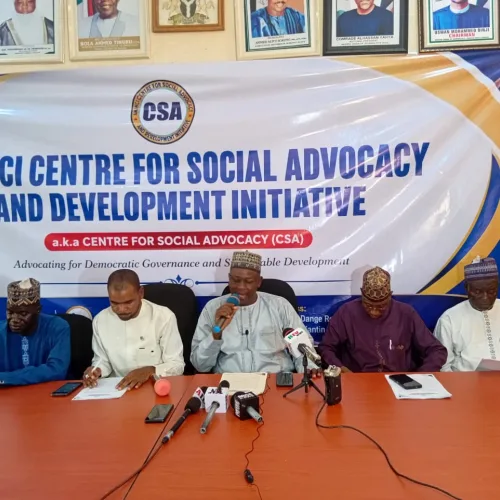
A group, under the platform of Aminchi Centre for Social Advocacy and Community Development Initiative (SCA), has condemned a statement credited to the Muslim Rights Concern (MURIC) that issued a 14-day ultimatum to the Minister of Defence, General Christopher Gwabin Musa (rtd), to “stop the killings” in Sokoto State or resign.
Ibrahim Abdullahi Shuni, Chairman of the Board and Chief Executive Officer of Aminchi Centre for Social Advocacy and Community Development, condemned the MURIC statement while briefing newsmen during a press conference held at the Secretariat of the Nigeria Union of Journalists, Sokoto State Council, on Wednesday.
Shuni stated that the attention of the public had been drawn to the statement by MURIC, through its Executive Director, Professor Ishaq Akintola, giving the Honourable Minister of Defence, General Christopher Gwabin Musa (rtd), 14 days to “stop the killings” in Sokoto State or resign.
“The concern expressed by MURIC over the loss of innocent lives, abductions and insecurity in Sokoto, and indeed anywhere in Nigeria, is understandable. Every Nigerian has a legitimate right to demand effective security, and no responsible government or security institution should be complacent about the loss of lives.
“However, the manner and substance of MURIC’s ultimatum raise fundamental questions about whether the organisation fully understands the workings of the Federal Government, the institutional structure of the Ministry of Defence, the constitutional chain of command of the Armed Forces, and, equally importantly, the shared responsibility of citizens in confronting insecurity,” he said.
He explained that the Federal Ministry of Defence is a complex institution comprising civilian administrative structures and the military components of the Defence Headquarters, the Nigerian Army, Nigerian Navy and Nigerian Air Force, alongside several defence institutions and agencies.
The official organisational structure of the Ministry itself demonstrates this distinction. The Honourable Minister sits at the policy level, while the Permanent Secretary and the various departments, agencies and military authorities perform distinct statutory and professional responsibilities.
It is therefore misleading to suggest that the Minister of Defence personally commands every soldier, determines every deployment, directs every tactical engagement, or possesses the unilateral ability to prevent every criminal or terrorist attack anywhere in Nigeria.
National security is a system. It requires the coordinated efforts of the Presidency, Armed Forces, Police, intelligence agencies, state governments, local governments, traditional institutions, communities and citizens.
“MURIC should therefore be careful not to reduce a complex national security architecture to one individual,” Shuni said.
He emphasised that the Honourable Minister of Defence is the political head of the Ministry of Defence and has important responsibilities relating to defence policy, strategic direction, oversight, resource mobilisation, procurement, administration, welfare, institutional coordination and accountability within the defence sector.
But the Minister is not the Commander-in-Chief of the Armed Forces.
The 1999 Constitution makes this very clear. Section 218 vests the President, as Commander-in-Chief, with the power to determine the operational use of the Armed Forces. The President also appoints the Chief of Defence Staff and the Service Chiefs.
“This constitutional distinction is not a technicality. It is fundamental,” Shuni said.
Please follow and like us:
Comments
Start the conversation about this story.