





Across Africa this week, the economic picture remained mixed as some countries made progress in taming inflation while others tightened monetary policy to contain rising prices. Tanzania strengthened its sovereign credit outlook, Zimbabwe continued its remarkable inflation turnaround, Kenya’s business leaders regained confidence despite cost pressures, while Rwanda raised interest rates to a near 17-year high. The divergent developments show an African economy navigating different stages of the inflation, growth and investment cycle.
African inflation battle splits as half see July relief
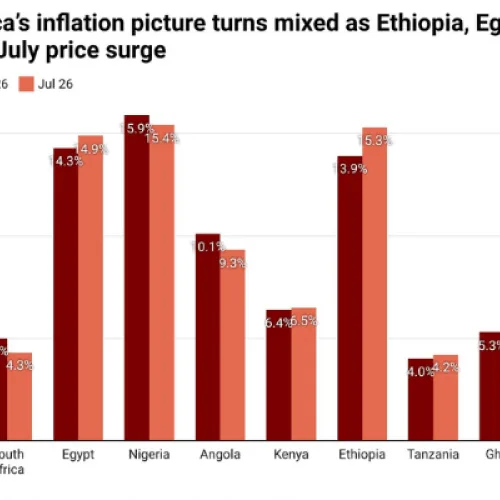
Africa’s inflation picture is becoming increasingly uneven, with eight of 16 major economies recording lower annual inflation in July, while seven saw price pressures increase.
South Africa, Nigeria, Angola, Zimbabwe, Ghana, Tunisia, Mozambique and Botswana recorded declines, while inflation was unchanged in Zambia. Ethiopia recorded the largest increase, rising to 15.3 percent in July from 13.9 percent in June. Zimbabwe recorded the biggest decline, falling to 3.2 percent from 4.7 percent.
In South Africa, inflation eased to 4.3 percent from 5 percent, its first slowdown in five months, supported by lower transport, fuel and food inflation. The contrasting trends highlight how food prices, energy costs, exchange rates and geopolitical shocks are producing different inflation outcomes across African economies.
Why it matters: Diverging inflation trends show that African economies are facing different price pressures, shaped by food and energy costs, exchange rates and external shocks.
Tanzania leads East Africa’s sovereign credit race
Tanzania’s sovereign credit outlook has strengthened after Fitch Ratings affirmed its B+ rating but upgraded the outlook to Positive from Stable, signalling the potential for a future upgrade if fiscal and economic improvements continue. The country now has the strongest Fitch outlook among major East African economies, ahead of Rwanda at B+/Stable, Uganda at B/Stable and Kenya at B-/Stable.
Fitch expects Tanzania’s government debt to decline from 48.9 percent of GDP in 2025 to 46.2 percent by 2028, while foreign-exchange reserves are projected to rise from $6.3 billion to $7.9 billion. The economy is also forecast to grow 5.8 percent in 2026 and average 6.1 percent in 2027 and 2028, supported by public investment, tourism, mining, and its growing role as a regional logistics hub.
Why it matters: A stronger credit outlook could improve investor confidence and reduce Tanzania’s borrowing risk, giving the country an advantage as it seeks to attract more foreign capital.
Zimbabwe moves from hyperinflation to one of Africa’s lowest inflation rates
Zimbabwe has brought inflation down from one of the world’s worst episodes of hyperinflation to below 3 percent, marking a sharp turnaround after inflation averaged about 736 percent in 2024. The improvement has been driven by tighter control of the money supply, fiscal discipline, the introduction of the Zimbabwe Gold (ZiG) currency, and stronger earnings from gold and other minerals. Annual inflation fell to 4.1 percent in January 2026 before declining further, while the central bank expects ZiG inflation to average about 5 percent this year.
The recovery is also being supported by rising mineral exports. Zimbabwe earned about $782 million from lithium exports in the first six months of 2026, more than three times the $237 million recorded in the same period of 2025. However, the economy still faces high debt, electricity shortages, foreign-exchange constraints and limited access to international financing.
Why it matters: Zimbabwe’s experience shows how monetary and fiscal discipline can rapidly restore price stability, but sustaining the gains will depend on turning lower inflation and mineral revenues into investment, production and broader economic growth.
Kenyan CEOs regain confidence despite economic pressures
Confidence among Kenyan business leaders is improving after four consecutive surveys of declining expectations. According to the latest Central Bank of Kenya survey, 44.4 percent of CEOs expect their companies to grow faster than they did in 2025, up from 38.9 percent in May. The improvement was supported by stronger demand and orders, business expansion, market diversification, new products, efficiency gains and increased use of technology.
Business activity also strengthened in the second quarter, with 34.4 percent of firms reporting higher sales, compared with 27.6 percent in the first quarter. However, rising costs remain a major challenge, as 63.6 percent of firms reported higher purchase prices while only 38.5 percent raised their selling prices. Bank loans also accounted for a larger share of business financing, rising to 33.7 percent in July from 24.1 percent in May.
Why it matters: The stronger corporate outlook points to a gradual recovery in Kenya’s private sector, but high operating costs, taxes, energy prices and limited access to credit could prevent improving business confidence from translating into stronger investment and job creation.
Rwanda raises rates to near 17-year high as inflation surges
Rwanda’s central bank has raised its key interest rate by 50 basis points to 8.75 percent, its highest level since 2009, as it intensifies efforts to contain accelerating inflation. The move is the third consecutive rate hike, taking total increases since November 2025 to 175 basis points. Inflation climbed from 9.1 percent in the first quarter to 13.2 percent in the second quarter and reached 14.5 percent in July, well above the central bank’s target range.
The rate increase comes despite strong economic activity, with Rwanda’s economy growing 10 percent in the first quarter and economic activity rising 10.9 percent in the second quarter. The central bank expects inflation to average 13.1 percent this year and gradually return to its target range in the second half of 2027.
Why it matters: Rwanda is now balancing strong growth against rising prices, with higher interest rates aimed at restoring price stability but likely to make borrowing more expensive for households and businesses.


Faith Omoboye is a foreign affairs correspondent with background in History and International relations. Her work focuses on African politics, diplomacy, and global governance.
Comments
Start the conversation about this story.