






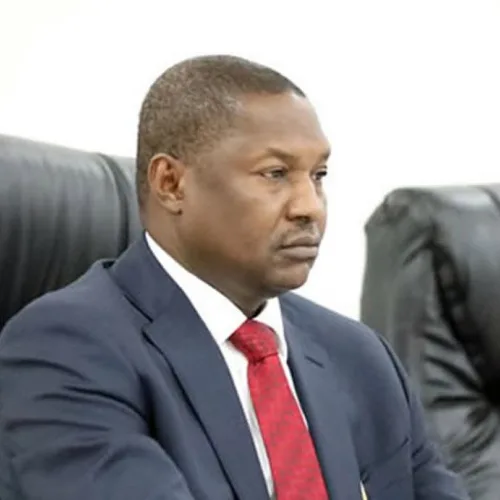
I just read that Abubakar Cika Malami, erstwhile attorney general of the federation and minister of justice, has announced a 600-man strong campaign council to challenge for the governorship of Kebbi state.
While Malami has every right to run for office as a Nigerian, you must marvel at the audacity of the man for believing that despite what virtually every Nigerian now knows about his wonderful time as attorney general, about how he and his family members became billionaires over night, funds and properties that they couldn’t lawfully lay claims to and had to forfeit them to the government would expect the people of Kebbi to vote for him.
But the man believes he can run, and possibly win too, assuming the people of Kebbi state have become both physically and emotionally deaf, dumb, and blind. But the Kebbi people are hardly any of these. If anything, our people possess some of the highest political sophistication in Nigeria.
They know who would be governor over them when they see one and so far, the youth have rejected him. But his biggest challenge is the incumbent governor of the state, Nasir Idris (Kauran Gwandu).
Now, let me concede that looking at Malami’s wonderful current public profile, everyone running against him would look very good and the people are most certainly to stand with that person against Malami.
The problem with Malami, however, is that he’s contesting against a Governor Idris who has left a modest record of impact on the sands of time, and has, in so far as, managing public funds go, remained on the prudent side of things and, therefore, on the whitelist of anti-graft agencies.
In simple terms, Governor Idris has ensured that funds meant for the people of Kebbi state have not found themselves into the construction of posh hotels in Kano, universities, highbrow residents in just about every city of note in Nigeria, shopping malls and even 5-star mosques that had to be forfeited to the federal government.
So, where have the monies accruing to Kebbi state gone since 2023? There’s a long list of destinations; destinations that the people of Kebbi can see and feel, but most importantly, know for sure that they belong not to one man, but the masses for whom the funds were meant.
From roads, and there are many, to schools, hospitals, interventions in agriculture, social services and welfare, cultural resuscitation, the list is too long for a single paragraph. The contrast for some people, however, is a long list of illicit properties that not benefit the people of Kebbi.
Infrastructure: this is perhaps the most visible evidence of where public resources have gone under Governor Idris. The administration completed the dualisation of the Birnin Kebbi-Ambursa Road, rehabilitated about 30 kilometres of township roads in Birnin Kebbi, worked on roads in Yauri, completed road networks around the Bola Ahmed Tinubu Ultra-Modern Secretariat Complex and dualised the Argungu Old Bypass Road.
These were among the projects delivered between June 2023 and April 2026. There is also the continuing construction of the Koko-Shanga-Fakai-Zuru road and several rural access roads, including projects under RAAMP, which were specifically designed to improve connectivity for farming communities and reduce the burden of moving agricultural produce from rural areas to markets.
And then there is the rural roads intervention which is particularly important in a predominantly agrarian state like Kebbi. In 2024, the governor announced plans to construct and upgrade 300 kilometres of rural roads across the state, while individual projects such as the 6.5-kilometre Malisa road in Gwandu and the Rini Junction-Gidan Jodi-Garu road in Augie were flagged off under RAAMP.
In January 2025, another 11-kilometre Maidangwami-Kangi road in Fakai, valued at N2.3 billion, was flagged off as part of a wider 350-kilometre rural road programme approved by the administration. These are not projects that exist only in campaign posters or somewhere in Kano as part of somebody’s body of illicitly acquired wealth; they are roads connecting communities, farms, and markets.
Education: the state’s education sector reform framework is robust and pragmatic, just as the 2025 budget provided substantial allocations for the rehabilitation and repairs of public schools.
The administration’s intervention has also extended to the construction and rehabilitation of school infrastructure, with the governor’s name now attached to model schools across the state. This is important because governance is not only about what happens today, but also what happens to the child who enters a classroom today and becomes the teacher, engineer, civil servant or entrepreneur of tomorrow, all of which will never be possible if some gluttons for public funds are allowed anywhere near the seat of power.
Healthcare has also received its share of the administration’s attention. The renovation of the Argungu General Hospital was among the completed interventions so far. Many other projects have also received attention including the renovation and modernisation of the Sir Yahaya Memorial Hospital. This is why the 2025 health sector operational plan specifically acknowledges the governor’s commitment to the health and well-being of Kebbi people and was developed with the participation of the state health ministry, the primary healthcare agency, and the state contributory healthcare management agency.
The Idris government has also improved the welfare of the staff. He has harmonised the remuneration of health workers to be at par with their counterparts across the country; and employed a good number of health workers to provide services. Add all these to the establishment of the Kauran Gwandu College of Nursing and Midwifery, Ambursa and a pattern of continuity and sustainability emerges.
Agriculture: Kebbi is an agrarian state therefore Governor Idris has made the farmer central to his economic intervention. His administration has sustained the free distribution of fertiliser and assorted grains, committing to the policy implementation throughout his tenure.
Farmers and youth leaders from across the four emirates, 126 districts, and more than 1,350 villages publicly commended the administration’s interventions in agriculture, infrastructure, and human capital development. The importance of this cannot be overstated in a state where agriculture is not merely an economic activity but the livelihood of a substantial proportion of the population.
Social intervention and empowerment: in 2024, the governor announced a N5 billion empowerment package for 50,000 beneficiaries, with each beneficiary receiving N100,000. Whether one sees such interventions as temporary relief or economic stimulus, the important point is that the resources were targeted at people at a time when the cost of living was becoming increasingly difficult for ordinary Nigerians. This is precisely what government intervention is supposed to do; cushion the people when the economy becomes too hard for them to carry alone, as against cushioning perceived poverty for oneself and family through fraudulent means.
The administration has also invested heavily in public buildings and the machinery of government, including the completion of the new state secretariat in Birnin Kebbi. The broader infrastructure spending reported for 2024 covered the secretariat complex, roads, a modern motor park, and other public infrastructure. One may argue about the wisdom of individual projects, but it would be difficult to argue that the money has simply disappeared without corresponding physical evidence across the state.
Security: the Nigeria Police Force presented 13 armoured operational vehicles to the Kebbi State Government in recognition of its sustained support for security operations, with the vehicles deployed to strengthen police operations in volatile areas. Governor Idris has also repeatedly sought greater federal security intervention, including air support, particularly to enable farmers in vulnerable areas to safely access their farms and harvest their crops.
This is where Malami’s 600-man campaign council begins to look like the opening scene of a circus. Politics is not merely about assembling 600 people in a room and announcing that a campaign has commenced; it is about answering the very simple question of what you intend to do differently and, more importantly, why the people should trust you with their collective purse.
Governor Idris has something every incumbent seeking re-election desperately needs: a record that can be physically inspected. The roads can be seen, the schools can be entered, the hospitals can be visited, the farmers can tell their own stories, and the beneficiaries of empowerment interventions are not imaginary people.
Malami, on the other hand, will have to campaign against the memories of his years in Abuja, against the allegations and controversies surrounding his stewardship, against the public conversations around assets and forfeitures associated with him and members of his family, and now against an incumbent who has a physical record to put before the electorate.
He will have to explain why Kebbi should exchange a governor whose projects are spread across the state for a former minister whose own political baggage has become almost as famous as his legal career.
The people of Kebbi will ultimately decide, and they should. But if the contest is going to be about records, then the records should speak; if it is going to be about character, let character speak; and if it is going to be about where public money goes, let us put the receipts, the projects, and the beneficiaries on the table.
Because at the end of the day, the Kebbi voter is not looking for a magician who can make public resources disappear. He is looking for a governor who can turn those resources into roads, schools, hospitals, agricultural support, security, empowerment, and opportunities for the people.
On the strength of the foregoing, Governor Nasir Idris has already entered the 2027 contest with something Malami’s 600-man campaign council cannot manufacture overnight: a record of government that the people can see, touch, and interrogate. And when the circus finally leaves town, the people of Kebbi will still be standing on those roads, sending their children to those schools, visiting those hospitals, and farming on that land. That, ultimately, is where the real election will be won.
Isa writes from Birnin Kebbi, Kebbi state.
Comments
Start the conversation about this story.