





Homoeopathic doctors in Nigeria, under their umbrella body, the All Nigeria Homoeopathic Medical Association (ANHMA), have said that they have a lot to offer and will equally improve the health sector in Nigeria, as well as the health conditions of the people.
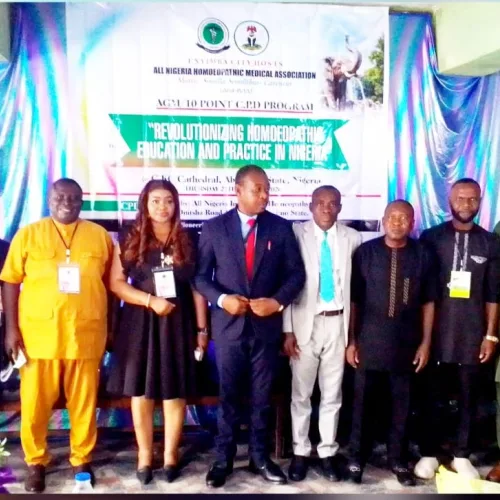
The ANHMA made the statement during its 2026 Annual General Meeting (AGM)/Continuous Professional Development (CPD) programme themed, “Revolutionalising Homoeopathic Education and Practice in Nigeria.”
The association urged all its members to realise that revolution in homoeopathy is non-negotiable and inevitable if they wish to give their services adequately to their patients.
Dr Victor Okoro, National President of ANHMA, while speaking, lamented the lack of understanding by both the government and the public on homoeopathic practice, stressing that up till today, the majority of Nigerians still think homoeopathic medicine is the same as herbal medicine.
“Lack of government recognition is a problem because when you lack funding, it reduces the level of public awareness of what we do. The public does not know what we do, and the local person by the corner does not even understand what homoeopathy is.
“When you ask them what homoeopathy is, they will say it’s herbal medicine. They don’t even know that homoeopathy is second to allopathic medicine all over the world. This is a major challenge we have in this country.
“Because we lack funding, the drugs homoeopathy ought to use for treatment are so insufficient that we don’t have the means of importing homoeopathic drugs.
“The remedies we’re currently using take a lot to get. That’s why it’s extremely difficult to see homoeopaths making ways in Nigeria and contributing their knowledge to the health sector because they’re so very restricted by the system.
“If the government can understand what we’re doing, I think it’ll be to the benefit of everyone. We appreciate the effort of the current government in trying to regularise the practice of homoeopathy in Nigeria.”
Okoro went on to say that with the world of medicine changing fast, with patients now asking better questions, as well as the government asking for data, coupled with regulators asking for standards, and technology obviously is asking homoeopathic doctors to adapt, if they do not revolutionise, they risk becoming irrelevant.
Okoro, who stressed that if homoeopathic doctors revolutionise, they will lead, however, said that a revolution in homoeopathy must happen in 3 areas: education, practice, welfare and advocacy.
Speaking on education, he said that the major challenge facing homoeopathic medicine in Nigeria is that most of its training is post-qualification.
He stressed that the education must also be digital, adding, “We must embrace e-learning, telemedicine, and AI-assisted case analysis so that a doctor in Aba can learn from a professor in New Delhi in real time.”
According to him, “Many of our young doctors graduate from conventional medical schools and then look for homoeopathic training, while the majority graduate from various colleges of homoeopathic medicine with different curricula.”
Dr Chima Ogbonna, Chairman of the Abia State chapter of ANHMA, said that homoeopathy has a lot to offer to the nation’s health sector, considering that Nigeria suffers from drug toxicity, which, according to him, is a major problem.
“I will say that it is only homoeopathy that can neutralise those toxic substances and bring the body to a neutral level so that the main symptoms can now be seen. So, homoeopathy is inevitable in the Nigerian health sector.”
Ogbonna, however, stressed that every homoeopathic practitioner must not deviate from evidence-based medical practice, as it requires treatments to have reliable evidence of efficacy and safety.
He urged the members to realise that conventional diagnostic methods must be integrated with all forms of therapeutic approaches; medicines should not be presented as clinically effective where high-quality evidence does not support that conclusion.
Ogbonna said that by all standards, it is impossible to separate homoeopathic medicine from scientific proof, as every homoeopathic practitioner needs to support every prescription with clinical examination/diagnosis.
He added that every homoeopathic practitioner must embrace clinical diagnosis before treatment, stressing that obtaining an extensive symptom history is not enough and should not be regarded as equivalent to validated diagnostic testing.
Dr Emmanuel Onwuchekwa, while adding his voice to the challenges of homoeopathy, said that the world of medicine is based on proof and validation, as medicine is solely focused on the scientific validation from diagnosis to treatment.
According to him, the solution to the misunderstanding of homoeopathic practice in Nigeria is to focus on scientific proof in whatever is done.
“As the second largest medical practice in the world, what the allopathic practitioners studied is exactly what we studied, but ours is relegated here in Nigeria; we as an association must focus on the science and education of our practice. We must consolidate our core on scientific practice and educational qualifications.”
The 2026 Annual General Meeting (AGM)/Continuous Professional Development (CPD) of the All Nigeria Homoeopathic Medical Association (ANHMA) attracted the presence of many members and leaders of the association from different states of Nigeria.
Please follow and like us:
Comments
Start the conversation about this story.