





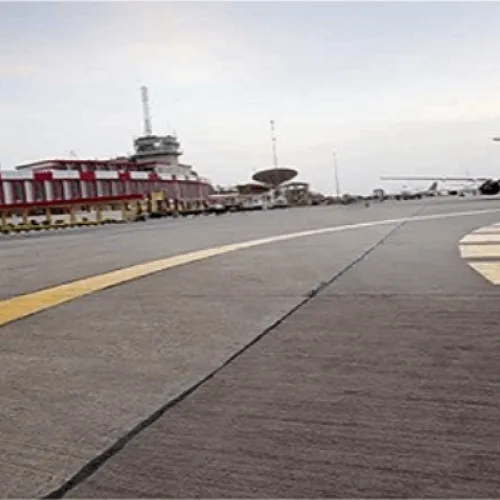
The Federal Government recently approved N46.39 billion for the comprehensive rehabilitation of the primary and secondary runways at the Mallam Aminu Kano International Airport (MAKIA), Kano.
Festus Keyamo, the Minister of Aviation and Aerospace Development, disclosed that roughly 60 percent of the contract sum has already been disbursed to the contractor, who has mobilized to the site.
However, the scale of the allocation has renewed intense scrutiny among aviation industry stakeholders regarding the true economics of runway construction and rehabilitation in Nigeria, raising critical questions around project valuation, routine maintenance, and fiscal transparency.
Building or rehabilitating a commercial airport runway involves a complex combination of specialized structural engineering, advanced drainage civil works, Precision Airfield Ground Lighting (AGL), and Instrument Landing Systems (ILS).
Because essential paving materials, lighting components, and navigation suites are predominantly imported, local tarmac projects are heavily exposed to foreign exchange volatility.
For instance, high-grade asphalt or concrete paving engineered to withstand heavy commercial aircraft impact averages between $1,200 and $1,800 per linear foot for general aviation, and up to $2,200 per linear foot for international carrier runways—driving overall project costs into tens of millions of dollars across the continent.
Beneath the asphalt or concrete surface lies an engineered sub-base and drainage network composed of crushed stone, graded soil, and subsurface piping designed to prevent water pooling—a critical civil works component factored directly into the overall per-linear-foot cost.
Runways also incorporate sophisticated Airfield Ground Lighting (AGL) and Instrument Landing System (ILS) navigational aids, which guide aircraft safely during low-visibility conditions. Upgrading to high-end Category III ILS suites across regional airport networks can run into billions of naira, as demonstrated by previous multi-airport installations costing up to N7.58 billion.
Beyond navigation systems, runway edge and centerline lighting utilize embedded LED or halogen fixtures that require continuous circuit monitoring, with individual assemblies—including specialized cabling and transformers—costing from hundreds to thousands of dollars each. Approach Lighting Systems (ALS), featuring elevated strobe and bar lights that extend past the runway threshold, add another layer of capital expenditure.
Airfield safety suites further require Foreign Object Debris (FOD) detection systems equipped with radar or optical units to scan for loose items on the tarmac. To maintain surface friction and clear heavy rubber deposits left by aircraft tires, airport operators must also deploy heavy-duty, truck-mounted rotary sweepers and scrubbers.
Across Africa, constructing or rehabilitating a commercial-grade runway ranges from tens of millions to several hundred million dollars depending on the scope, geographical terrain, and soil grading requirements. Notable regional benchmarks include Nigeria’s N46.39 billion ($30 million) allocation for Kano, South Africa’s planned R6.2 billion ($330 million) realigned runway in Cape Town, and Ethiopia’s massive $12.5 billion mega-hub project at Bishoftu International Airport.
However, concerns have been raised on how Nigeria keeps inflating the budget to construct airport runways.
For instance, Abuja airport second runway was originally projected at N64 billion, escalating past N90 billion, and later surging up to an estimated N532 billion before scaling back for alternative funding.
The planned project has a long history, from being awarded to Julius Berger in 2009 at the cost of N64 billion to the House of Representatives throwing it out in April 2010, insisting the cost was outrageous.
Aviation industry stakeholders had expressed concerns about the unending rising cost and the controversy surrounding the second runway project at the Nnamdi Azikiwe International Airport, Abuja
The House revoked the project in 2010 and ordered the Federal Airports Authority of Nigeria (FAAN) and the Bureau for Public Procurement (BPP) to conduct fresh bidding, but 15 years after, the project is yet to be completed.
Today, the project which was awarded for the sum of N64 billion was later re-awarded for N90 billion, but later the China Civil Engineering Construction Corporation (CCECC) handling the project conducted a new variation, which catapulted the cost from N90 billion to N532 billion, indicating a 591.11 per cent increase.
Lagos domestic wing runway was contracted at N44.13 billion for runway and taxiway rehabilitation paired with CAT II LED lighting systems.
Port Harcourt airport runway was allocated N42.15 billion for comprehensive runway and taxiway rehabilitation and CAT I lighting enhancement.
Today Kano airport runway has been approved at N46.39 billion for the rehabilitation, alongside airfield lighting upgrades.
Samuel Caulcrick, the former Rector of the Nigerian College of Aviation Technology (NCAT) told BusinessDay that the government claims total costs for Kano airport cover primary and secondary runways, taxiways, and specialised drainage work.
“The current status is that 60 percent of the sum has been released; contractors are already on site.The scope of work is the rehabilitation of primary and secondary runways (Runways 06/26 and 05/23) and upgrades to airfield lighting,” Caulcrick said.
He however hinted that stakeholders want detailed bills of quantities and technical specifications made public to justify the high cost.
“I reserve my comments until the bills of quantities and technical specifications are made public,” he added.
John Ojikutu, industry expert and the CEO of Centurion Aviation Security and Safety Consult wondered why an airport runway need over N20bn for repairs or rehabilitation if the operator has been complying with periodic or the regulated periodic maintenance?
“When was the last periodic maintenance done on the runway before it deteriorated to the level of needing huge spending. With the traffic at any of the international airports, the airport runway’s periodic maintenance cannot be less than yearly.
“If my memory would not disappoint me, the Kano Second Runway jointly used with the NAF had similar repairs about five years ago. The question is, what has been the Nigeria Civil Aviation Authority (NCAA) Audit Reports for the airport in the lady five years ?” Ojikutu said.
He said with several aviation projects coming up at a time when politicians are preparing for elections, Nigerians have to be critical of the political officers spending.
However, Seyi Adewale, the chief executive officer of Mainstream Cargo Limited said he considers this amount fair for a moderate airport runway.
“It could go up or down based on several factors that include; the natural environmental factors such as soil type, topography. Also, the level of quality of work to be designed including structural strength or integrity, runway length, supporting structures such as drainage, adjourning or supporting infrastructure, lightings and markings. All these cause significant cost changes as it may be considered; concrete or asphalt for example,” Adewale explained.
He however noted that there might be strong concerns if the N46 billion cost is only to upgrade the existing infrastructure rather than building a new infrastructure and system.
Ifeoma Okeke-Korieocha is the Aviation Correspondent at BusinessDay Media Limited, publishers of BusinessDay Newspapers. She is also the Deputy Editor, BusinessDay Weekender Magazine, the Saturday Weekend edition of BusinessDay. She holds a BSC in Mass Communication from the prestigious University of Nigeria, Nsukka and a Masters degree in Marketing at the University of Lagos. As the lead writer on the aviation desk, Ifeoma is responsible and in charge of the three weekly aviation and travel pages in BusinessDay and BDSunday. She also overseas and edits all pages of BusinessDay Saturday Weekender. She has written various investigative, features and news stories in aviation and business related issues and has been severally nominated for award in the category of Aviation Writer of the Year by the Nigeria Media Nite-Out awards; one of the Nigeria’s most prestigious media awards ceremonies. Ifeoma is a one-time winner of the prestigious Nigeria Media Merit Award under the 'Aviation Writer of the Year' Category. She is the 2025 Eloy Award winner under the Print Media Journalist category. She has undergone several journalism trainings by various prestigious organisations. Ifeoma is also a fellow of the Female Reporters Leadership Fellowship of the Wole Soyinka Centre for Investigative Journalism.

Comments
Start the conversation about this story.